
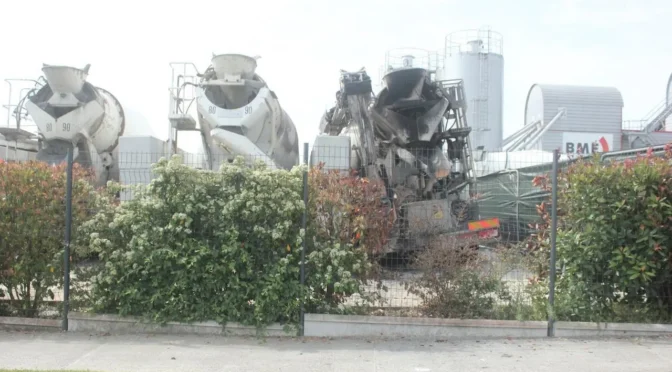
Four concrete mixer trucks set on fire at a company near
Nantes; an investigation has been launched
During the night of Saturday, May 23, around 4:30 a.m., the gendarmerie was alerted to a fire involving concrete mixer trucks in Nort-sur-Erdre, near Nantes. “‘I heard two loud booms,’” explains a resident of the hamlet of La Verrière, who lives about one kilometer as the crow flies from Rue d’Anjou, where four concrete mixer trucks were on fire. The explosions were likely caused by bursting tires or fuel tanks on the vehicles.
This Friday, May 29, trucks blackened by flames are parked in the lot of Bétons Manufacturés de l’Erdre (BME Guimard Bétons), a family-owned business that has been manufacturing and delivering ready-mix concrete for over 40 years. “Forensic investigators have documented the scene,” states the gendarmerie, which is taking this fire very seriously, given the context of opposition against land development.
The ongoing investigation has been entrusted to the Ancenis Criminal Investigation Unit and the Nort-sur-Erdre Independent Unit.
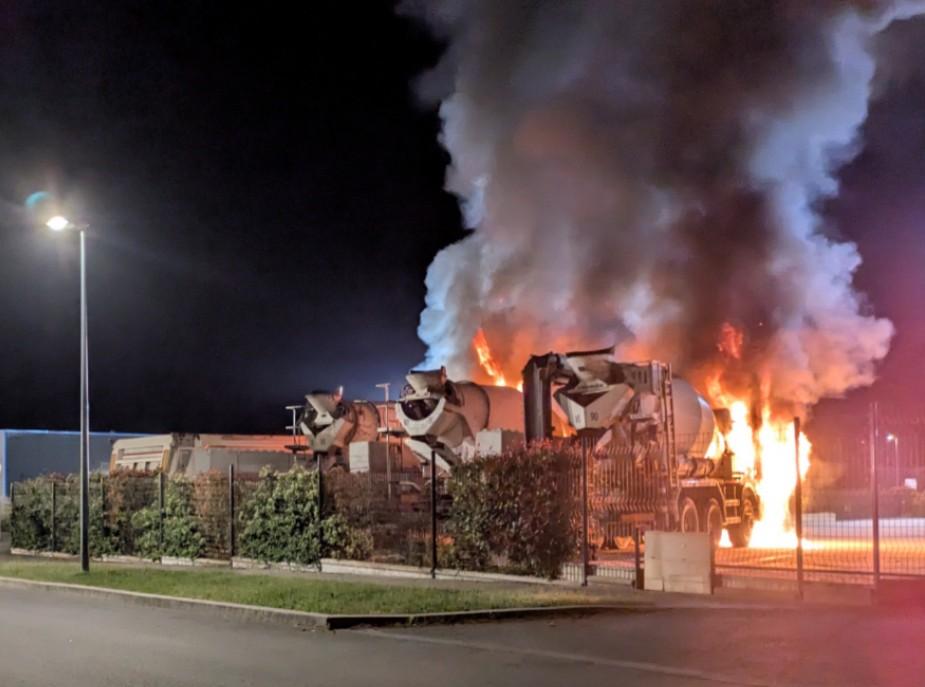
Claim of sabotage – Spring of Local Struggles
Indymedia Nantes, May 25, 2026
On the night between Saturday and Sunday, my beloved comrades and I went out to burn four concrete mixers north of Nantes.
Let’s fight against concrete and the world it represents. Let’s destroy ecocidal industries.
It was awesome—we strongly encourage you to do the same where you live!
***********
Despite major commitments to zero land conversion and the preservation of biodiversity, the reality is grim: France continues to pave over its agricultural and natural lands on a massive scale.
Every year, more than 24,000 hectares are still being converted to non-natural uses—equivalent to five soccer fields per hour—and this massive destruction shows no signs of slowing down. Concrete paving seals off the soil, while aggregate extraction converts farmland into artifical surfaces and destroys groundwater reserves—often irreversibly. Cement, an essential ingredient in concrete production, is responsible for 8% of global CO2 emissions and the loss of natural habitats—the leading cause of biodiversity loss.
Ouest-France, May 29, 2026