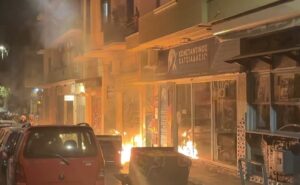
20/12, Athens, Greece. Hooded groups simultaneously launched attacks with at least 50 Molotov cocktails on a passing MAT squad on Akadimias Street, on OPKE police officers on Spyridonos Trikoupi and Solomou Streets, while they attacked a squad on Charilaou Trikoupi Street near the PASOK offices with stones and other objects. At the same time, hooded people set fire to garbage bins in Exarchia Square on Emmanouil Benaki and Valtetsiou Streets. During the incidents, extensive use of Molotov cocktails, chemical and flash grenades was made, mainly in the Themistokleous area and around the square.
19/12, Switzerland. For several weeks, civil servants in the Swiss canton of Vaud have been on strike against the cantonal government’s budget plan, which includes massive cuts. The 0.7% cut in public sector salaries in particular has met with massive opposition. The strike was particularly noticeable in schools. On 9 December, 20,000 people took to the streets of Lausanne to protest against the budget. On 12 December, the cantonal government announced that it would reverse the salary cuts. However, on Monday 15 December, thousands of people took to the streets again to protest against the budget plan. According to the unions, the number of demonstrators was 20,000.
18/12, Turin, Italy. In the early hours of Thursday, 18/12, the 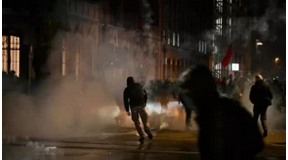 Askatasuna Social Centre, in the heart of Turin, is occupied by police forces, the surrounding area resembles a militarised zone, with closed roads and schools, armoured vehicles and auras, while at the same time the homes of people participating in the project are invaded. The cops attacked with water cannons when the demonstrators tried to enter the building. The solidarity activists carried out frequent stone and bottle throwing against the forces of order into the night. 10 police officers were injured by bottles, stones and other objects thrown. This whole operation comes as a vengeful response of the State and the far-right Meloni Government to the tireless solidarity movement in Palestine and its efforts to obstruct the military cooperation of Italian capital with the Israeli war machine. The frequent, massive and militant demonstrations, the roadblocks and especially the attack on the offices of the Leonardo SpA company, are what made the people of Askatasuna a target of the repressive mechanism and the city municipality.
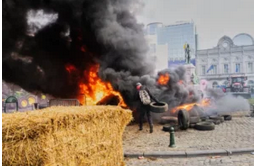 18/12, Brussels, Belgium. Chaos where street fighting and destruction prevails outside the European Parliament in Brussels, where a mass mobilisation of thousands of farmers from all over Europe is taking place, in view of the upcoming signing of the EU-Mercosur free trade agreement, with police firing tear gas and water cannons against farmers blocking the roads with tractors, throwing potatoes and eggs while clashing with the cops. Hundreds of tractors and thousands of farmers took to the streets of Brussels hours before the start of the Summit of European Union leaders. The farmers have gathered to demand a reduction in production costs and changes to the Common Agricultural Policy. The authorities have closed all roads and even banned pedestrians from walking on central avenues without special accreditation from European institutions.
18/12. Buenos Aires, Argentina. Thousands of Argentine workers and trade unions marched on Thursday against the labour reform plan promoted by President Javier Milley. The protest is challenging changes considered retrogressive for labour rights and the defence of proper employment. From the morning, groups of demonstrators have gathered in various parts of downtown Buenos Aires, to deminstrate in the Plaza de Mayo, in front of the Casa Rosada, while security forces have implemented a strong plan to prevent a complete traffic shutdown on the main avenues. National Gendarmerie agents are stopping buses at access points and preventing the transport of thousands of demonstrators to the mobilisation. The reform plan, which includes changes to hourly wages, changes in workers’ compensation and terms of dismissal, and limits collective rights and the right to strike, has been officially postponed to a meeting in February 2026.
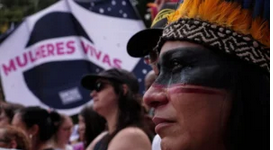 18/12 Brazil. Horror and anger flood the streets of Brazil in one of the largest mobilizations against femicide the country has ever seen. Multiple cases that have occurred in recent weeks have triggered a magnificent movement of demonstrations in 89 cities throughout the country. The “Rise for Women Alive” became a cry of accumulated indignation for a phenomenon that does not stop growing. Endless stories of daily horror in a country where an average of four femicide cases are committed per day. “The message is one: if you are a woman in Brazil, you cannot disagree with your husband or your boyfriend. You cannot go for a walk. You cannot walk in the street after 10 p.m. or before 6 a.m. You cannot even work.”
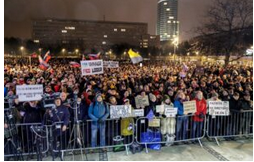 18/12, Slovakia. Plans by Prime Minister Robert Fico’s Slovak government to abolish the principle of whistleblower protection are facing strong opposition. Protests were held in ten cities on Tuesday, including in the capital Bratislava, where demonstrators in Freedom Square had a message for Fico: “Resign, resign.” A banner held by the crowd read: “Fico’s government is helping the mafia,” suggesting a direct link between the State and the Mafia.
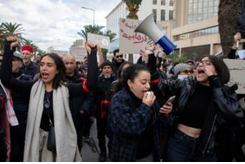 12/17 Gabes, Tunisia. More than 2,500 people demonstrated in the southeastern Tunisian city of Gabes, continuing massive protests over pollution from the state-owned CGT (Groupe Chimique Tunisien) chemical plant. Protesters poured into the streets of this coastal city, chanting “Gabès wants to live,” “We want to live” and “dismantle the polluting plants,” as they headed to Chat Essalam, a suburb north of Gabes where the CGT chemical plant is located. Residents say toxic fumes from the chemical plant are responsible for increased rates of cancer, respiratory diseases and osteoporosis. At the same time, the impact of the systematic dumping of industrial waste into the sea is also particularly noticeable on the economy, as fishermen report that catches, which are a main source of income for many residents of the region, have decreased dramatically. Protests in Gabes have flared up as hundreds of students have developed respiratory problems attributed to toxic fumes from the fertilizer and phosphoric acid production plant.
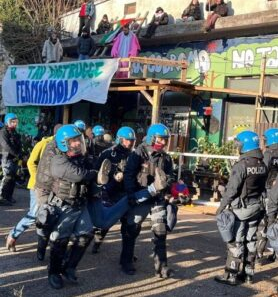 15/12 Vicenza, Italy. Clashes between police and protesters broke out during the eviction of the “Boscodromo” social centre, a place of resistance against the destruction of the neighbouring forests to make way for the high-speed railway line. The justification given is that the biodiversity of the forest and the public use of the area must be preserved. Dozens of police appeared in the morning in front of the social centre, attacked about a hundred activists inside the building with tear gas and then destroyed the barricades set up to defend the centre. Immediately after the eviction, an excavator began demolishing the building. Several people were arrested and taken to the police station for identification.
12/14 Brazil. Thousands of Brazilians demonstrated in major cities on Sunday against a legislative attempt to reduce the prison sentence of former President Jair Bolsonaro and his supporters for conspiring to overthrow after his defeat in the 2022 election. The demonstrations, organized by social groups, artists and political movements, condemned the judiciary for trying to reduce the sentence of the former president, who was sentenced in September to 27 years in prison, and his supporters, who stormed government buildings after his defeat. It was the first major protest since Bolsonaro, whose far-right movement has reshaped Brazilian politics, began serving his sentence last month in a specially constructed cell in a federal police building in the capital, Brasilia. About 15,000 people gathered in Sao Paulo, Brazil’s largest city, according to researchers at the University of Sao Paulo, but fewer than at a similar protest in September.
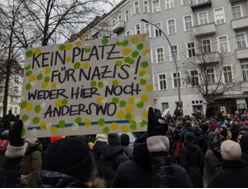 12/14. Berlin, Germany. Neo-Nazis planned to march in Friedrichshain and Lichtenberg. Large protests opposed the march. In the end, the march was cancelled. For weeks, activists had been preparing protests against a far-right march that was to start at Ostkreuz and go through the alternative neighbourhood of Friedrichshain. Since the march in Marzahn in October (Aufmarsch in Marzahn im Oktober, article in German), it was the second time recently that these neo-Nazis, some of whom are very young, have appeared in a belligerent mood, most of them wearing masks. They shouted far-right slogans and threatened the residents of the area, many of whom spontaneously placed banners on their balconies and at windows. 50 neo-Nazis eventually participated in the march on Saturday. Several thousand people participated in a total of 13 counter-rallies to express their opposition. The Nazi march was stopped less than halfway along its planned route, after more than 2,000 people demonstrated against them directly on the road where they were about to march. The neo-Nazis who were stopped were escorted to the subway and travelled to Lichtenberg, the final point of the planned route.
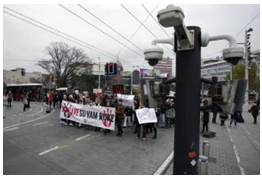 12/13, Belgrade, Serbia. With the slogan “you have blood on your hands,” thousands of protesters in Belgrade blocked the city’s main streets. A car ran over protesters at a blockade in Novi Sad. A similar incident was reported a week ago, when four musicians were injured while participating in a silent traffic blockade in downtown Belgrade. In recent weeks street protests have also resulted in occasional violent incidents, when pro-government thugs have turned out to disrupt rallies and student demonstrations. Classes at more than 50 university faculties and several secondary schools across Serbia have been suspended for days. Serbian farmers also blocked a road in central Serbia on Friday with their tractors, holding a banner with a bloodied palm. The actors’ union announced daily protests outside theatres. On Monday Serbia’s prosecutor filed an indictment against a government minister and three others for abuse of power and forgery of documents to facilitate the implementation of a real estate project linked to Jared Kushner, son-in-law of US President Donald Trump. The investigation focuses on a dispute over a bombed military complex in central Belgrade, which was a protected cultural heritage site but is facing redevelopment as a luxury complex. The plans have sparked protests from Serbs, who argue that the site should be preserved as a monument to Yugoslav-era modernist architecture and as a tribute to those who lost their lives when it was destroyed during the NATO bombing in 1999. Vučić’s government has sought to quell growing discontent by publishing around 130 documents related to the renovation of the train station building, which was one of the protesters’ demands. Prosecutors have arrested 13 people, but one government minister has been released. This has fuelled scepticism about the process, as the ruling populists exercise tight control over both the police and the judiciary.
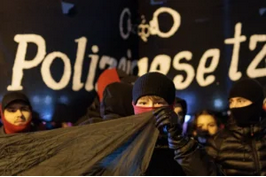 12/13, Berlin, Germany. Attacks, destruction, arrests at an anti-cop demonstration in Berlin. On Saturday night, security forces broke up an anti-cop demonstration in Berlin’s Friedrichshain. Previously, attacks had occurred and banned slogans were being chanted. The demonstration, symbolically called ACAB because of the day -12/13 – had two goals: state repression and colonialism. The cops arrested 25 people. Other demonstrators chanting banned slogans could not be identified because their faces were covered. Eight police officers were injured. Over 1,000 people participated. The demonstration, which was a protest against control and colonialism in Berlin, was directed “against the entire system of control, prisons, colonialism, borders and genocide, which the police embody and defend every day“.
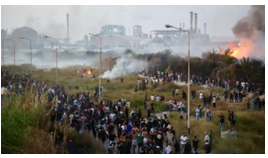 13/12, Tunisia. Clashes between police and young protesters erupted for a second consecutive night in the northeastern Tunisian city of Kairouan after a man died during a police chase that sparked fears of a wave of protests across the country. The deceased’s family said the man, who was riding a motorcycle without a licence, was chased by police, beaten and taken to hospital with injuries. He later fled but died on Friday from complications from a head injury. On Saturday night, protesters set up barricades, burned tyres and threw stones, Molotov cocktails and flares at security forces, who used tear gas to disperse the crowd, according to witnesses. As Tunisia prepares to mark the anniversary of the 2011 revolution that sparked the so-called “Arab Spring” in January, the atmosphere in the country is electrified by demonstrations, with unions calling for a nationwide general strike at the start of the new year. In the southeastern city of Gabes, thousands of people have been demonstrating for weeks, demanding the closure of a chemical plant on environmental grounds.
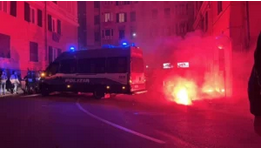 13/12, Brescia, Italy. Thousands of people took to the streets to protest against an anti-immigrant rally by fascist groups from all over northern Italy. Workers, students, anti-fascist and anti-racist groups gathered in the afternoon to reiterate that the city has nothing to do with xenophobia. Late in the afternoon in Foce at an event organised by Genova Antifascista against the CasaPound headquarters on Montevideo Street, it moved towards the nearby headquarters of the far-right movement with slogans against CasaPound and the forces of order. An impressive force of law enforcement awaited the demonstrators: police and carabinieri in riot gear, trucks with metal nets – the so-called “alari” – and armoured vehicles positioned to protect the CasaPound building and along the main road junctions. Large numbers of police forces with armoured vehicles and water cannons were deployed to confront the anti-fascist protest. In Genoa, hundreds of anti-fascists gathered once again to demonstrate against the recent establishment of the headquarters of an anti-fascist group. The demonstrators tried to reach the building, which was guarded by armoured vehicles and dozens of police. Meanwhile, in the Lombardy city, two other demonstrations had been organised in response to the anti-immigration one, one by Antifa (with 2,500 participants) and one by the “Io Accolgo” network.
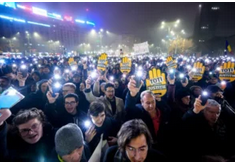 13/12, Bucharest, Romania. Thousands of people demonstrated on Friday in Bucharest and other cities in Romania against corruption in the judicial system. Specifically, the demonstrations have been going on since Wednesday after the publication of an investigation by the Recorder platform, which revealed testimonies of judges and prosecutors about pressure from high-ranking officials. Participants in the demonstration on Friday demanded the resignation of the justice minister, the president of the Supreme Court and several high-ranking officials. With a system that is inherently corrupt and designed to be manipulated from within, Romania is among the most corrupt countries in the European Union. The demonstrations continue.
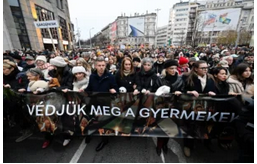 12/13 Budapest, Hungary. 50,000 Hungarians demonstrated Saturday in front of the offices of Prime Minister Viktor Orban, a veteran nationalist. The protesters are calling for the prime minister to resign over a child abuse scandal at a juvenile detention centre.
12/12, Italy. Strike across Italy. The strike movement concerns the railway sector, urban public transport, hospitals, schools, private employees and the wider public administration sector. The strikers are demanding an increase in pensions and wages, an end to constant changes in the retirement age and are opposed to tax reforms. Marches were held in the country’s largest cities: from Rome to Florence, from Milan to Bari in Puglia.
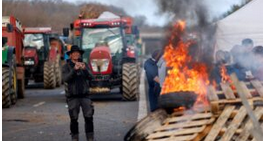 12/12 France. French farmers protested and blocked roads in protest against the French government’s decision to cull all cattle on farms affected by Lumpy Skin disease. The A64 motorway linking Bayonne to Toulouse in southwestern France remained blocked by farmers for 180 kilometres. In Carbone, near Toulouse, where farmers camped for several nights, tractors and bales of straw blocked the motorway. In the Ariège region, police used force against 500 demonstrators, while demonstrations took place in Bordeaux, Agen, Périgueux and on the A75 motorway. The farmers, in their attempt to pass through the police blocks, threw manure at patrol cars and also at government buildings.
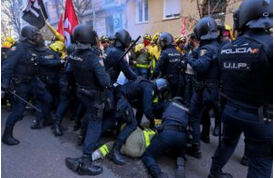 11/12, Madrid, Spain. Clashes between striking firefighters and police broke out at Tragsa headquarters during another demonstration by Madrid’s forest firefighters, who have been on strike for more than 150 days. Police used batons, pepper spray and tear gas to attack firefighters who had gathered outside Tragsa’s general meeting of shareholders to demand that the public company begin negotiations with workers on a new collective agreement (which expired in 2012). At least 10 firefighters were taken to hospital, some of whom were hit in the face by tear gas, and nine were arrested. Since July 2025, forest firefighters in the Community of Madrid have been on indefinite strike to protest precarious working conditions and demand greater safety in the workplace, including protective equipment against carcinogens, the filling of vacancies to reduce workload, and the official recognition of the professional category of forest firefighters.
11/12 Portugal. A general strike against the labour reform took place in Portugal. At the start of the day, one of Lisbon’s train stations was almost deserted, while the notice boards announced the cancellation of most train services. The capital’s metro stations were closed, many garbage collection services were stopped, as were many non-emergency hospital units. The government is seeking to extend the duration of fixed-term contracts, allow companies to hire subcontractors after layoffs, and even increase the minimum security service in the event of a strike. Other controversial measures include reducing flexible working hours for breastfeeding mothers to two years. Clashes between police and protesters erupted in front of the Portuguese parliament during a general strike when more than 3 million workers took to the streets of the capital and 10 other Portuguese cities to demonstrate. Police fired rubber bullets to clear protesters from Parliament Square and arrested six people.
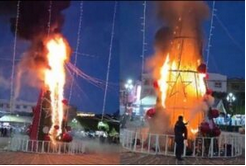 10/12, Zitácuaro, Mexico. Hundreds of people took to the streets and burned the Christmas tree in the city centre to protest and demand justice for the death of Ángeles Esquivel, a 24-year-old woman who was shot and killed by a police officer. Family members, friends and residents of Zitácuaro, in the state of Michoacán, marched through the city streets to the city hall. When the mayor refused to meet them, they set fire to the Christmas tree. The police officer responsible for Ángeles’s murder, after shooting the 24-year-old and another woman who is still hospitalised, escaped with the help of his superiors, sparking public outrage. Mexican police are often accused of murders, kidnappings, torture, sexual assaults, extortion, and more, but most of the time these acts of violence go unpunished.
9/12, Argentina. Thousands of people took to the streets of the capital and dozens of other cities as part of a national day of action against hunger called by the Union of Workers of the Popular Economy (UTEP). Workers, students, retirees and social organisations demonstrated to demand the reintroduction of the Supplementary Social Salary (SSC), an economic incentive for families below the poverty line, which has been frozen since Javier Milley’s government took power in 2023. During the day, incidents occurred due to a heavy police presence aimed at limiting the visibility of the social demand.
6/12, Germany Student strike and demonstrations against compulsory military service with demonstrations in 90 cities in Germany, in protest of the draft law on military service. The main slogan of the demonstrations: “We do not want to become cannon fodder.” For many months, the German government’s draft law on military service has been causing strong reactions.
4/12, Genoa, Italy. More than 5,000 metalworkers took to the streets of Genoa as part of a general strike by the industry in support of the struggle of workers at the former Ilva steelworks. The workers used heavy vehicles such as trucks, cranes or tractors to block roads and highways and faced violent repression by the police in order to resist the imminent closure of the steelworks that would leave 1,200 workers on the streets. Clashes between police and protesters broke out in front of the city’s prefectural palace when workers from the former Ilva steelworks tried to break the police blockade that had been set up to protect the government building. Workers at Europe’s largest steelworks, who have been on strike and in permanent mobilisation since last month, destroyed the metal barriers that police had used to block off the area. Police fired tear gas to suppress the protests. After clashes with police in front of the prefectural palace, the demonstrators reached the city’s train station and blocked train traffic.
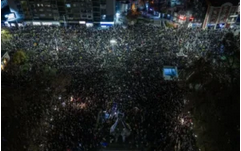 2/12, Sofia, Bulgaria. Tens of thousands of protesters flooded the streets of Sofia in Bulgaria and in 12 other cities in the country, holding one of the largest marches in recent years and demanding the withdrawal of the new budget and the resignation of the government. In the centre of Sofia, the huge square in front of the National Assembly building was suffocatingly filled with citizens shouting slogans against the corruption that is sweeping the European Union’s poorest country, as it prepares to adopt the euro, reports ERT. Organisers estimated the turnout at about 50,000 people. The protesters shouted “Resign!” and projected the words “Resign” and “Mafia” onto government buildings. Two large banners read respectively “Generation Z is coming” and “Young Bulgaria without the mafia.” The protesters are demanding the withdrawal of the 2026 budget, which includes tax increases and additional social security contributions. At the same time, they are expressing strong dissatisfaction with corruption in the public sector, calling for the resignation of the government. At Sofia University, the most violent protesters were beaten by the police. The protesters had their faces covered with scarves and wore hoods. They threw stones, bottles and fireworks at the police. Several police vehicles were vandalised. The police intervened with tear gas. Clashes broke out between the protesters. On December 11, after several days of demonstrations, the prime minister resigned.
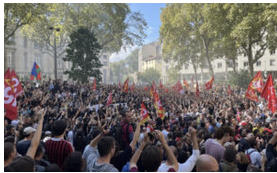 02/12, France. Thousands of people took to the streets in a major national day of strikes and demonstrations to protest the austerity measures being prepared by the government of Sébastien Lecornu for 2026. 150 demonstrations in several French cities were organised by unions against the massive cuts in teaching and hospital positions foreseen in the government’s budget for 2026 and to demand wage increases, social and tax justice, as well as resources for public services, especially hospitals.
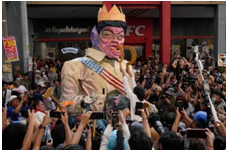 11/30, Manila, Philippines. Thousands of protesters marched in the Philippines demanding the immediate prosecution and resignation of top lawmakers and officials implicated in a corruption scandal that has rocked the Asian democracy. Public anger over widespread corruption is to blame for shoddy, defective or non-existent flood control projects in an archipelago prone to deadly floods and extreme weather. At least seven public works officials have been jailed for misuse of public funds and other corruption charges in a single flood control project. Executives of Sunwest Corp., a construction company involved in the project, are being sought. Protesters at Sunday’s rallies said many more officials, including implicated senators and members of the House of Representatives, should be jailed sooner and forced to pay back the money they stole and used to fund fleets of private jets and luxury cars, mansions and extravagant lifestyles.
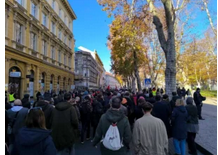 11/30, Zagreb, Croatia. Thousands of people demonstrated against the rise of the far-right, after several actions by neo-fascist groups targeting the Serb minority, which have ignited ethnic and political tensions in the country. The demonstrations, under the slogan “United against fascism”, were organised in the capital Zagreb, with the participation of more than 10,000 people, but also in other major Croatian cities, such as Zadar, Rijeka, Pula, to protest against neo-fascist violence and intimidation by far-right groups in Croatia. In Rijeka, after the march, hooded men threw flares, injuring one person in the back. In recent months, Croatia has seen nationalists increasingly try to impose their fascist agenda.
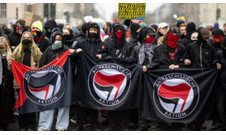 11/29, Berlin, Germany. Hundreds of anti-fascists took to the streets of the German capital to protest against a march called by the neo-Nazi party “Die Heimat” (The Homeland) together with the neo-Nazi group “Deutsche Jugend Voran” (DJV) (German Youth Forward) against “gangs of beggars” in central Berlin. The date was probably chosen in the hope that there would be no anti-fascist resistance, as nationwide protests against the AfD were taking place in Giessen at the same time. It would be the first joint public appearance of the two organisations. However, with around 150 neo-Nazis, some of whom had travelled from other areas, the mobilisation did not have the success that the Sentürk marches had in the spring. More than 1,000 anti-fascists blocked the route on Unter den Linden, forcing the neo-Nazis to halt their demonstration after less than 100 metres. The police, who had apparently also expected far fewer protesters, were unable to react. Thousands of anti-fascists had blocked the bridge leading to the city centre. A shower of bottles and eggs thrown at the neo-Nazis forced the police to break up the demonstration and escort the 150 participants of the xenophobic rally to the train station.
11/29, Rome, Italy. Over 100,000 people took to the streets of the Italian capital to protest against the rearmament policies of the Giorgia Meloni government and in solidarity with the Palestinian people. as part of a two-day pan-Italian strike called by unions in solidarity with Gaza and against the government and its plan to increase military spending. The November 29 demonstrations also included chants against journalists, underscoring a widespread and justified hostility to the corporate media, whose coverage of both the genocide in Gaza and the wave of strikes in Italy has been consistently false, distorted and complicit. The anger directed at the press was not limited to Palestine. It was an expression of opposition to the role of the media as a tool of the state, promoting war narratives and obstructing discussion of the working class struggle against austerity.
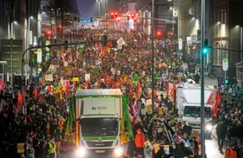 11/29, Giessen, Germany. On Saturday, November 29, more than 30,000 anti-fascists opposed the far-right AfD party and the establishment of its new youth organisation. Clashes broke out between anti-fascists and police in various parts of the city when police attacked various barricades that anti-fascist protesters had set up since morning. The rear window of an AfD member’s car was broken, while AfD spokesman Julian Schmidt was violently attacked by a group of masked men, resulting in a broken nose. During the riots, police used water cannons and batons to control the situation, with at least 15 police officers injured by stones and fireworks, while journalists from the state media were also attacked by groups of protesters.
28/11, Venice, Italy. General strike with thousands of people in over 50 Italian cities. The strikers are demonstrating against the budget, against the rearmament policies of the Meloni government through the continued sale of arms to the state of Israel which goes against the spending of social services, while the protests also promote solidarity with the Palestinian people. In Venice, clashes between demonstrators and police broke out outside the headquarters of Leonardo Spa, a company controlled by the Italian Ministry of Economy and Finance, which supports Israel’s genocidal campaign in Gaza through the sale of arms and services. The cops attacked with batons and water cannons to disperse the crowd.
11/27 Schio, Italy. Clashes between police and protesters erupted during an anti-fascist demonstration against the far-right rally organized by the Italian neo-fascist party Forza Nuova. When the anti-fascist protesters tried to approach the fascist rally, they were violently attacked by the police with batons, water cannons, and tear gas canisters.
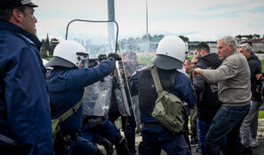 25/11, Greece. In scattered parts of the country, farmers are escalating their mobilisations, with over 50 demonstrations from the prefecture of Serres to Larissa, Corinth, Halkidiki, Volos, Thessaloniki, Crete, etc. With broken police checkpoints, closed highways and dozens of rallies, the images show that the agricultural front remains dynamic, with many labour unions and other sectors striking and supporting the farmers. Clashes with riot police, violent episodes, arrests and serious charges against the arrested farmers. The mobilisations continue.
via: https://trohia.espivblogs.net/2025/12/20/pagkosmia-exegertika-nea/