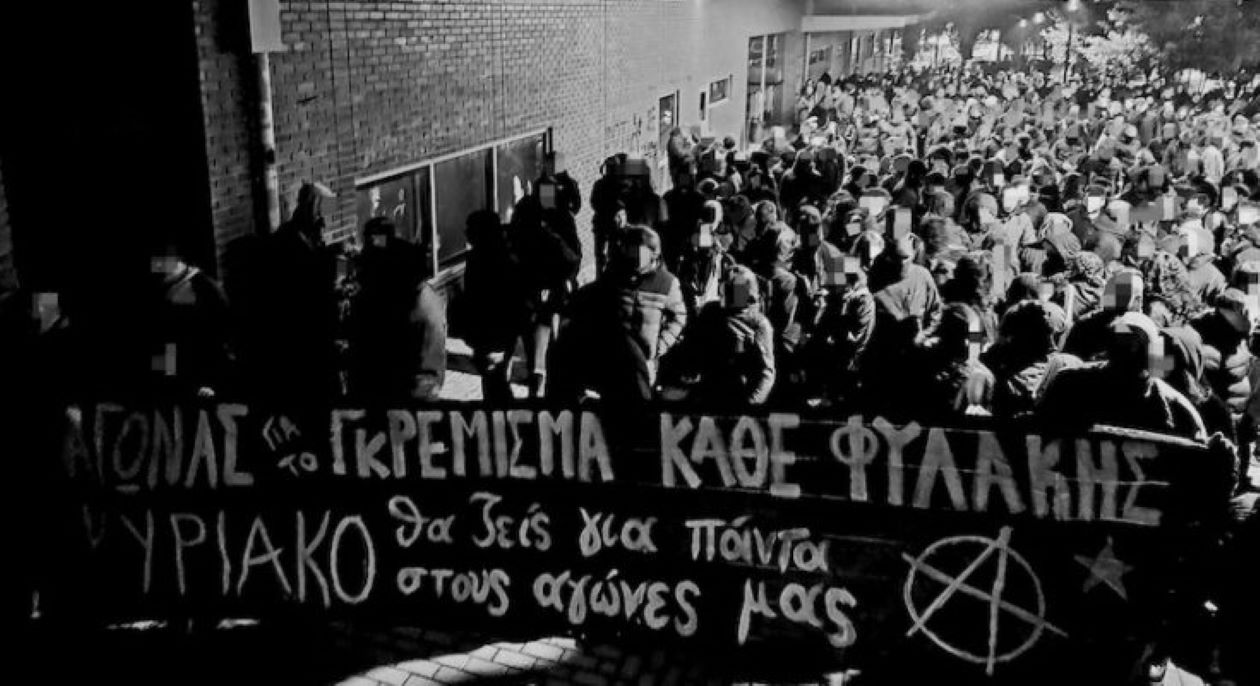
The third issue of “disfare – per la lotta contro il mondo-guerra” (undo – for the fight against world war) is now available.
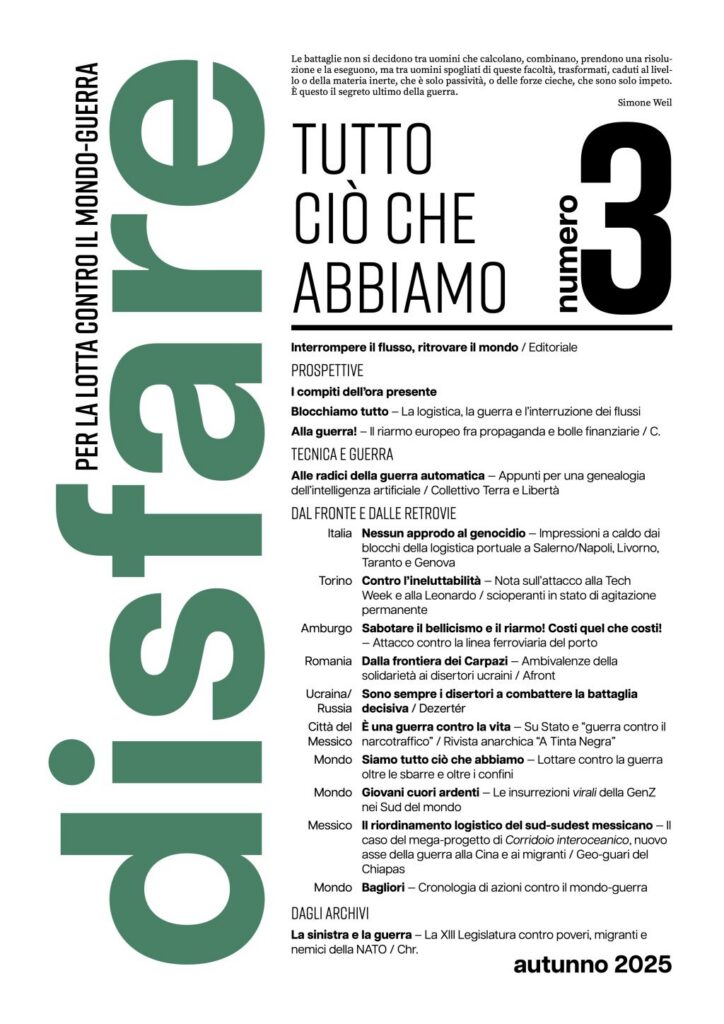
È uscito il terzo numero di “disfare – per la lotta contro il mondo guerra”, dell’autunno 2025.
Per richiedere copie / To request copies / pour demander des exemplaires: disfare@autistici.org
- 56 pagine, 4 euro a copia, 3 euro per i distributori (dalle 3 copie in su)
- 56 pages, 4 euros per copy, 3 euros for distributors (from 3 copies upwards)
- 56 pages, 4 euros par exemplaire, 3 euros pour les distributeurs (à partir de 3 exemplaires)
Scarica il pdf dell’editoriale: disfare_3_editoriale
Editorial
Interrupt the flow, rediscover the world
What happened between late September and early October was, in some ways, a perfect storm. The call launched by the dockworkers of Genoa (and taken up in the ports of Ravenna, Livorno, Salerno, Marghera, Trieste, Naples…) to “block everything”, on the occasion of the Sumud Flotilla’s attempt to break the Israeli naval blockade of Gaza, saw millions of people take to the streets with the idea of participating in a concrete effort against the genocide. The ambivalence on board was reflected in the streets – internationalist solidarity versus humanitarianism, direct action versus representation, breaking the law versus constituent proposals, rejection of delegation versus mediatisation, mutual recognition among the exploited versus interclassism – and did not allow any easy or immediate interpretations. These were “spurious”, “opaque” uprisings – as political analysts have been saying since the Forconi, the Trattori, and the No Green Pass protests[1] – whose simultaneity and numbers put the government in a difficult position, while various components of the more or less institutional left attempted to secure a space for political representation[2].
Fog and manipulation, certainly, but in a fracture of normality, a breach has opened up for what until recently would have been unthinkable. Blocking factories, ports, stations, motorways, airports, schools, universities. Taking to the streets without permission and clashing with those who prohibit it. No longer the question “why take to the streets?” but, for many, being in the streets with nothing to ask for, with the yearning for all the horror to end and the feeling that the time for action can no longer be postponed.
Propaganda had accustomed us to thinking of war in Europe as a 20th-century phenomenon, and it’s again from the 20th-century that the myth of the general strike has returned, with all the force – and fault lines[3] – that it brings with it. Hundreds of thousands of people took to the streets across Europe (in France, Spain and Greece), producing, voluntarily or not, irregularities and misalignments which – as in the mass demonstrations that inflamed the “global South” thanks to the no future youngsters (p. 41), those who risk facing the prospect of conscription in the coming years – have opened up the possibility of jamming the machinery of terror, with a combination of action and non-collaboration[4]. The practice of widespread blockades broke the deadly established order by a game of decomposition and correspondence: “blocking to advance”, said a slogan with a taste for oxymoron. Decomposing total war into its specific ramifications – a factory, a road, a port, a government building, a cable, the police – and, by attacking them, recomposing the overall picture of hierarchical and commercial relationships.
After two years of genocide streaming live, and while on the Eastern front the threat of total destruction – which science wants to make technically endless[5] – continues, those moments – some unexpected, such as the attack on Tech Week and Leonardo in Turin (p. 28), others organised and collective, such as blockades (p. 22) and demonstrations at various decisive junctures of war – have sometimes broken the time of representation, of law, of the humanitarian banality of good that does not question the structures of domination and of its ineluctability. And, against the flat sea of resignation, they have made a new-found ethical tension palpable.
Misalignments and disruptions to normality, sometimes within and against the demonstrations themselves, were capable of revealing logistics – a science and technology whose rationality originates in the military sphere (p. 7) – as the central pivot in the organisation of the total war. The organisation of flows, increasingly sophisticated and engineered, in which civilian and military routes overlap seamlessly on a daily basis, presents obvious vulnerabilities and thus becomes a powerful terrain for anti-militarist struggle, as evidenced by the actions of anonymous defeatist saboteurs in many parts of the old continent – against railways, ports and research centres (p. 30, p. 46).
The recent blockades and sabotages of war logistics (whether of goods, human beings or information) take on a much deeper meaning than simply “disarming” production and technology (so that they can continue to expand for the general good) as invoked in the representations of the Left – whose history is tightly linked to war, be it privatisation, peace missions, labour reform, public order or administrative detention (p. 49). It is life itself that comes to be conceived as a flow that can be manipulated and optimised. For this reason, interrupting the flows of war can mean questioning everything: breaking with the conception that life can be reduced to an entity entirely analogous to machines, a conception which is at the core of the attempt to replicate human intelligence through computers – a project that, since its inception, has been aimed at increasing military power (p. 14). The very concept of militarisation, although often used with good intentions, is misleading: it implies a corruption or distortion in the military sense of knowledge, technologies and institutions that is supposed to be only recent and localised. In reality, the techno-world and war – as we explore in this issue particularly with regard to logistics and artificial intelligence – are involved in a historical relationship of co-production through which they have given and continue to give shape to each other and share the same underlying logic.
Meanwhile, the History that the rulers would like to write continues to take shape. Military conflict always seems to be on the brink of erupting (from Poland to Iran), while pre-war mobilisation and authoritarian alliances are strengthening – for example, through the hunt for deserters, who are now being tracked down in Ukraine by the very drones that are replacing them in the trenches (p. 31, p. 33). The BRICS+ countries – which have contributed to manufacturing the machinery of genocide (from Chinese and Indian drones to Brazilian oil, South African and Russian coal, Egyptian, Emirati and Saudi logistics…) – do not represent an “alternative” at all. While the “eternal peace” flaunted by Trump in the Middle East is the same as the one proposed for Ukraine: shaky or non-existent truces, foreshadowing further massacres in that macabre sequence of destruction-depopulation/reconstruction-reorganisation that reveals the continuity between the genocidal plan and that of ordinary eviction or urban redevelopment. While alliances between states are increasingly taking on variable and inextricable geometries, the US attack on Venezuela confirms an old and well-known adage: America First means first and foremost closing the ranks in its “backyard”. In fact, in Latin America, behind the rhetoric of the war on drugs (p. 35), neo-colonial domination is consolidated over resources and bodies considered strategic for military-commercial logistics, energy and the dollar (p. 44). Meanwhile, in Europe, the rearmament bubble (p. 11), pushed by both the sovereignist and globalist elites – although with different rhetorical strategies –, is preparing great profits for financial predators.
The decline of Western power reveals its ferocity and makes mass incarceration a reality, already fully visible in Gaza and the West Bank, in the deportations of migrants in the US and Europe, in the raids in the outskirts of urban areas that turn into massacres in the favelas of Rio, and in the banning of “internal enemies” – terrorists, traffickers, and the “bad” kind of poor. Reflecting on the “mutual relationship between forms of incarceration and the characteristics of resistance” (p. 38) is therefore more necessary than ever. At the very moment when, following proscription and over two thousand arrests, the prisoners of Palestine Action are embarking on a hunger strike, the presence of prison police in riot gear during the October 4th demonstration in Rome gives a clear image of the future that awaits that part of humanity considered an enemy or a threat, inside and outside the borders. In this war scenario, whether defined as “high” or “low” intensity, there will be no international rights, constitutions or supranational bodies to defend populations from the abyss. For this task, “we are all we have”.
If humans have long been “without a world”, undoing the war-world – the horror that is simply “given” – means precisely (re)finding the world as intention and meaning for that part of humanity that has been cut off or never admitted to the History of the ruling class. At a time when, through weapons of total destruction, the scenario of a world-without-humans is potentially unfolding, the breaches opened in September and October, intertwined with the unexpected events of October 7th, tell us that it is possible to reactivate the histories of the dominated by interrupting the historical continuum of domination. As the contribution “The tasks of the present hour” (p. 5) points out: “We must break escape what Riccardo d’Este called ‘the totalitarianism of the fragment’ (…). While our privileges differ greatly depending on skin colour, class and gender, all our lives are sustained by the global plundering of resources and bodies, forests and childhoods, community livelihoods, glaciers and cosmovisions. An unexpected notification is coming from the “Global South”: resources and bodies are becoming increasingly scarce, as the Palestinian revolt summons five hundred years of plunder and resistance”.
“There is no certainty about tomorrow”, says the largest prison uprising in history, in Palestine. And as the autumn protests affirm, here as elsewhere, rejecting technologically equipped dispossession and the material and spiritual predation of our lives has perhaps become thinkable.
[1]Uprisings that have emerged in Italy since 2011, TN.
[2]Let us focus here on the CGIL trade union, which first called a strike on 19 September – weakening the strike called by the grassroots unions on 22 September – and then, without fear of contradiction, joined the general strike on October 3rd initially called by the grassroots union SI Cobas, in order not to alienate its own social base.
[3]According to Walter Benjamin’s well-known reflection (On the Critique of Violence, 1920), which, returning to Sorel’s critique, distinguishes between the political general strike – which aims at a change in the balance of power entirely within the sphere of the State and the law – and the proletarian general strike, which raises “the question of a different kind of violence”, revolutionary because its aim is not to seize the state, but to destroy its order and temporality.
[4]Which we discussed in the first issue of disfare, in the article “The Fire of Prometheus”.
[5]The new nuclear-powered missile Burevestnik – “storm bird” – tested by Russia, reactivating global technological and scientific competition, can remain in flight at low altitude for hours thanks to its atomic engine.