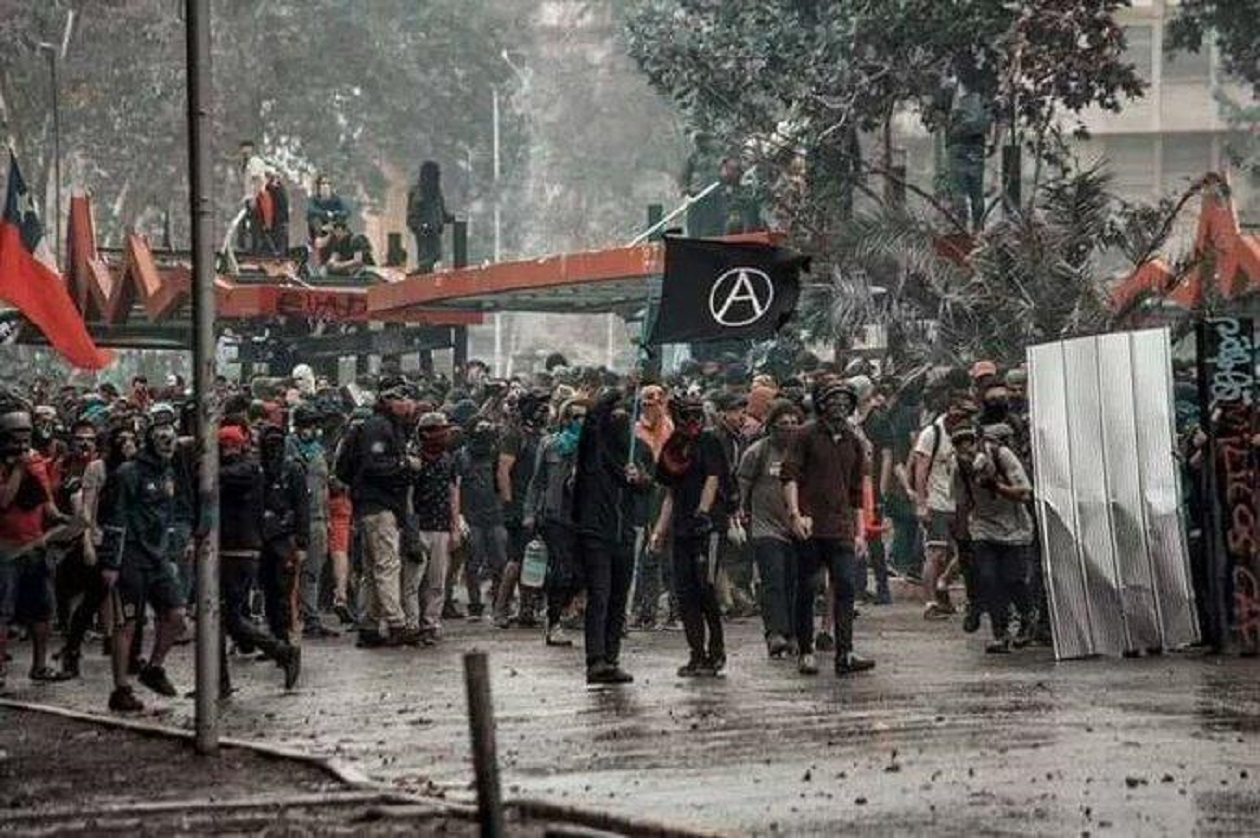
The squat at the School of Biology (“To Steki sto Viologiko”)
Squats have always represented breaths of freedom for radical movements, serving as spaces for meeting, political discussion, and the housing of various initiatives. For these reasons, they have always been a thorn in the state’s throat, and thus a frequent target of repression. The Squat at the School of Biology was first occupied in 1987 by students, becoming a new social space for expression. From the very beginning and for the next 34 years, its character and activity were diverse and multifaceted. Groups with different traits and ways of action coexisted within the same space, united by the core values of solidarity and self-organization.Over the years, the space hosted student, theatre, radio, and political initiatives, as well as radical bookstores. It was a venue for countless coffee gatherings, collective cooking, book presentations, film and documentary screenings, Greek language classes for immigrants, self-defense courses, and more. It also became a landmark in Greece’s, and not only Greece’s, DIY music scene.
The squat supported many political and social struggles, including those of students, conscientious objectors to military service, and political prisoners, often raising funds to cover judicial and medical expenses in the spirit of solidarity. Functioning as an active meeting point and forum for discussion in the city, it formed a living cell within the University.
The evacuation
In 2019, following the election of the new New Democracy (ND) government and the adoption of its political doctrine of “law and order”, a large-scale campaign began against squats. Under the direction of Michalis Chrysochoidis, then Minister of Citizen Protection, a coordinated effort to dismantle these spaces took shape.Although this campaign was temporarily halted during the pandemic, the government’s stance on squats remained clear.
At the same time, attempts to impose university reforms through Law 4777, aiming to “sterilize” universities, were temporarily blocked by the student uprisings of 2021.The government’s message that “nothing is over yet” was soon followed by the threat, and ultimately the evacuation, of the squat. In the early morning hours of New Year’s Eve 2022, police forces evacuated the Steki at the School of Biology, located within the university campus.The operation symbolized the state’s ongoing effort to suppress every form of expression and action that differs from the dominant narrative and falls outside the narrow boundaries of “normality.”
The response – The squat behind the School of Chemistry
Faced with the threat of evacuation, an open assembly for the defense of the Biology School squat was formed, consisting of many individuals and collectives. After the evacuation, and following a decision of the assembly, on 10 January 2022 the abandoned building behind the School of Chemistry was reoccupied as a response, with the intention of creating a new squat that would continue to host the city’s political struggles.The building was chosen because it was located within the university campus, making its occupation an act of resistance against the sterilization of academic spaces and the gentrification of the urban environment. Another factor was that the building had been long abandoned, and the occupation would bring it back to life.
In the two days of its existence, the new squat received strong support from a large number of people and students, while many events and activities were organized to help it operate as a functional space.
The chronicles of the evacuation of the new squat
In the morning hours of 12 January 2022, an evacuation operation took place, with all sorts of cops mobilized inside and around the university area. The building was surrounded by riot cops, OPKE units, and undercover cops, who started pounding on the doors and walls, shouting at the people inside to come out.The people decided to defend the building and refused to surrender. After approximately one hour, undercover cops breached the space by opening a hole in the wall, deploying chemical agents indoors, and using stun grenades.Fifteen individuals who were inside or around the building were subsequently arrested and transferred to the Thessaloniki Police Headquarters.
It is worth noting that, since the evacuation, the building remained empty and dilapidated, with wrecked walls and broken windows, resembling a ghost within the university. Despite government declarations that it would be converted into a laboratory, it was never utilized and has since been completely demolished.
The trial
The charges
On 20 March 2025, the case was brought to trial at first instance, with 14 defendants facing the following seven misdemeanor charges:
- Disruption of the functioning of a public service (committed jointly)
- Disturbance of public peace (committed jointly)
- Violation of the law on radio frequencies
- Use of violence against a civil servant by multiple persons, with an object capable of causing bodily harm (committed jointly)
- Attempted dangerous bodily harm (committed jointly and in concurrence)
- Violation of the law on weapons
- Disobedience
A 15thdefendant faced slightly different charges, as they were arrested outside the building. They are accused of the same offenses, with the distinction that, for the 4thand 5th counts, they are charged with complicity rather than direct commission.
The court oral proceedings and the penalties
During the oral proceedings, the judge asked a standard question to all defendants, maintaining a subjunctive tone. At the same time, they led the examination of the prosecution witnesses without allowing them to answer the defense lawyers’ questions, which they constantly interrupted, protecting the witnesses from falling into contradictions and deconstructing their narrative.
The prosecution witnesses from AUTh, specifically Chara Charalabous, Dean of the School of Sciences, and Theodoros Dardavesis, Dean of the School of Health Sciences, initially tried to present that the building was still recently usable, but later showed that they didn’t know the real situation, contradicting themselves about its use in the past year and its future purpose. The narrative about the building’s use, as well as the supposed works for its future use, was demolished by the defense and by the testimony of a professor from the Department of Chemistry of the School of Science, as well as by the presentation of class schedules of the building’s schools. However, the charge of “Disruption of the functioning of a public service” was upheld in the final decision.
The charge of “Attempted dangerous bodily harm (committed jointly and in concurrence)” against two undercover police officers who testified as prosecution witnesses was demolished by the oral proceedings themselves, since both testified that during the operation they stayed outside the building and never came into contact with the defendants, nor suffered any injury. However, this charge was also upheld, giving each person a penalty of 10 months for each undercover officer, meaning 20 months in total.
The charge of “Use of violence against a civil servant by multiple persons, with an object capable of causing bodily harm” has a minimum sentence of three years’ imprisonment and a maximum of five if not dropped. In this case, it was not dropped, giving eight people sentences of 30 months due to the extenuating circumstance of post-adolescent age, and 40 months to four other defendants for whom no extenuating circumstance was recognized. The sentences for this charge were the heaviest compared to the others, set as the base penalty upon which the other sentences were added.
Moreover, while the judges avoided asking any question whatsoever about the charge of “Disobedience”, it was not dropped, despite never being examined.
The charges of “Possession of a weapon” and “Violation of the law on radio frequencies” were the only ones dropped out of seven, as the evidence was totally insufficient to sustain them. Hence, the defendants were found guilty by induction, since the court itself failed to prove their culpability.
The total sentences, after being counted together, were set to 5 years and 1 month (61 months) plus a monetary fine of 500 euros for four defendants. For the eight to whom the extenuating circumstance was recognized, the total sentence was 3 years and 10 months (46 months), while for the last defendant it was 12 months. The district attorney proposed serving the sentence, and the judges accepted it, but the lawyers’ proposal for suspension due to appeal was also accepted by the court. The remaining two people, who had a different defense in court, were found innocent of all charges except disobedience, with a final sentence of 2 months.
The imposition of prudence and the next day
This outcome does not surprise us, as we know well how the judicial system works when prosecuting fighting people, upon whom it exhausts all its austerity, contrary to the outcome of other cases involving political figures, police officers, and other para-state snitches (like the case of Tempi, the cop-procurer in Kolonos, and the murders of V. Maggos). However, we must recognize that handing out heavy sentences for misdemeanor-level charges, like imprisonment of people from radical movements who have accepted them, is unprecedented even for today’s standards.
Defending the political act of occupation led to a heavy conviction despite the inability to prove the defendants guilty, and sentences were given without recognizing any misdemeanor for many, setting a precedent after the issuance of the new criminal code. In court, all those who appeared chose not to denounce their political action and identity. They stood facing the exhausting and disparaging sentences, while those who chose to distance themselves were treated differently, showing once again the cost of taking political responsibility.
The militant defense of the squat guarantees very strict criminal prosecution and exaggerated charges. As always, the state showed its tough face against everyone who fights back, imposing conformity and setting an example for the treatment of such political actions and struggles from now on. A similar outcome came from the second evacuation of the Matrozou squat from the Koukaki community, which led to multiple and heavy sentences for the defendants, threatening them with imprisonment.
The escalation of repression by every means and the threat of imprisonment continues as always, and in the face of the new criminal code, collective resistance is more necessary than ever. The state tries to create an atmosphere of terror, highlighting the criminalization of political acts in order to exhaust and oppress radical movements. Occupations are spaces of collectivization and political discussion, which we will continue to defend.
We stand united against the rotten judicial system and the new criminal code, while we await the announcement of the appeal court dates.
No squatter in prison!
Solidarity with the prosecuted people from the second evacuation of the Matrozou squat!
Solidarity with all squats!
In the coming months, a fire fund will be organized to cover the judicial expenses of the case.