In one of Europe’s most densely populated regions, the unceasing flow of traffic, along roads, tracks, pipelines and cables, is a prerequisite for the functioning of the mega machine that holds us all hostage, leaving only destruction in its wake. When the smooth functioning of this infrastructure breaks down, even for a few hours, it can have a cascading effect, interrupting the logistics required by the war machine, capitalism, and the state.
This past month traffic in the Randstad was a bit more chaotic than usual.
Major road closures aggravated the usual rush hour traffic; half of Amsterdam’s ring road was closed for the weekend of the 21/22 of June for an overhyped celebration of the city’s 750 year anniversary.
The following week the highway between Schiphol airport and the Hague was blocked off as part of a massive security operation to ensure the safe transport of the world’s most prominent war criminals to the NATO summit.
Aside from these planned inconveniences there were also a few unannounced interventions in the usual flows of traffic.
The unusual activity began the weekend before the NATO conference, when electricity cables were cut near the World Forum in the Hague, where the meeting was set to take place. After an extensive investigation authorities claim to have found the culprit, a fox, who was supposedly spotted on camera around where the cut occurred. Greetings and solidarity to the fugitive fox.
Throughout the week there were several DdoS attacks against the NATO office and online portals of the municipality of the Hague. Many, but not all, of which were claimed by a pro-Russian hacktivist group. Service provider Odido also reported network issues, however they claim that the the disruption was unrelated to the summit. Although many of these actions played out within the framework of interstate conflict, it is always interesting to take note of when and how the communications infrastructure that connects domination is interrupted.
Monday morning Extinction Rebellion attempted to block the A44 highway leading to the Hague. Police intercepted the demonstration before it reached the highway so activists continued their gathering in a nearby field, before being arrested.
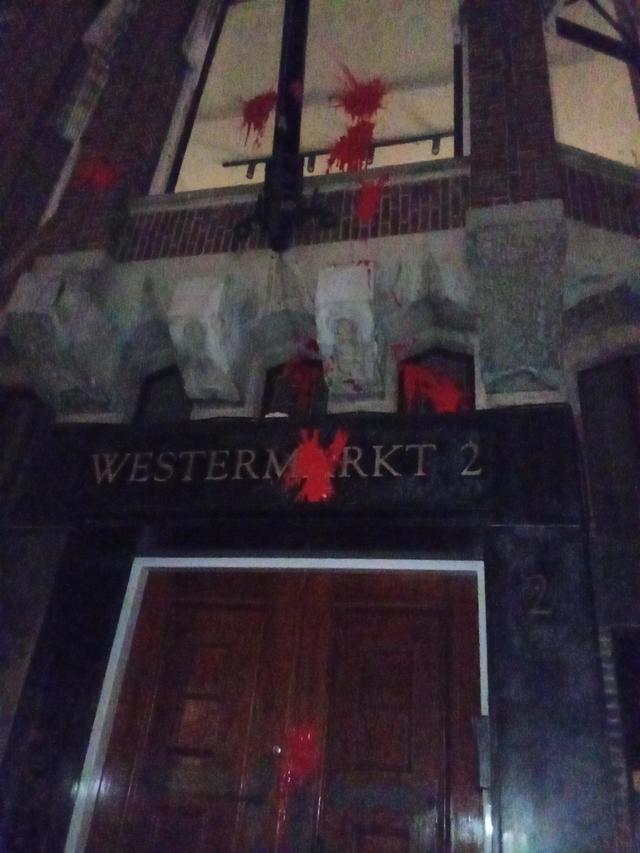
During the night from Tuesday to Wednesday the NATO innovation fund (Westermarkt 2) was redecorated when anonymous artists threw several paint bombs at the building. A post on indymedia cite the fund’s investment in dual (civilian-military) use infrastructure, like AI, as a motivation for the action.
 Early Tuesday morning trains between Amsterdam, Utrecht, and Schiphol and even further south were disrupted when a fire broke out along the tracks near the airport, damaging 25 cables over a length of 30 meters. The fire caused extensive damage, in part because it destroyed a 3kV cable, and took a whole day to repair. It is believed to be the result of arson, but authorities remain puzzled as to who would do such a thing. Speculating that it could be the work of state actors, activists, or even… copper thieves?
Tuesday afternoon the disruptions continued when an overhead cable mysteriously snapped near Gouda, stranding several trains and shutting down service between Utrecht and the Hague. A journalist who happened to be on one of the stranded trains reported hearing a conductor say that the cable had been pulled down. May every cable snap.
Wednesday morning, shortly after the damage done by the fire on Tuesday had been repaired, train service was interrupted again between Amsterdam Zuid and Schiphol. It is unclear what exactly caused the disruption, which has vaguely been labeled “a technical issue.”
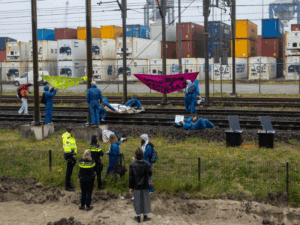
Later on Wednesday there was another intervention on the rails, this time on the train tracks near the harbor in Rotterdam. Activists blocked the train tracks for several hours, preventing freight from entering or exiting the harbor. Expect a delay in the delivery of your Amazon packages.
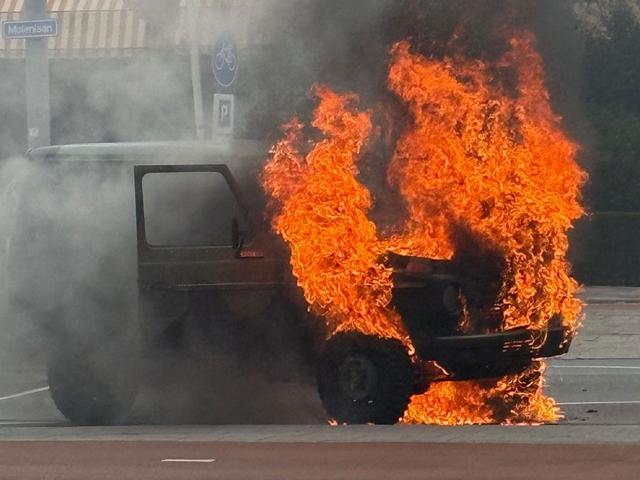
To round off the unexpected occurrences around the NATO summit a military vehicle spontaneously caught fire in Rotterdam on Wednesday. One can only hope that the flames burned bright enough to ignite the imagination of would-be rebels.
Anarchists and other rebels have a rich history of sabotaging railroads, cables, and the dispersed infrastructure that power empire. Not only is infrastructure easy to strike, the effects are unpredictable and can have ripple effects, spreading the fire of revolt beyond our wildest imaginations. Even though we witnessed the largest security operation in the history of the Netherlands, there have been no reported arrests of foxes or other wild animals that acted under the cover of the night. This makes us wonder; what if there were a hundred foxes chewing, burning and pulling at the cables that power the war machine?
receive by email
original here