“An extra eye on the network”: how SNCF is using drones to monitor its railway tracks
Le Figaro, May 3, 2025
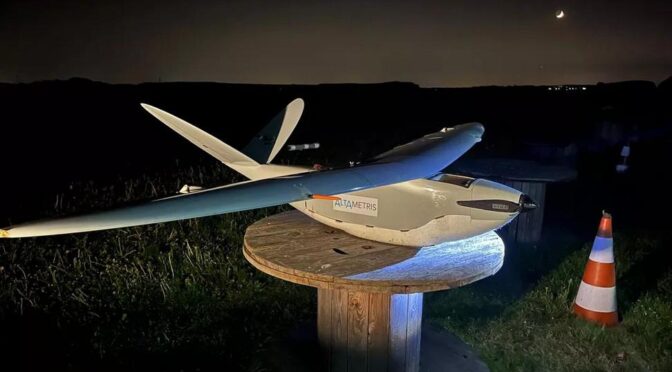
The rendezvous is at 11pm in the middle of nowhere, in an undisclosed location. There, on the eve of major departures for the long weekend, the SNCF is organizing a rather special surveillance operation, using a drone at the intersection of several high-speed railway lines. High-quality equipment resembling a small plane, capable of flying more than 100 meters above the ground and more than ten kilometers away from its pilot, making it invisible to even the sharpest eyes. Equipped with a thermal sensor and able to see “as in daylight” despite the advanced darkness, it can spot the slightest intruder as well as confirm that the catenaries and other technical installations are in a good condition. “The advantage of the drone is that it can monitor a large area in a very short time, and possibly detect anything abnormal,” explains SNCF Réseau’s Executive Vice President Projects, Maintenance and Operations Olivier Bancel.
The aim of this operation? To prevent the slightest risk in these tense times, but above all to communicate the SNCF’s ability to take advantage of new technologies to protect its 28,000 kilometers of track. As we watch, the exercise begins shortly before midnight, and the drone takes off. A few meters away, the aircraft spots an unmarked car in the vicinity of an SNCF critical juncture that, on the face of it, has no business being there. On the ground, the telepilot indicated this disturbing presence to the rail safety authorities, who immediately took over and sent a team to check it out. Five minutes later, the verdict was in: “all’s well”. “That’s the end of the exercise for us,” says railway safety officer Sébastien Conseil, team leader for the evening. Although this was just a practical exercise, the SNCF assures us that it carries out “doubt verification almost every time a drone is deployed”.
Essential surveillance
The resources allocated to this surveillance are costly – the SNCF would not say how much – but invaluable, because the risks are manifold: from theft of copper or cables to sabotage, everything is considered. And while there’s nothing to fear in terms of passenger safety, we’re promised, the fact remains that such damage can have very serious consequences for train operations. Last summer, just a few hours before the opening ceremony of the Paris 2024 Olympic Games, the SNCF was the target of a “massive attack” severely disrupting train traffic on the Atlantic, Northern and Eastern axes. Coordinated fires affected “nerve centers” and affected around 800,000 passengers. On the same day, a malicious act was thwarted on the LGV Sud-Est by railway workers carrying out maintenance operations during the night. But the network is not only watched over by these small flying objects, as Olivier Bancel is keen to emphasize.
“Our sensitive installations are equipped with fencing, alarms, fiber optics and cameras, and inspections are also carried out on the ground by our maintenance teams, not to mention the work carried out by rail safety”, he lists. Another regulatory inspection is the daily passage of an empty train, equipped with cameras and capable of carrying out certain geometric measurements, every morning before the opening of the high-speed line. “Systematic routines that can be stepped up if necessary”, says the Executive General Manager. “Surveillance was intensified 10 years ago thanks to drones, because they offer an incomparable advantage for carrying out long-distance rounds along the tracks and are highly complementary to other existing devices”, he explains, assuring that the SNCF group has been ‘a forerunner in this field’ by developing a dedicated subsidiary: Altametris.
Drones for data collection
An essential task, given that the SNCF is the victim of some 10,000 intrusions a year, points out Olivier Bancel, for whom “every intrusion is a risk”. “It’s not necessarily synonymous with malicious intent, but it can constitute a risk and requires certain emergency measures, such as slowing down train movements”, he continues. In this respect, drones are “an additional eye on the network”. However, supporting rail safety was not the primary mission of these small technological tools, which – originally – had been developed to inspect and map the network.
“We have a fleet of around 200 drones, the majority of which are made available to SNCF. It enables us to monitor wildlife as well as any faults on the network, but our core business is data collection”, explains Alexis Meneses, Altametris’ Strategy Director. On a daily basis, some fifty people work in this subsidiary, equipped with drones of all sizes, some of which have been designed to get into steep areas, along rock faces or into any other area inaccessible to agents, such as certain bridges or tunnels. The rock faces at Le Trayas in the Var region of France, for example, had been precisely modeled in 3D. The result is improved safety for personnel, lower operating costs and better monitoring of network conditions.
via: sansnom
Translated by Act for freedom now!