
Against the immigration detention prison of Amygdaleza in Menidi and for the abolition of all prisons and detention centers!
Banners on the main route to amydaleza detention centre
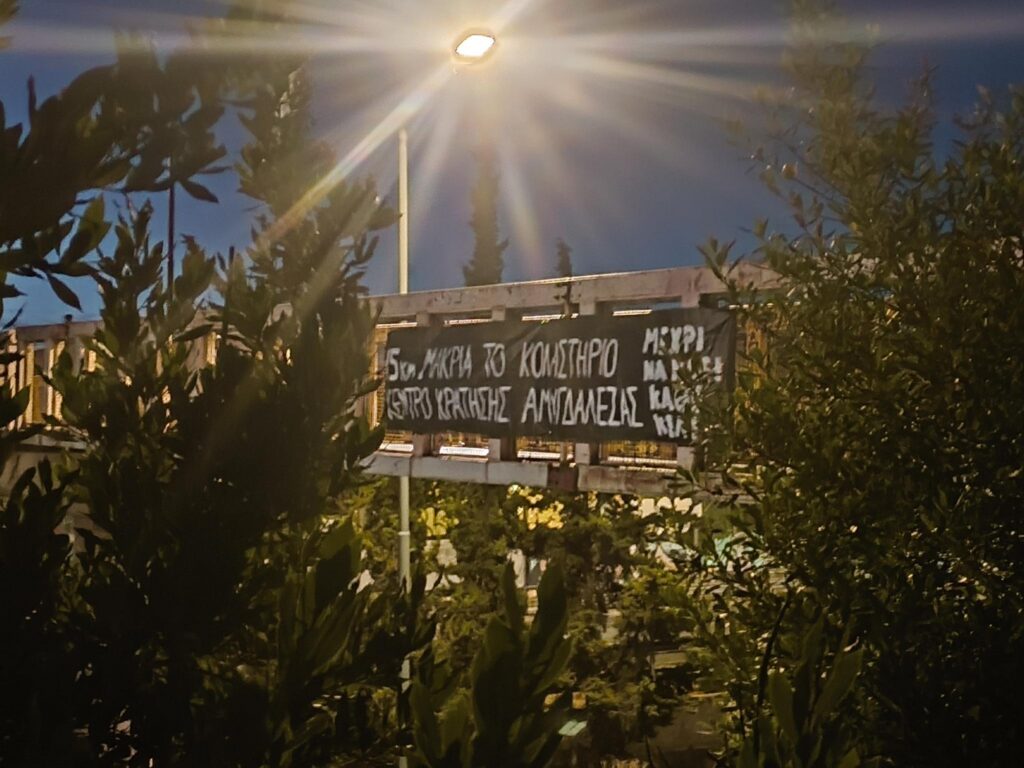
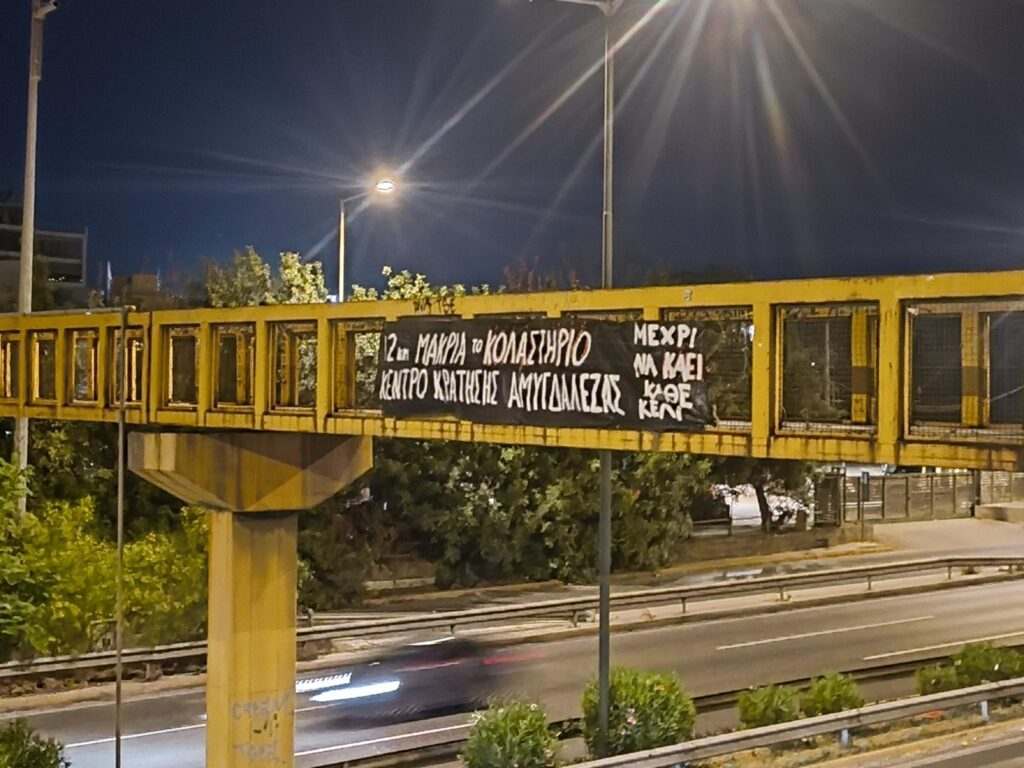
STATEMENTS FROM PRISONERS INSIDE MIGRANT DETENTION PRISONS:
I came from the sea to the prison. I didn’t do anything. I’ve been locked up for 11 months. And if I go to Egypt, I’ll get arrested. I applied for asylum, it was rejected, I filed an appeal, and I still haven’t received a response. What’s the solution so I can get out of prison? And I don’t want to go back to Egypt because if I do, I’ll be arrested. I asked them for a free lawyer to represent me in the appeal, but they didn’t provide one. There’s a Lebanese citizen with me; his country is at war, and he’s imprisoned with me. If he goes back to his country—where there’s a war—it won’t work; he can’t go back to his country again. We’re dying here. We heard that your country is a land of freedom, so we risked our lives and money to get here, but all we found was subjugation and racism. We are human beings like you, we only need security. We left our countries and now we are being used to build yours.
I came to Amygdaleza in October last year. I spent 8 months there, then they moved me to camp Drama. Here the situation is worse. I had an operation on my leg. Nobody wants to help me. Even when I ask, they don’t allow me to see a doctor. My leg is swollen. I came directly from the sea and I haven’t seen the country yet. I want someone to stand with me and support me.
Being locked up is hard, and life is hard here, and there’s nothing available. And I don’t have anyone in Greece who could, for example, get me a visit permit or anything like that. My mental state was ruined. So it wasn’t worth it to leave our country and get locked up. We were forced to do it, but we didn’t want to. Life is hard in prison. The police put us there—we don’t even know why. For example, we don’t know how long we’ll be here or how long we’ll have to stay—they don’t know anything at all I mean, I arrived in September, and people came after me and were released. I don’t know why they’re still here. No one even comes to tell us, “You’ll stay for this long and then be released.” Whenever we ask them, no one is willing to answer us. And here, there’s no food, no soap, no shampoo, no clothes—nothing is available Honestly, when I went to the hospital, the doctor was going to admit me because my mental state was ruined—I wasn’t eating or drinking—but the police had taken my phone, so they gave me treatment and sent me back. The problem is that I didn’t leave the country or cause any trouble. I mean, they brought me in from the sea and put me on the couch right away. The ones who should be detained are the ones causing trouble outside, but I just came from the sea. I didn’t cause any trouble, and I’m coming back to my country—not to cause trouble. I’m coming to work and support my family back in Egypt. And during the ten months I’ve spent here, my mental health has been completely destroyed.
I hope our voices reach the people in charge so they’ll let us out of here I mean, I’m 20 years old—I can’t handle this imprisonment.
The Amygdaleza migrant detention prison in Menidi is part of the parallel prison structure in Greece – detention centres which incarcerate people due to administrative (police) decisions for not having state-sanctioned documents. In Amygdaleza, around 900 men and 40 women from countries including Egypt, Pakistan, Albania and Georgia are subjected to the worst possible conditions, designed to exhaust and oppress. The overcrowded, unhygienic and rotting structures are not only physical and psychological punishment but intentional conditions designed to push people into self-deportation rather than suffer such torture.
In Amygdaleza people are isolated from the city and support networks, with limited possibilities to connect with the outside world and nothing to pass the time. Many people come to Amygdaleza straight from the borders – traumatised from shipwrecks and police violence – and enter the prison in a state of confusion, without clear information about why they are there, how long they will stay inside and without support to claim asylum. Others are taken from the streets of Athens, on public transport or while hanging out in public spaces; some have been working and living for years in Greece. In Amygdaleza they find themselves in limbo, and only those lucky enough to have existing support networks in the city can access lawyers and basic things like clothes, soap and SIM cards through visits from friends, who have to travel 1.5 hours by bus from Athens to reach them. Violent police repression, cops selling sedatives openly or covertly administering them through food, and solitary confinement are all common practices to subdue and control the prison population.
Detention centres are inherently exclusionary tools to enforce racist borders and are used by states across the world. The detention centre is a result of the process of criminalisation: the state creates the ‘crime’ of so-called irregular movement, i.e. movement without papers, and then imprisons those who assert their right to free mobility. Because movement in itself is human and non-aggressive, the state must create the figure of the threatening ‘other’ in order to the existence of the detention centre and the horrific, punitive conditions inside. This ‘other’ inside the detention centre is the young, single, racialised man (often Muslim) who represents a ‘threat’ to public security and the fiction of national ‘values’ or ‘culture’. The torturous conditions of detention centres in addition to deportations, pushbacks and fear on the streets is the only real violence and it comes from the state. The racist anti-migration narrative which has spread to the point of banal normalisation must be resisted because it underpins the justification of racist borders, and because it maintains the structural system of exploitation.
In September 2025, Greece passed a new anti-migration law, which enshrines into law the racist phrase ‘illegal migration’. Among other things this new law increases maximum detention time to 2 years and makes remaining in Greece without documents a criminal offence punishable by up to 5 years in mainstream prison. We have witnessed the chaos inside Evelpidon that this law has created, mass trials with judges ignorant of the new law but still making random convictions, a total lack of translators who continue their years long strike due to below minimum wage pay and individuals representing themselves due to a total lack of legal support.
The overwhelmed, corrupt and racist legal system is incapable of accommodating the new anti-migration law, and that is exactly the point. Just as the trials that convict individuals for smuggling – which have an average length of 5 minutes each – prove, the legal system will create a big expansion in the populations of already overcrowded mainstream prisons (where currently 1/3 of prisoners are from a migrant background) and detention centres. Such an expansion will create profit through construction and contracts and through exploited labour in agricultural prisons but just as importantly it will solidify a racialised social and political system it which fear, oppression and the law combine to create an exploitable class for the benefit of an ethno-nationalist state. Even before the new law, the criminal prison and detention centre systems were interconnected, for instance through the standard practice of transferring people who have finished a criminal sentence but are without papers or applying for asylum to detention centres, arbitrarily extending their imprisonment and punishment.
People regularly die in migrant detention centres such as Amygdaleza – as well as police stations where there are no doctors at all – due to the lack of medical staff, equipment and the indifference and racist attitudes of the police. The true numbers are not reported but we hear on an almost weekly basis about incidents of self-harm, attempted suicide, suicide and deaths due to neglect. These are both totally preventable and part of the inherent violence of the system which suppresses prisoners through systemic neglect of their physical and mental health needs, leading to the development of health conditions stemming directly from the conditions of detention or in the worst cases loss of life. We hear terrible reports of the lack of care and respect for the treatment of dead bodies. Often these incidents lead to mass protests in the centres from prisoners who see how little the state values their lives.
14th June marks 3 years since the state massacre at Pylos in which over 650 people drowned due to the actions of the Greek Coast Guard and 9 people were wrongfully accused of driving the boat and sent to prison. Pushbacks on the border and criminalisation through false accusations of so-called smuggling have become common practice. Inside the country, borders extend into migrant’s lives through limitations on access to health, education, housing and work. One of the biggest facing individuals is the constant threat of imprisonment in detention centres for months and years simply for not having the ‘correct’ papers.
We Call for a Mikrofoniki against detention centres in Nea Ionia Saturday 13/6 18.30: https://athens.indymedia.org/event/101391/
We Call for the demonstration 3 years after the state murder at pylos 14/6/ : https://athens.indymedia.org/event/101387/
FOR A WORLD WITHOUT PAPERS WHERE EVERY CAGE HAS BURNED