
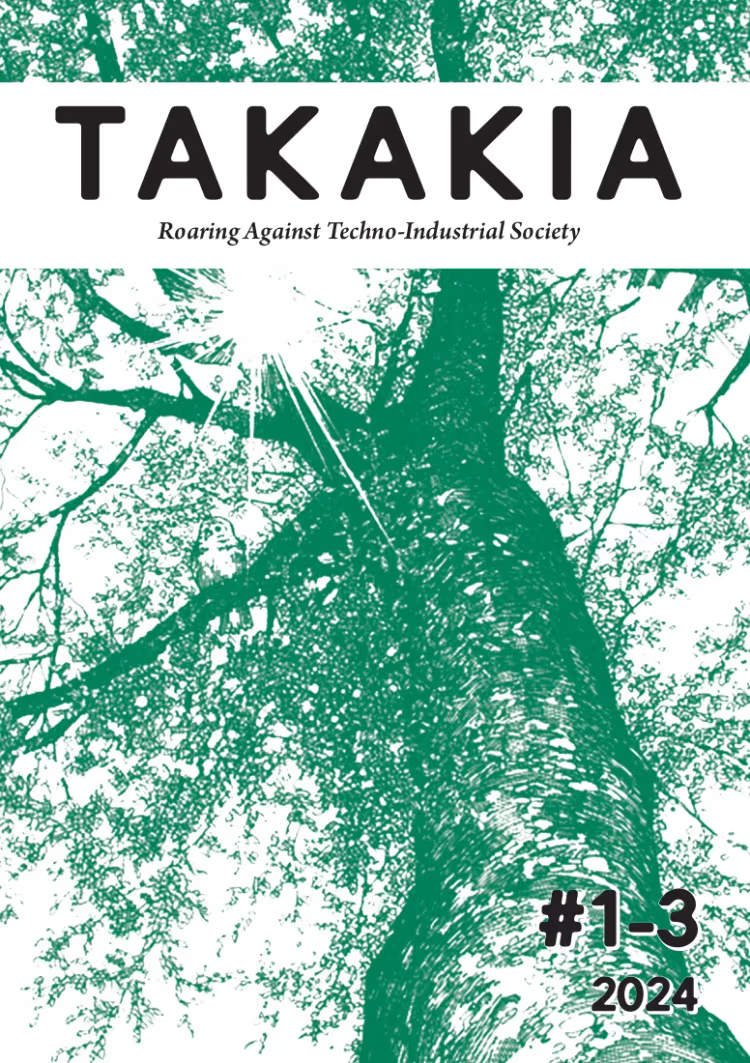
On the Tibetan Plateau, north of the Himalayan giants, a rare plant which bore witness to the Jurassic period clings to icy granite cliffs. On this roof of the planet, the green shoots of this plant remain close to the ground and rarely exceed the thickness of a finger, while its leaves are minuscule. Its bright, vivid green has been observed by only a handful of humans. Its common name in Japanese, nanjamonja-goke, aptly conveys the plant’s unusual resilience: “impossible moss.”
Takakia moss is the oldest known living genus of land plants. It is probably 390 million years old — older than the supercontinent Pangea, which began to break up 200 million years ago to form the continents as we know them today. While Takakia is particularly ancient, mosses (“bryophytes”) are among the oldest plants on earth. Their resilience, adaptability, and evolutionary capacity are quite simply unique, enabling them to thrive almost anywhere, from the driest deserts to lush forests, from windswept Antarctic knolls to mountaintops.
In the modern world, mosses, so fundamental to life, have been relegated to the background. In the vicinity of humans, they are often subjected to merciless chemical warfare in an attempt to expel them from concrete, windows, and door sills. Is it a coincidence that, in imagining a decaying city, in dreams of the downfall of industrial society, mosses — life-giving plants that are resilient in the face of even the worst pollution and radiation — are among the first to cover the ruins of factories and metropolises, highways and landfill sites? In nature’s revenge, moss advances. With it comes untamed life, the wild, the feral, the untended.
Takakia has survived at least four mass extinctions of flora and fauna, all due to climate change. This is not the first time moss has witnessed glaciers melt. Today, however, the impossible moss faces a challenge of even greater proportions. It has coped with the most extreme conditions on the planet. Once lifted up by the tectonic rise of the Himalayas during the formation of the continents, its resilience is now being severely tested by the total ecological crisis that is industrial society. This is what Takakia on the Tibetan Plateau tells humans who seek it out: year after year, its struggle hardens but its resistance does not falter. It retreats but fights on, relentless. Takakia draws a clear line: resistance and freedom or submission and agony. The memory has not been erased of the mosses that blanketed the planet and, at the close of each cataclysmic era, gave birth to everything that lives and grows. Aasaakamek — those ones who cover the earth. Today, this vital force nourishes the dream of seeing those ones cover the industrial ruins of the Anthropocene. Each Takakia shoot serves as a reminder of the challenge before us: to work toward the downfall of industrial society, or perish with it; free and wild resistance, or morbid submission.
Takakia is originally published in French — this is a selection from its first year, focusing on texts that are just as relevant outside of the context of France. On the final page, you’ll find a list of the texts which the translators didn’t include, to give you a better idea of what else Takakia has published in its original form. Those who read French can find the unabridged issues on the Takakia website: takakia.noblogs.org
162 pages
Europe: Rupture Distro
US & Canada: A Million Earthworms
ARTICLES AND STORIES
Takakia. Free and Wild Resistance.
In Times of Ecocide. Some Questions for Anarchist Action In the Current Era.
Can New Energy Technologies Save the Planet? Ask the Sperm Whale.
Hydrogen. The Trojan Horse of the Energy Transition.
Ancient Green. Moss, Climate, and Deep Time.
Marrichiweu. The Fierce Struggles of Mapuche Rebels.
In the Footsteps of Leftraru. Account of the Attack on the Heliport of the Arauco Logging Company.
Solidarity with the Kanak Insurrection
Resisting the Technosphere
Liberating Nature… Or Defending Agricultural Land?
At the Crossroads of Logistics. The Geography of Industrial Transport.
It’s in the Deepest Night That the Moon Shines Clearest. A Plunge Into the Ecological Ferment and Anti-Industrial Sabotage of Germany.
Insurgent Kanaky Disrupts the State…. And the Mining Industry
Industrial Chemicals. The Dark Reign of the Artificial
In the Line of Fire. Interview with Anarchists in Greece on Forest Fires and Resistance to Techno-Industrial Society.
Direct Action. War on Patriarchy, War on Death Technology: A Story of Armed Resistance in Canada
COLUMNS
Resistance
Mega-Reservoirs: Out of Breath?
Sápmi: A Train to Nowhere
Sharpening
10 Minutes
Weeds
Winter Harvesting: Dandelion Root and Burdock
Spring Harvesting: Hoary Cress and Ground Elder
Cleansing
Tales
And So, We Wage War On Them. Part 1.
Back to Basics. Part 2.
Reviews
The Ecofascist Temptation: Ecology and the Far-Right
The Only World We’ve Got & Coming Home to the Pleistocene
Supplements
The Gazette. Dispatches from the Feral Resistance.
Undómiel