
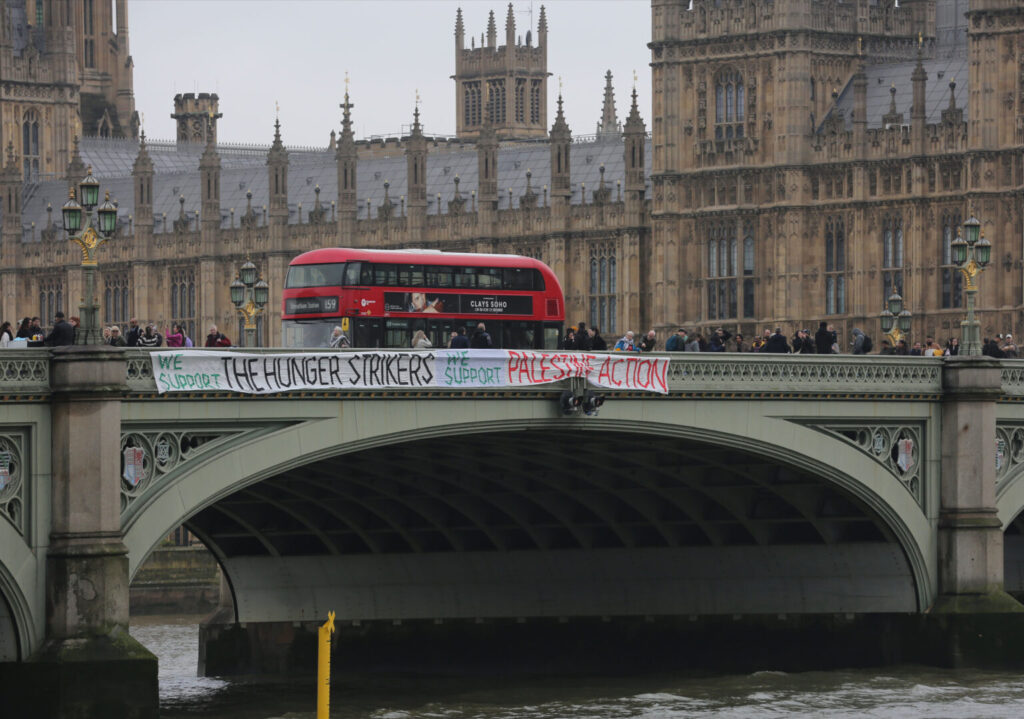
At 12PM on Saturday 15th November, five protestors were arrested under the Terrorism Act for dropping a large banner from Westminster Bridge which read, ‘We Support The Hunger Strike. We Support Palestine Action.’
The action was taken not only in support of Palestine Action, who were proscribed as a ‘terrorist’ group, by the British government, on the 5th July 2025, but in support of the hunger-strike currently being undertaken by a number of Palestine Action prisoners. The prisoners, who have formed Prisoners For Palestine, launched an indefinite, rolling, national hunger-strike on the 2nd of November, the anniversary of the signing of the Balfour Declaration, in support of a list of demands communicated to the government 2 weeks earlier.
The first 2 prisoners to refuse food were Qesser Zuhrah and Amu Gibb in Bronzefield Prison, and over the next few days they were joined by Heba Muraisi in New Hall Prison, Jon Cink in Bronzefield Prison, T Hoxha in Peterborough Prison, and Kamran Ahmed in Pentonville. All the prisoners have been held on remand since being arrested by counter-terrorist police a year ago, though none are charged with terrorist offences. Qesser, Heba, T and Kamran are members of the Filton 24, accused of destroying killer drones at Elbit UK’s facility in Filton, Bristol. Amu and Jon have been imprisoned since June, accused of being involved in the Palestine Action raid on RAF Brize Norton, when cargo planes were sprayed with red paint. More prisoners are expected to join the hunger strike.
The prisoners demands are that the prisons stop censoring and restricting their mail, phone calls, and books, that they have a right to a fair trial, without the interference of the British and Israeli states, and Israeli arms companies like Elbit Systems. Elbit are Israel’s biggest arms manufacturer, supplying 85% of the predator drones used to kill Palestinians in Gaza, and the prisoners are demanding their British factories close for good. After a year, unconvicted, on remand, with up to another year to come, before trial, well-exceeding the statutory custody limit of 6 months, the prisoners are demanding immediate bail. With their harsh treatment having deteriorated even further since Palestine Action were proscribed, the prisoners are demanding deproscription.
There has been a huge outpouring of public support for Palestine Action since they were proscribed, with more than 2000 people already arrested, mainly for holding up signs reading, ‘I Oppose Genocide. I Support Palestine Action.’ It is anticipated that the protestors responsible for today’s banner drop, shaming the British Parliament to its face, will join the ever-swelling numbers of those arrested under the Terrorism Act. Defend Our Juries, who have been co-ordinating the protests, will next week launch another wave of civil disobedience, with protests planned in dozens of British towns and cities. The Lift The Ban actions are timed to coincide with the Palestine Action challenge to their proscription, by way of Judicial Review, which will take place between the 25th and 27th November.
This weekend there are also protests at seven British prisons: Pentonville, New Hall, Styal, Low Newton, Bronzefield, Peterborough, and Eastwood Park. The solidarity actions will take place on both Saturday and Sunday.
Despite Prisoners For Palestine communicating their demands to the Home Secretary 2 weeks before the protest began, as the hunger-strike enters its 3rd week, there has still been no response from Keir Starmer’s government.
The first of the three trials of the Filton 24 begins at Woolwich Crown Court on Monday, 17th November, and there will be solidarity demonstrations outside the court.
A spokesperson from Prisoners for Palestine said:
“Today’s banner drop echoes the sentiment of people across this country, who are disgusted by the proscription of Palestine Action and the ongoing imprisonment of protestors who oppose genocide. There are six prisoners for Palestine who are engaging in an open ended hunger strike, left with no other option but to use their bodies as a tool to resist injustice.
Each of the prisoners face up to two years on remand without trial, far exceeding the six month pre-trial custody time limit. They’ve also faced harsher treatment due to the weaponising of counter-terrorism powers against them. Now, they’ve entered their 14th day of hunger strike and people across the country are mobilising in support of them.”
PRISONERS FOR PALESTINE HUNGER-STRIKE APPROACHES ITS FOURTH WEEK, AS ELBIT SYSTEMS AND THE BRITISH GOVERNMENT GO ON TRIAL
November 19, 2025
Eighteen days since the start of the Prisoners For Palestine rolling, indefinite hunger-strike, and more than a month since the Home Secretary was notified of the prisoners’ intentions, and of their demands, there has still been no response from the British government. With the health of the six hunger-strikers already deteriorating, and the first of the Filton 24 trials finally beginning this week, a joint Prisoners For Palestine/CAGE International online press conference was held this morning.
Alongside Francesca Nadin, from Prisoners for Palestine, was Anas Mustapha, Head of Public Advocacy at CAGE International, barrister Franck Magennis (Riverway to the Sea), Palestinian/Egyptian film maker and activist Saeed Taji Farouky, Shahmina Alam, sister of Kamran Ahmed, of the Filton 24, and one of the Prisoners For Palestine hunger-strikers, and RAF Veteran Steve Masters, representing Defend Our Juries. There was also a solidarity statement from veteran activist Bernadette McAliskey.
Anas Mustapha of CAGE was first to speak, expressing full support for all the prisoners, and to all those taking part in the hunger-strike. Urging the government to respond to the prisoners demands, Anas said that only one conclusion could be drawn from their lack of action: “Britain is more invested in enabling and defending a foreign entity’s genocide than in safeguarding the rights and safety of its citizens. As the lack of food begins to take its toll on those striking, the risk to their health increases by the day.”
This week saw the start of the first of the 3 Filton 24 trials at Woolwich Crown Court, with Zoe Rogers, Fatema Zainab (Ray) Rajwani, Jordan Devlin, Samuel Corner, and Charlotte ‘Lottie’ Head, accused of breaking into an Elbit Systems facility in Filton, Bristol, and causing damage to a weapons shipment due to be sent to the Israeli military, for use in Gaza. Elbit produces 85% of the deadly Quadcopter drones used to target civilians, particularly children, in the Gaza Genocide. The Filton 24 maintain that they have upheld international law, while it is Elbit, and the British government who are the criminals.
The Right to a Fair Trial is a key demand of the hunger-strikers. Not only were they violently arrested, and held as ‘terrorists’, despite not being charged with any terrorist offence, but all 6 activists now on trial have been held for more than a year already, with long waits still ahead for most of the other prisoners. There has, provably, been interference in the judicial process by the Israeli government, Elbit Systems, their biggest weapons maker, and the collusion of the British government, police, and Crown Prosecution Service, as well as the withholding of evidence. It is for this reason that the hunger-strikers are also demanding immediate bail.
This morning, Franck Magennis told the press conference: “The British State is wielding the blunt weapon of remand in custody, denying people bail to attack the anti-Zionist movement, and it’s most principled activists. Many of these comrades have spent years remanded on bail, and many people accused of offenses related to Palestine solidarity are likely to be acquitted by juries, formed of ordinary people, increasingly outraged at the ongoing Zionist Genocide.”
With the trial set to last 10 weeks, the prisoners on trial at Woolwich Crown Court, are having considerable daily suffering inflicted upon them, with several being brought from HMP Bronzefield, a 2 hour journey away. They are being woken each day at 5am, and transported in vehicles known as ‘sweat boxes’, by the notoriously incompetent and uncaring private prisons company, Serco. They are receiving little if any food, their court clothes, (and at least one of their evidence bundles), are being lost or misplaced, and it is difficult for them to shower, rest, make phone calls, or consult with their lawyers, particularly as they often arrive at court late.
Despite the disinterest of the British government in the health and welfare of the Prisoners For Palestine hunger-strikers, (Qesser, Amu, Heba, Jon, T, and Kamran), there has been a groundswell of support both in Britain and abroad, with protests and actions taking place, including seven solidarity protests outside British prisons last weekend, with hundreds attending, a banner drop on Westminster Bridge, and political prisoners abroad taking solidarity action.
Shahmina Alam, sister of hunger-striker Kamran Ahmed, and a pharmacist who fully understood the health implications of the protest, told the press conference, of her brother, who is experiencing breathing difficulties: “I dread the call I’m going to get today, I also dread the call I’m going to get telling me that he’s passed out, I dread the day I don’t receive a phone call at all.”
Another key demand of the hunger-strikers is the deproscription of Palestine Action. With the proscription set to be challenged by way of Judicial Review, between the 25th and 27th of November, Defend Our Juries have organised a fresh wave of ‘Lift The Ban’ protests, which started yesterday in 10 British towns and cities, and will continue at least until the 29th November. The more than 150 people arrested for holding up signs opposing Genocide, and supporting Palestine Action, will join more than 2000 other activists previously arrested at ‘Lift The Ban’ demos, including Steve Masters, an RAF veteran of 19 years, who spoke at this morning’s press conference, saying: “I never imagined that I would have to protest the complicity of my own government in a genocide.”
Saeed Taji Farouky centred the hunger-strike very much in the Palestinian struggle, telling the press conference: “These are people who inherit a very proud legacy of Palestinian resistance in general, and also Palestinian resistance within prisons in particular, and I assure you that the Palestinian people themselves consider these prisoners an integral part of the fight against Zionism, an integral part of the liberation movement.”
While suffering physically due to the effects of the hunger-strike, the six prisoners currently taking part in the protest remain strong, defiant, and committed to winning their six demands:
- An end to the censorship of letters and books, and freedom of expression.
- Immediate bail.
- The right to a fair trial.
- The deproscription of Palestine Action.
- The closure of all Elbit weapons factories in Britain.
Speaking for Prisoners for Palestine, former Palestine Action prisoner, Francesca Nadin, said: “Those on hunger-strike, and all the prisoners, stand shoulder to shoulder with those on trial currently. We are united in this fight, whether it be in the courts, in the prisons, or on the streets.” Of the hunger-strikers, she said, “They are taking power back into their own hands, for justice, for freedom, and most importantly for the liberation of Palestine.”
Francesca then read Bernadette McAliskey’s inspiring solidarity statement. Speaking of the terrible cost paid by the Irish hunger-strikers imprisoned by the British Crown, Bernadette reminded us that, “there is no barbarity, no abuse of the political system, no abuse of the law to cover their own breaches of International Law, to which a British government, still imbued by Colonial entitlement and privilege will not stoop.”
Bernadette’s message of solidarity continued: “Our hearts break for the ‘Filton’ and ‘Brize Norton’ prisoners, their families and friends, because we have been there. We know the price a morally bankrupt Government will exact from the young idealists who, to prevent international crime, and terrorist action, took direct preventative action against the weapons of war. This is not terrorism. This is resistance. This is direct action forced on decent human beings because the government, with whom the duty lies to resist terrorism, is implicit in it by omission and commission.”