
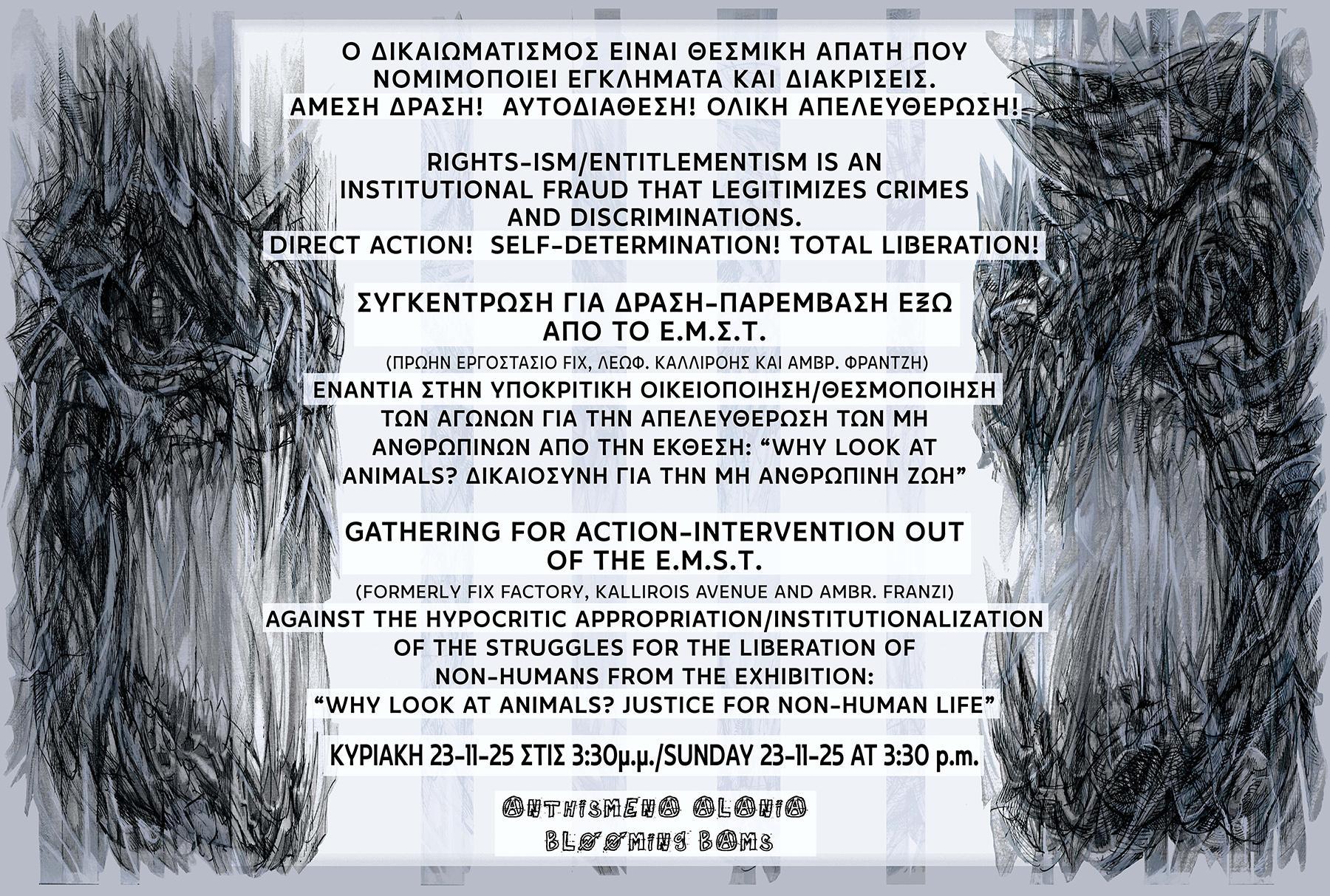
What justice are they talking about?
Starting from the use of the term Justice in the title and texts of the exhibition of the state institution EMST, Why Look at Animals? Justice for Non-Human Life, (2025-26) along with its lack of conceptualization and since the term is used in an organization of an official institution, this pretentious ambiguity triggers thoughts of some indirect or direct purposes. Firstly, the possibility of the deliberate reduction, equalization, assimilation and weakening of the struggle for the liberation of non-humans and humans into an exclusive issue of legislative and institutional claims. Secondly, its transformation into a matter of cultural “to trade” that follows the consumer fashions of each era and its transformation into a commodified showcase of the capitalist pursuits of the cultural/creative industry.
After all, the practice of the non-creative, capitalist classes when they initially reject the creative action of the insurgents, and then appropriate and market it as if it were their own invention, is now well known. Under these circumstances, it is necessary to show that such expediencies are usually interspersed with discourses about justice, rights-ism/entitlementism and human/non-human rights, legal or natural, which are fundamentally misleading and hypocritical up criminally false.
From the very beginning, the concept of justice, from Ancient Greece and Plato in Τhe Republic, had a regulatory function, bridling in the freedoms of human beings by turning them to citizens with duties and responsibilities that are presented utopianly even in the discourses of Socrates, demonstrating with his death, the inherent injustice of law. Platonic justice remained philosophically distant and politically authoritarian and subsequently the pragmatistic political thought of Aristotle did not make it less authoritarian. It is widely known that Aristotle’s justice as a Jurisprudence virtue, there was no way to send slaves on a protest march in the market of Athens, something that the late Stoic natural law would not have done either (Alvarez-Nakagawa, 2024).
With the entry of Roman law, the ancient Greek prosopeion, that is, the theatrical mask was transformed by the Romans into a translation from prosopon to persona. The persona, as a person/personality, becomes one of the three basic institutions of Roman law along with the thing (res) and the action/act (remedies). All these institutions essentially advocate the existence of laws that give the legal right to persons to perform legal acts to possess things. However, in order to be entitled to such protection they had to have three legal privileges. That they be free, that they be citizens of Rome, and that they be independent. This means that unprivileged enslaved subjects were perceived as things (res) in the possession of their masters, those who lived outside the borders were considered persons only in some cases, while femininities and children belonged to their patriarchs and were not independent persons. Therefore, Roman law protected the paterfamilias (the Father of the family), the patriarchal right of possession of things, and Roman law thus inaugurated one of the best-known mechanisms of Western legitimacy: the hypocritical lie, based primarily on the patriarchal, white privileged and dominant philosophical method of legitimate inclusion through systematic and clear exclusion. The protection of possession of things allowed the possession of slaves, “animals”, goods, wives and children within a legal process that signified their submission to the patriarchs, and the patrilineal inheritance was considered as a collective body under the absolute authority of the father/patriarch. Many of the human and all of the non-human were marginalized through their alleged inclusion and their legal recognition was essentially always accompanied by the authority of some who enjoyed rights and protections while the “others” as things were eliminated by persons of the law, relegated to the hierarchical scale below human-persons (2024).
In the course of the history of rights-ism/entitlementism, – which always appears as a “generous offering” of rulers, although at any time they have the power to change it, paraphrase it or bypass it – in the 17th century, natural public law appears, created as a scientific discipline by Machiavelli and Hobbes. Natural public law is founded on the dogmatism of the state and rights, replacing the ancient Greek idea of the excellent polity with the omnipresence of the legitimate government. Hobbes, in Leviathan, structures a blatant contradiction: It recognizes the natural rights of people and at the same time abolishes them with the creation of the Sovereign/Leviathan who, by concluding a social contract with people, reduces them to subjects. They, in order to save their rights, must simultaneously consent to their abolition. That is to say, in modern politics, the recognition and protection of natural rights prepares its disappearance, the Sovereign/Leviathan has the absolute power and the subjects lose the right to resist (Douzinas, 2006).
Natural rights, while promoted as more inclusive than legal rights, are fundamentally based on metaphysical theologies and seemingly scientific findings that make them seem even more false and hypocritical, especially when they assuming that there are universally accepted and fundamental rights which have been granted to humans by nature and cannot be contradicted by any legal entity (ziq, 2022). In addition, this defines the hierarchical position of human beings vis-à-vis non-human beings, yet promises that all human beings are created equal. However, in the course of implementing this equality, a series of discriminations and conflicts were created that reach up to the contemporary era.
For example, in the American Declaration of Independence the three “natural universal rights” are formulated: the right to liberty, the right to the pursuit of happiness and the right to life. Thomas Jefferson, plantation owner, rapist and owner of hundreds of black slaves, in the first two paragraphs of the historical document complains to King George III of England that he does not recognize the above inalienable rights of the American colonists, which highlight that all human beings are created equal. He, like all the rulers before and after him, do not pay attention to the irony of their words: that the rights they give are inextricably linked to the exploitation of the rest of their supposedly “equal” to them “subjects” who with blood expand their plantations, their mansions, etc. (ziq, 2022).
The American Declaration of Independence (1776), along with the Declaration of the Rights of Man and of the Citizen (1789) and the Bill of Rights (1791) were the three revolutionary texts of the 18th century whose impact reaches into the contemporary era. In fact, the authors of the UN Declaration faithfully followed the Declaration of the French Revolution in 1948 with the only difference being the change of the phrase, the rights of man with the phrase, human rights. However, all these texts did not actually restore the relations of the citizens with the political powers, but deep down, they constituted legal procedures for the protection of property rights (Douzinas, 2006). Therefore, the Declaration of the Rights of Man and of the Citizen of the French Revolution brings nothing but a conflictual relationship between the concepts of the human and the concept of the citizen, between the native and the foreigner, between men and women, slaves, blacks, inhabitants of the colonies and of course “animals”, that is, all those who are excluded from political rights.
However, the biggest difference and the biggest fallacy brought by the French Declaration is that all human beings are born equal. Childhood is the most characteristic example of human inequality and dependence on others (parents, social networks, etc.). Therefore, in the declaration, any relationship with the nature of the human as an individual, whether with the gender, race, social class, age, disappears and not only that. Αs described by Agamben (2005), with article 1, in which it is declared that human beings are born and remain free and equal in rights, for the first time the subject of the royal sovereignty of divine origin, is transformed into a citizen of national sovereignty. Birth establishes citizen as a direct bearer of nation-state sovereignty, ushering in the biopolitical consequences that are becoming more distinct in contemporary times.
Here, the historical example of the Abolitionists of the 19th century should be mentioned, in order to clear up some misconceptions. The above does not downplay the struggles of refugees, immigrants, prisoners or the demands for free medical coverage for gender transitions, because they are practices that can strengthen self-determination. However, the example of the Abolitionists helps to understand that the struggles of the enslaved are not given only to improving the living conditions of their slavery, but the main goal is total liberation. Thus, the rhetoric and logic of capitalist formations regarding the well-being of human and non-human beings is driven exclusively by anthropocentrism, control and submission to the sovereign powers that devalue human and non-human beings in “issues of legal interest”.
Any instrumentalization of institutions as well as rights after 19th century is mostly, a consequence of the Marxist tradition of transitional stages, which failed by showing eventually authoritarianism in the example of the Gulags. The contemporary political ecology of the symbiotic and inclusive view involves ethical, philosophical and political dimensions that are close to the Spinozist and anarchist theory of freely acting subjects, the importance of their interactions and the abolition of all authority and hierarchy. It is wrong to make an incomplete and one-dimensional reading of the anarchists of the 19th century when they, e.g. Reclus, Kropotkin, etc. referred with openness to total liberation and continue to influence contemporary action and theory. Any “post-anarchist” approaches to renewing anarchy have already revised their views “on new and old anarchy” admitting that anarchy is freely formed in each era without changing the basic needs for total liberation, abolition of all authority, self-determination and the multidimensionality of diversity. Everything equal, everything different.
Why are they identified with the philosophy of rights?
The history of rights proves that governments create them to bring about a competition of civil liberties and economic advantages, so that the subalterns victims of power waste their time fighting for a place in the world and fall short of the energy they need to fight the system that imposes these blatant inequalities on them in the first place (ziq, 2022). It is also discernible that the hierarchical structure of rights-ism leaves non-humans at the bottom of the scale, while it is obvious that even their insertion into similar institutional reforms, not only won’t be for their benefit, but this specific systemic legitimacy will bring about more dichotomies.
Through the hierarchical scale of rights-ism/entitlementism, the intersecting relationship of the oppressed human with the non-human, assuming from power roles sometimes as things (res), owned objects and marginalized, invisible existences without any value, is also clearly shown. The interconnected relationship of oppressed humans with non-humans has not yet been fully understood. In fact, pioneering theorists of “animal” liberation, such as Peter Singer, scorned this relation of oppression, and therefore there is a critique that considers this to be one of the reasons for the failure of Singer’s position towards non-humans (Schaler, 2009). Singer and Tom Regan are presented in the editorial note (p.10) as the thinkers that the exhibition faithfully follows and with whom it identifies on the philosophy of rights. Below it will be analyzed why their philosophy of rights is followed by this specific institutional organization with such zeal.
Initially, it should be emphasized that the two thinkers align themselves with the aforementioned philosophy of the tradition of attributing rights to humans by extending it to non-humans. Primarily this goes along with two basic principles; the first is that their philosophy follows the Hobbesian tradition as seen in the American and French declarations. Thus, the recognition and simultaneous abolition of the equality and inherent worth of non-humans is accomplished, ceding their ostensibly fundamental natural rights to a social contract. This social contract, whether it is utilitarian as in the case of Singer or a matter of moral rights for Regan, is accompanied by the indirect and in some cases direct involvement of authoritative, legislative and all kinds of institutional functions. The second principle stems from the first and has to do with discrimination and the abolition of inclusiveness in the history of the philosophy of rights, as an invention of institutional powers that are always hierarchical. Therefore, the consequences of their philosophies do not differ from those mentioned above. Competitions, conflicts and entanglements of interests arise equally, from the perpetuation of authoritarian behavior that, under the guise of egalitarian policies, causes further inequalities.
In particular, Singer’s utilitarian approach does not deal with the strengthening of the position for the equal treatment of humans and non-humans and is more directed towards investigating how the equal interests of all beings should be treated equally (Gruen, 2012). This validates institutional-type processes that inevitably trigger conflicts. Various comments of his in relation to the killing of disabled individuals, especially in infancy and childhood, the voluntary killing of elderly or generally sick people and the acceptance of the use of animals for experiments brought a global uproar and generalized protests against him which may have also damaged the broader understanding of the movement for the liberation of non-humans. The concerns raised by his discourses on the “right to life” of disabled persons, children and laboratory animals ranged from a range of interpretations that cause ambiguities and misunderstandings. The most important, however, is that they move towards a rational-type mentality of death politics with seemingly legitimate connotations, placing the subjectivity of individuals on to live or die into a logical framework of supposedly objective social decisions.
Tom Regan is diametrically opposed to the use of non-humans for experiments, disagreeing with Singer’s rationalized casuistry. However, in his theory of moral rights, he includes, as he says, the case where it is preferable to drown a million dogs in order to save even four people. In the same case, Singer may not agree with the one million, but he certainly accepts that it is preferable to drown one dog than one human (Gruen, 2012). These kinds of rationalized casuistries may sound right to the ears of some individuals, but deep down they artfully perpetuate speciesism and anthropocentrism based on normative discrimination by bringing into the discussion external authority agents whom they encourage to legitimize themselves as judges of the death and life of others.
Both philosophies have been criticized for their focus solely on right reason and their complete loss of emotion, resulting in their formation as dogmas. Many feminists have accused them of belonging to the Kantian tradition of elite white male property owners who had previously excluded women and animals from the moral community of privileged rights-holders (Donovan, 2012). Singer and Regan talk about rights regardless of gender, race, class, or species. Nevertheless, was not the slave trader Jefferson talking about equal rights to liberty, happiness and life?
What does John Berger have to do with discourses about justice?
Although the exhibition at EMST claims to be inspired by John Berger’s book (Why Look at Animals?, 1980, translated in Greek, 2019), however, with its second title: Justice for Non-humans, from the outset proves its deviation and the distortion of Berger’s words in this particular book. The basic issues of the book, not only do not touch in the slightest on the discussion of the rights of “animals”, on the contrary, even words or concepts such as rights, justice, etc. are completely absent from its entire text. Subsequently, the misinterpretation of Berger’s argumentation in the curatorial note of the exhibition continues at other points, which are sometimes distorted and sometimes made invisible depending on the advantageous extraction of conclusions, directing the impressions of the public.
On p.7 of the editorial note, it is claimed that Berger points out that the “animals” from the central position they had in human life, gradually disappeared from the field of vision. Nevertheless, Burger emphasizes the cultural marginalization of the “animals” which he considers a more complex process than their physical marginalization. The “animals”, he says, are transformed into a spectacle and have disappeared in another way. Therefore, not only have they not disappeared from the visual field of human life but also instead, they have turned into all kinds of images, displayed in the various institutional-commercial spaces such as bookstores, zoos, aquariums, galleries, museums, etc. In these spaces, the audience stops in front of each “animal” as if viewing a work of art, taking its confinement, abuse and torture as for granted, while the “animals” themselves end up always being observed, with the result that the condition that they too are observing is lost.
Moreover, criticizing that side of art that helped transform animals into images and objects, he characteristically argues that the disturbingly prophetic dream of Grandville’s anthropomorphic engravings reached the platitudes of Disney where “animals” are used as spectacles and masses to describe “human” situations. Furthermore, one of Berger’s ascertainments is that since the 19th century, public institutions have supported colonialism and imperialism, and zoos as well as museums have covertly used these ideologies while claiming to promote the knowledge and enlightenment among citizens. EMST is also trying to do something like this, so such ascertainments cannot be included in the editorial note.
Another important issue raised by Berger, which not only does not appear in the editorial note but also is presented distorted by the participants in the exhibition, is that of “domestic animals” or “pets”. Here, Berger is the most clear and categorical, on an issue that acquires particular importance after the Greek anthropocentric-racist law 4830/2021 that limits non-humans exclusively to fully controlled “companion animals” of human domination. The practice of owning “domestic animals/pets” regardless of their utility, Berger explains, is a distinctive feature of consumer societies and of private nuclear family that wants them adorned and decorated with memories of the outside world. “Domestic animals/Pets”, now further degraded to “companion animals” are sexually isolated, sterilized, microchipped, like the objectified, slaughtered units of meat for commercial use, and are completely transformed into property elements and creatures of their owners’ lifestyles.
For the “animal” that ultimately depends on its owner for every natural need, there is a fanatically propagandized hypocritical activism that is enhanced by the exhibition at EMST and which is activated by institutional animal-friendly organizations, governmental and non-governmental, that want more tightening of the law, more sterilizations and the imposition of a full-scale eugenics process on the non-humans. The leading guise for this extermination propaganda is the abandonment of animals in cities, with the only, of course, solution against their freedom, to turn them from free-stray, adespota, animals into decorative stuffed toys dominated and sterilized from all sides in the hands of their despots. In other words, to transform them, as Berger also claims, into non-human puppets completely.
The regressive hypocrisy of the cultural/creative industry and the ostensible radicalism in the commercialization of institutional centers of culture/contemporary art (malls)
At the end of the catalogue of the exhibition, its funding is mentioned as indicated in the text below:
The exhibition is co-financed by ESPA 2021-2027 in the framework of the approved project “EMST Exhibition 2025-2026 ‘WHY LOOK AT ANIMALS?’” with MIS code 6018632, following the call 20 of the Programme “ATTICA 2021-2027” ERDF fund with A / A OPS ESPA: 2148, entitled: “Cultural events – Development of innovative actions in the field of culture and tourism”. (p.78)
In the European program of the period 2014-2020, the General Secretariat for Culture (G.G.P.) refers to the Cultural/Creative Industry for the first time. The term arose from the Greek state’s attempt to follow, through the NSRF (ESPA), the programmatic developments that started with the 3rd Community Support Framework for the period 2000-2006 and to absorb funds not only for its cultural heritage but also for the sector of contemporary culture. However, it copies the general objectives of the EU, without trying to understand the functioning of the real needs in the local cultural sectors and thus the establishment of domestic policies is absent (Avdikos, 2014).
However, G.G.P. was planning priority axes such as the combination of modern culture with tourist promotion and the strengthening of the entrepreneurship of young artists and private investments. That means, gentrification, touristization and stimulation of the unbridledness of the business world, which appear as progressive pluralism and inclusiveness through the economic games of speculators who “wear the mantle” of philanthropy such as St. Niarchos (his foundation is a sponsor of E.M.S.T.) and the president of the Greek industrialists and art collector in the midst of the Greek crisis, D. Daskalopoulos (he has “donated” part of his collection to E.M.S.T.).
What the G.G.P. does not try to understand and ultimately turns into “fine print” under the institutional Greek doctrine: “let’s find ways to make the European money fall…and who cares…” is that already since the 1980s, development programs in the U.S. and later, in the 1990s in Europe, have been bringing “innovative” changes to cultural institutions, strengthening competition between them and forcing them to focus on their entrepreneurship. Thus, institutions and organizations that would not be “spectacular” with “catchy” events to attract more people and would not focus on their commercial facilities, e.g. gift and souvenir shops, concert venues, restaurants, etc. would be deprived of funding (Zukin, 1998).
Therefore, this post-modern “radical” turn brought to Greek institutions, foundations and organizations, governmental or non-governmental, many billions of euros through the European Regional Development Fund (ERDF) to officially strengthen the cultural entrepreneurship. This was also a result of the “Green Paper – Unlocking the potential of cultural and creative industries” of 2010, in which for the first time institutionally the “cultural and creative industries” in the EU are mentioned and entitled: “Communication from the Commission to the European Parliament, the Council, the European Economic and Social Committee and the Committee of the Regions on a European agenda for culture in a globalizing world”, thus strengthening globalized local and regional development strategies with the sectors for culture, the circulation of cultural works, the financing of Mass Media, state organizations and all kinds of NGOs related to the sectors of culture (Audikos, 2014).
The E.M.S.T. (national museum of contemporary art) follows all these strategies, giving emphasis on its events to be first and foremost compensatory, even if in terms of content they may be extremely contradictory. Therefore, like Technopolis, which hosts a meat market festival (Meat Market Festival) and a vegetarian festival (Vegan Festival), in the same postmodern line of flattening polyphony, E.M.S.T. hosts an exhibition on the liberation of non-humans and at the same time in the restaurant of its facilities, managed by the Nice’n’easy group, dishes of braised calf’s tail, rooster, blue crab, eel, goat cheese, egg yolk, etc. are served with great “environmental sensitivity” (Stamatiadou, 2024).
Besides that, it should be mentioned the parallel existence of the exhibition of the D. Daskalopoulos collection in which there is the installation of A. Messager, Dependance/Independance (Dependence Independence) with stuffed non-humans (fox, etc.). In the curatorial note, the artistic director of the E.M.S.T. takes a specific position, saying: “I consciously avoided including stuffed or dead animals […] as this would constitute an obvious and perhaps simplistic approach to violence against animals…”. In the quote, the author talks about those stuffed “animals” that are exhibited in order to show the violence against them, so it is even worse when Messager presents them as living fictions, stating that she perceives taxidermy and photography as the same thing, because both take a dead “animal” and freeze it, “as it is alive forever,” making it simultaneously perceived as illusory and real (Conkelton & Eliel, 1995). Messager manages the spectacle of stuffed creatures like the dolls and puppets that Berger points out, insisting on treating non-humans as possessions and objects.
The violence against the human/non-human bodies comes from the combination of their aestheticization with their objectification, causing the degradation of their dead bodies for which the term Necroviolence is used. This mentality began with a human exhibit, the “Venus of the Ottentots” (Saartjie Baartman), in the 19th century, where an African woman was used both alive and dead as an exhibit of an “ape-like black body,” as interpreted in the colonial Western imagination at that time. It later continued with the exhibitions from 1995, Body Worlds and Animal Inside Out which consist of plastinated dead bodies of humans and non-humans, for which their organizers were accused of using and displaying remains without consent, from people who may have been tortured or executed, while there were indications of their involvement in the trade of prisoners’ organs. However, the term Necroviolence initially arose during the abandonment of human dead bodies in areas where there are migratory/refugee flows. All of the above demonstrates the intersecting relationship of oppressed humans and non-humans.
However, Art Oriente Object participates in the EMST exhibition with a work made of a coat with animals “trampled” on the highways, The Roadkill Coat, (2000). Does this particular work not constitute, for the artistic director of E.M.S.T., “an obvious and perhaps simplistic approach to violence against animals”? It would be equally unacceptable to use for supposedly “activist” protests either the dead “unknown” bodies of immigrants/refugees, or the dead bodies of non-humans hit by cars. Furthermore, it should be noted that this macabre and supposedly “ecological-activist” protest has also ended up being a new fashion trend that the fur industry is boosting, trying to recover its losses from the attacks it receives about the millions of non-humans it slaughters annually. Finally, E. Talbot’s, Human/Nature (2025), with a huge fabric made of silkworms invokes the capitalist fraud of their ethical breeding. In reality, their mutant species is blind, unable to fly, while their constant reproduction leads to millions of caterpillars that inevitably end up dying of starvation, dehydration or being thrown away for animal feed. These working conditions include child labour and huge amounts of water and energy.
The mixture of discriminations of the philosophy of rights, intense business competition that transforms institutions into cultural malls and commercial melting pots according to the neoliberal model, where what is sold or sells is valuable, together with investments/funding in state/private organizations (NGOs, etc.), promotes the protection of animals through their disappearance/transformation, as Burger points out and the state legislates, into “companion animals/pets”, into a vulgarly macabre spectacle of exhibitions such as that of E.M.S.T. and into stuffed decorative pets of their patriarchal despots. E.M.S.T. supports this philosophy followed by “animal-friendly” /Animal Welfare associations/companies/organizations, as can be seen in a project participating in the exhibition, which promotes the views of the “animal-friendly”/Animal Welfare organization Adespota Mysthria (Stray Mysteries). The Adespota Mysthria (Stray Mysteries) collaborate with the Municipality of Elefsina, with the stated aim of ensuring the welfare of strays by reducing their population through sterilization (Animal Welfare Group of Elefsina “Adespota Mysthria (Stray Mysteries)” – Elefsina, Western Attica, n.d.). Have they ever heard that this is called Eugenics? This particular example is typical of the Hobbesian tradition that speaks of freedoms through their disappearance and reaches as far as the ironic soccer chant which Greek hooligans yell, that says: “…we are who fight against violence!…Here it will be done your grave!”.
However, all these types of eugenic “animal-friendly”/Animal Welfare associations/companies/organizations, carry out strict propaganda reminiscent of the atrocities of TERF “feminists” who present themselves as radical while basically reproducing patriarchal and authoritarian stereotypes, following far-right discriminations. Based on the same philosophy, under the guise of animal protection, all these “animal-friendly” companies/organizations launch that they are allegedly opposing the law 4830/2021 but deep down what they are asking for is its further tightening. More microchips, more sterilizations, complete disappearance of “animals” from parks and squares, thus aiding the phenomenon of gentrification and bringing in a lot of revenue to the state from the high fines it imposes through this eugenic, racist and anthropocentric law. The law 4830/2021 was supposedly made to prevent the licentiousness of animal traders and hunters, but this is a guise, like all the guises mentioned above which always focus on control, invisibility, disappearance, division and Machiavellian-style conflicts: “divide and conquer”.
via: athens.indymedia.