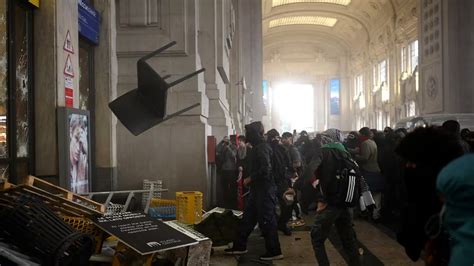
The day of September 22nd was an important breathe of fresh air, as if the lid had finally come off. We were in no doubt about the fact that it would be Palestine to reignite social anger and not internal politics. For example, the “let’s block everything for Gaza” has challenged the security decree more than protests organised around that specific issue have done until now.
The historic cycle of war we have entered puts lives and therefore struggle initiatives on to a necessarily international level, which is reflected in the internal front. If ideas often diverge, feelings have something universal about them. That emotions against the genocide were growing was palpable: the general strike gave them the chance to express themselves. The fact that sentiment turned into mass participation was also due to the partial and opportunistic legitimation – at the humanitarian level – by the media and the cultural world, due to the involvement of the Global Sumud Flotilla.
The bridge between support from a distance and direct participation in the blockages came about thanks to the Genoa dockworkers. It was their declarations – and the history from which they originate – to crack the politico-humanitarian-spectacular recuperation operated on the Flotilla and transform a strike into a real movement. She was right, the Palestinian writer, when she spoke of a flotilla for latecomers. But if among the latter there are thousands of young and very young, the delay could take on the dimensions of a new beginning. It is therefore a question of pushing the tide forward as far as possible, taking full advantage of the crack that has opened up (and which might not remain open for long).
From this point of view the evaluation of September 22nd changes if one observes it from the social point of view or concentrates on the groups that have kept the initiative going alongside the Palestinian resistance over the past two years. The most significant initiatives, in our opinion, have been the blocking of the ports, because they have united strategic precision and mass participation – war supplies to the Israeli genocidal system pass through there, war logistics are organised there –, whereas the other blocks are more generic. That everything must stop in the face of genocide is an important indication, which is felt and is easily reproducible, even in small situations. But to it must be added the capacity to strike the machinery of collaboration (factories, research centres, banks, insurance companies, businesses).
The lack of such an addition denotes a certain backwardness of the most organised groups, to whom the September 22nd strike gave an occasion, largely lost. If the “state of permanent agitation” continues to create moments of encounter and rupture, as seems likely, it is necessary to know how to put name, surname and address on those enriching themselves with the extermination of the Palestinian people. Uniting “let’s block everything” (allowing wider participation) with “let’s smash the global genocidal machinery to smithereens”. If even a ONU speaker talks of “genocide economy”, practical conclusions need to be drawn. If “the genocide continues because it is profitable”, international solidarity with the Palestinian resistance must transform it into a very bad deal.
via: ilrovescio.info
Translated by Act for freedom now!