Press here to download the file in pdf format.
Contents:
- Editorial
- For solidarity to army refuser Ella Keidar Greenberg (Israel)
- Refusal Statement: The imperative is Refusal
- Against military service and for the rejection of all militarism (Hamburg)
- Toulouse, au centre des guerres
- Militarism and “anti-militarism” in Bristol and beyond
- The Local Face of Militarism (Slovenia)
- Solidarity to the regions of Palestine – Insubordinates to the slaughters of state and bosses
- Burnt flags look beautiful
- Nations are not vegeterians…
EDITORIAL
We have entered a condition in which the war rhetorics, actions and policies are proliferating and presented by the dominant groups as a ‘natural’ outcome – for some of its actors inevitable and for others legitimate – of the immediately preceding era, that of fear and imperilment. Now, the economic plunder, the strategies of customs tariffs and inflation, with all the techno-scientific controls at their side, are expressed in warlike terms.
The control, repression and surveillance of bodies, social groups and entire societies is intensified either through the construction of new ideologies and technologies of war or through the evolution of the old ones. Nation-states are promoting again in visible terms not only practices and rationales of marginalization and exclusion but also the physical extermination of those who do not fit into their narratives and those who stand critically against them. The permanent state of emergency, of ‘natural’ – or not – disasters and crises (economic, political, state, health, environmental, energy, etc.), means, among other things, the permanent equipment of state powers. They come with new opportunities to apply repressive doctrines based on the form of the ‘expert’ and, of course, on blind submission and loyalty to them; including among the “experts”, every war “think tank”, with or without stripes.
We live in an era where migration, either as a consequence of things mentioned above (and many others), or as a choice to seek different conditions of survival, has been institutionalized as a consolidated repressive and warlike paradigm. Nowadays, the figure of the ‘migrant’ (the stateless person, the poor person, the person who lacks the status of citizen of a nation-state) is not only treated with the legal cynicism of the ‘criminal’ but also with an even worse one, that of the ‘national enemy’. The pushbacks, abuses, humiliations and murders of migrants (with evolving surveillance technologies, fences, land and sea border patrols) take the form of a “repulse” of an opposing army, tactical or irregular, which even legitimizes mass murders such as the one off the coast of Pylos. And those individuals from the “surplus” populations who survive shipwrecks and various kinds of “accidents”, become the commodity or the labor force that once matched the form of slave or prisoner.
We are in an era where war conflicts and preparations, massacres of entire populations and communities for the interests of states and capital, emerge from the orchestrated obscurity of the “end of history” and are once again being served up as normality. War, which never stopped in much of the world, is coming back as a central agenda even in societies that for decades “prospered” from its profits, while it was unfolding “somewhere else”. Nationalisms are rediscovering themselves with the entire political spectrum bowing to their “glamour”, with successive “enemies” demarcating “national communities” by distorting social/class antagonism, with several doses of trade protectionisms, with border walls and modern “war department stores” for every war need. The european states, within this framework which they themselves are promoting, discuss the return of the army’s khaki as the dominant trend: on the one hand, by reintroducing compulsory military service and, on the other, by reintroducing a war economy. In other words, an era that is at once unprecedented and trivial, with tried and tested recipes enriched with many new elements. With a globalized domination of ethnocratic and capitalist balances and antagonisms, constantly changing and transmitted at an unprecedented rate throughout the planet.
*
The european union, with its impressive economic programs of more than 800 billion euros, is rearming the already armed european states. With the overall political framework of the program named ‘rearm europe’ incorporating the transition of industry (research, development, production) into the war economy and with european companies, large or start-up, advertising their war products at every opportunity. With universities incorporating more and more postgraduate programs into their academic agenda, in cooperation with military institutions, to develop new innovations in the fields of warfare, such as smart weapons systems, surveillance software, etc.
Concerning military service, several member states are seeking to reintroduce it, either as compulsory and universal, or as more flexible compulsory models. A reintroduction that is part of a broader european “defense doctrine” (i.e. war plan), part of which is manifested in the “Niinistö report” officially presented in October 2024 by the finnish president Sauli Niinistö, at the “request” of european commission president Ursula von der Leyen earlier that year. A “defense doctrine” oriented not just towards the reintroduction of military service in the EU but also towards a more general design of european ‘total defense’ (i.e. universal warfare) and an interconnection of military and civil defense (i.e. the militarization of society), promoting a pan-societal approach to war readiness and activation. In short, a dominant planning for the transition from the state of emergency to the state of war. This warlike turmoil is observed with similar intensity in several balkan states, which one after the other are opening the discussion on reintroducing military service or implementing it on a pilot basis (such as croatia), through intense debates on the threat of internal and external enemies and under the constant threat of military conflicts.
In this context, the greek case could not be absent of course, where, unlike most european countries, the military service remains compulsory for more than a century now. In a constant reconfiguration, in a direction of equipping itself increasingly aggressively (with planned or unplanned budgets of billions of euros per year and a focus on the air force), while at the same time promoting the social role of the army, mainly aiming at its social legitimization. The work started by the SYRIZA-ANEL coalition government, as a left-wing state power with a right-wing minister of national defense, continues with great success. In the light of “useful service”, what is being followed is the direction of acquiring skills and work experience by soldiers in the field that each one has studied (or chosen); while the access of permanent personnel (civilian or military) to universities and training and specialization organizations is strengthened and spread, on purely repressive programs or seminars of study and specialization. The prevailing slogan is “to turn military service from a chore into an opportunity” and puts, in the worst (or best, according to the dominant power) terms, what is described above. At the same time, the militarization of the borders and the direct or indirect participation of the greek army in wars (in palestine, ukraine, the Red Sea, etc.) continues unabated.
On this basis, a deeper organization of the militarization of everyday life is taking shape in europe and the balkans, focusing this time not on “social peace” but on the clear preparation for war; a further strengthening of the military/police apparatus as the one who regulates and guarantees ‘security’ from ‘internal’ and ‘external’ enemies; an intensification of repression of any questioning and undermining of ‘national’ or ‘european’ unanimity, and an even more intense death-policy of the surplus populations.
*
The dominant political choices of the states worldwide have for many years – and not only recently – been engaged in a military arms race. It is no coincidence, after all, that global military armaments have been setting historical records of increases for the past 10 years, reaching 2.5 trillion dollars annualy. The capabilities of armies in manpower, infrastructure, think tanks, technological development, suppression and extermination are getting gigantic. Highlighting, ultimately, that the war process is not separated in the increasingly blurred boundaries of war and peace, nor are the means or tools it uses in every aspect of everyday life. The peace of the dominant powers is not the opposite of their war, but it is the one that prepares each time for the next war and the one within which the war process is inherent and organized.
Similarly, militarism can be identified in its most obvious manifestation with the military way of life in a camp, in a trench, in a military regime, etc. However, as a philosophy of organizing and systematizing violence in hierarchical terms, it is also a dominant ideology for a social condition where every social/class division and every role crystallizes into an unquestionable normalization. It is an integral part of the violence exercised by the state power to constantly establish its preservation and perpetuation. Militarism is not a “necessary evil” of the state but a structural and legitimate component of it, which among other things is inherent within it, in order to control, surveil and suppress any social/class resistances that appear within its territory.
However, the normalization of both the war process and militarism- as given and inevitable situations – traps almost every oppositional stance into fragmentations, but also into a pro-war or a pacifist assimilation to the war process. This is also why any appearance of collective and emancipatory responses by those who resist is generated more as a spontaneous and delayed reflex to the horrific endings of the military machine, as in the massacre and displacement of “those from below” in Gaza and the West Bank by the israeli state, than as a sustained opposition to its fostering structures and causes. On this basis, the spreading of anti-authoritarian possibilities for a world without states, nations, capitalism, patriarchy, religions and the diffusion of an anti-militarist/anti-war discourse as well as the submission of critical views on authoritarian choices in relation to totalitarianism and war outbreaks, contribute, among other things, to the formation of an ongoing, timely and total rupture with war and peace of the dominant groups.
The following texts are a collection of such discourses and actions in an anti-nationalistic, anti-militaristic, anti-war and anti-patriarchal language. A language that tries not to change as time passes but instead to sharpen and acquire each time more and more sharp angles, strengthening resistance and solidarity. Texts with different social references and objectives, with distinct starting points and experiences, with different perspectives and analyses, but all of them identifying the importance of deconstructing militarism and war. As well as in the strengthening of anti-militarist/anti-war struggles in different places, outside and against the framework of nationalisms, according to the specificities of these places and the interconnection of oppressions and resistances.
Starting with the recent refusal to enlist by trans Ella Keidar Greenberg, who was imprisoned by the israeli army for refusing to serve not only for reasons of values but also because of the war it is waging against the Palestinian population. Continuing with the introduction of a forthcoming publication from Hamburg, germany, where an anti-militarist event was called in November 2024, in response to the pursuit of the german state to reintroduce the military service as well as the general resurgence of militarization that has been taking place there in recent years, in a state with a heavy militaristic legacy. Their written submission seeks the perspectives and possibilities of refusals and struggles against war and militarism. Next is an introductory text by comrades from an anti-militarist event in Toulouse, france, in response to the construction of a NATO command headquarters in their city and the large military arms industry that has been developing there for decades; linking at the same time past stories and refusals with today’s anti-militarist and anti-war struggles. Additionally, the text ‘Militarism and anti-militarism in Bristol and beyond’, from the city of the same name in england, which raises wider issues and questions around the anti-militarist struggles that emerge or die off, and how militarism is normalised in everyday life there, not only through the military but also through companies of the war industry. Next, we cite one of four anti-militarist/anti-war texts that we translated (and which can be found on our blog), coming from the “Initiative against Militarism”, from slovenia. This text, with an antimilitaristic analysis, shows the inextricable connection of militarism and war with the state, as well as the participation of private companies at the war process. Finally, we also cite three of our own texts on the massacre, displacement and solidarity in palestine, the nationalist massacre in ukraine, and a text on the concept and recent history of internationalism in the greek state in spite of times of ignorance, historical oblivion and national and internationalist delusions. All of the above texts were selected based on their content, attempting to contribute to the mutual understanding and interconnection of anti-war/anti-militarist opinions, perspectives, refusals and struggles against war, the state, capitalism and patriarchy.
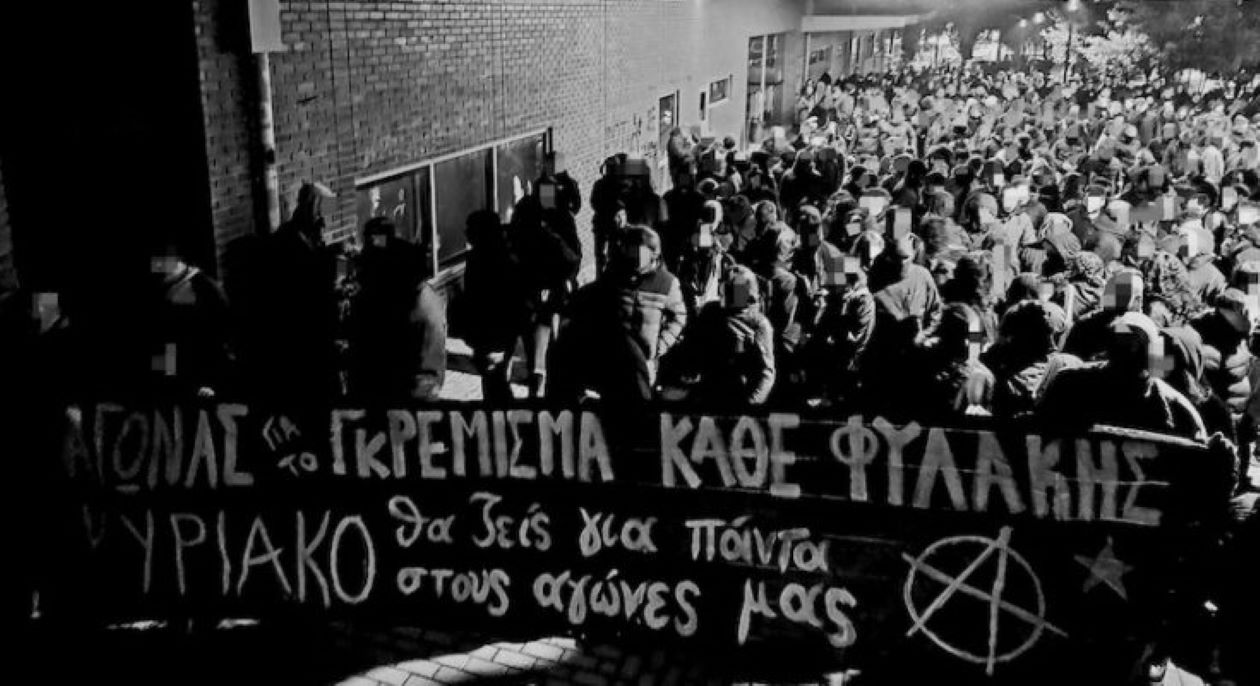
The opposition exclusively to one state/inter-state war conflict without its interconnection with the general military machine, the creation of fronts in the name of a “broad anti-war protest movement” demanding the consensual cessation of wars by the institutions that create them, are far from – if not antithetical to – a comprehensive attitude against the existing system of exploitation, oppression and social divisions. We approach the opposition to war and peace of the dominant groups through the opposition to what constitutes them: militarism, patriotism, patriarchy, the state and capital. That is why, for our part, as initiative for total army refusal, we are not only refusing military service as such – in times of war and in times of peace – but the culture of the war process as a whole. In the perspective of a generalized social/class sabotage of the conditions that feed it on a daily level: in state power and nationalism, in schools and universities, in military camps, in the factories of the war industry and class exploitation, in the ports that transport weapons and soldiers, in the media and spaces where war culture is propagated, in the hand and the conscience of a soldier, etc. For a world of freedom and solidarity, where war and peace are in the same dustbin of history…
Initiative for total army refusal (athens)
olikiarnisi@espiv.net
May 2025