
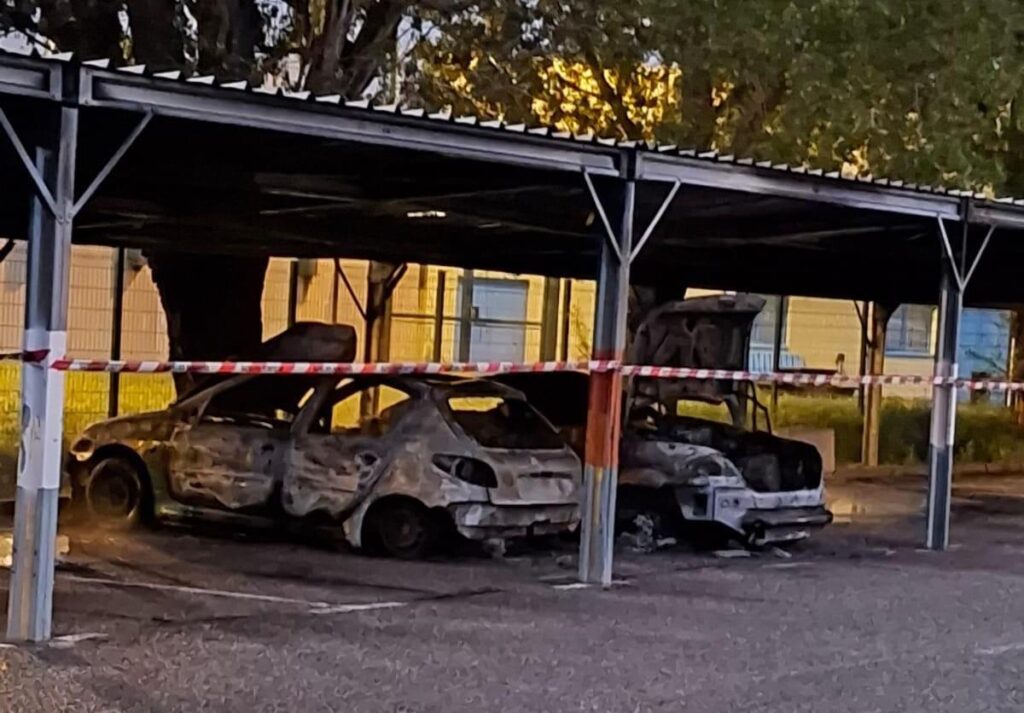
 Tarascon (Bouches-du-Rhône), Wednesday April 16th, 5:20 a.m.: three cars set alight in the parking lot of the prison.
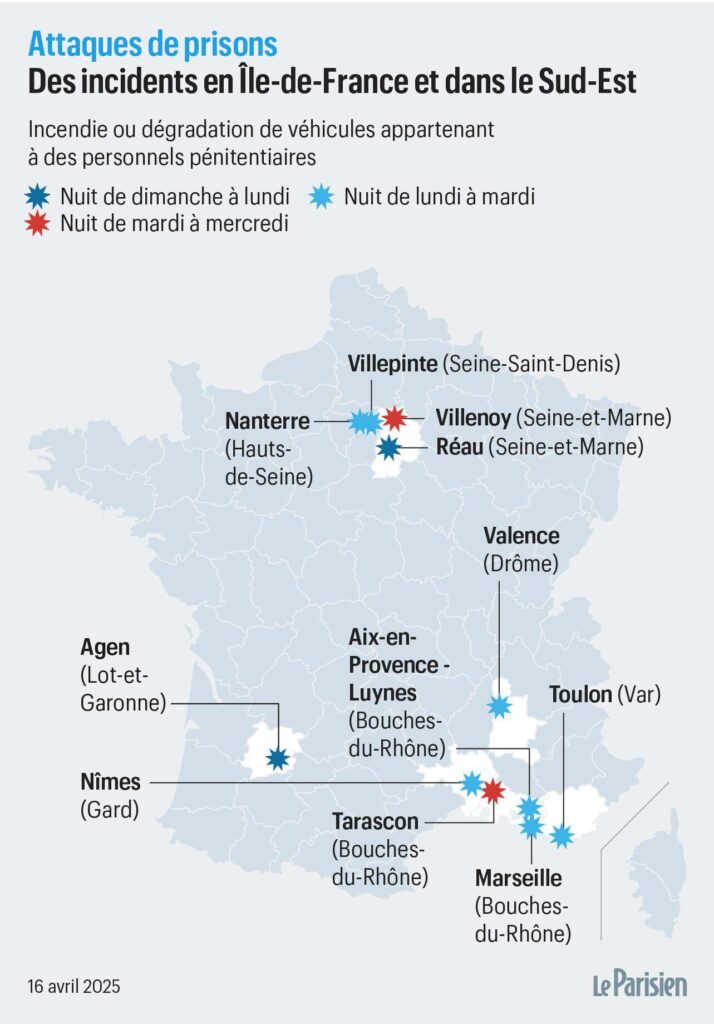
Since the evening of Sunday April 13, a wave of incendiary attacks (and not only) has hit the penitentiary and the property of its minions in a dozen towns in the south of France and the Paris region. After an initial detailed summary published the day before yesterday, here’s a short, fiery supplement on the third night, from Tuesday to Wednesday April 16, when the guards once again had a taste of ashes.
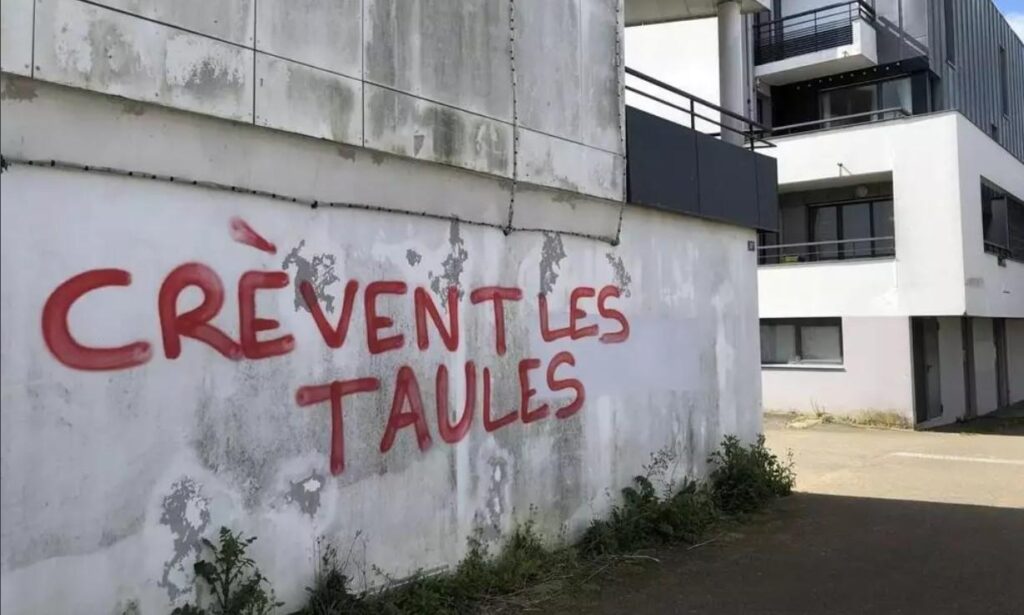
In addition, while DDPF tags (which journalists believe to be an acronym for “Défense des droits des prisonniers français”, named after a Telegram channel) were found alongside several of the targeted targets, the Ministry of the Interior also mentions “anarchist slogans”. Today, one of its daily mouthpieces gave a little more detail on this subject (Le Monde, 17/4), stating that “in Angers in particular, spray-painted inscriptions were found on the facades of houses close to the prison: ‘support for convicts’ and ‘prison kills’”. In reality, these tags had been drawn up at the beginning of April, i.e. before the attacks… which in no way detracts from their relevance, on the contrary, particularly the “crèvent les taules” (“destroy prisons”) which is so hotly topical in the area.
Lastly, in a lengthy interview with France info (17/4), the national anti-terrorist prosecutor, Olivier Christen, gave his own account of the attacks: he reported “12 incidents, two against the personal homes of prison officers, one against vehicles in the parking lots of the École nationale pénitentiaire (Enap) and nine directly against prisons”. Geographically, “eight départements were affected”, including “a third of the incidents committed in the Bouches-du-Rhône and a third in the Île-de-France region”, with a total of “21 vehicles torched and a dozen vehicles damaged” (not to mention the machine-gunning of the Toulon prison gate and the burning of the ERIS prison gate in Aix-Luynes). In conclusion, this fanatical defender of state terrorism and fervent supporter of armored propaganda, even added a layer of conspiracy theorizing of which he has a secret: “It could be groups of politically radicalized people, it could be groups more linked to organized crime, it could also be a convergence of objectives and people manipulating each other: anything is possible”.
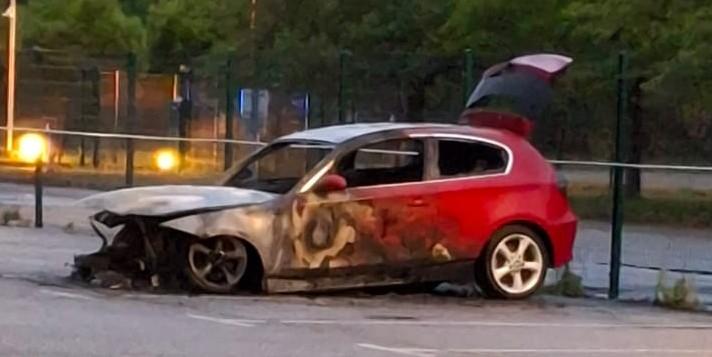 Tarascon (Bouches-du-Rhône), wednesday april 16th, 5.20am: one of the three burnt-out cars in the parking lot of the prison.
Tarascon (Bouches-du-Rhône). On the night of Tuesday to Wednesday, April 16, at around 5:20 am, three vehicles were set on fire in the prison’s secure parking lot: one belonged to a guard on duty and the other to a company working at the detention center.
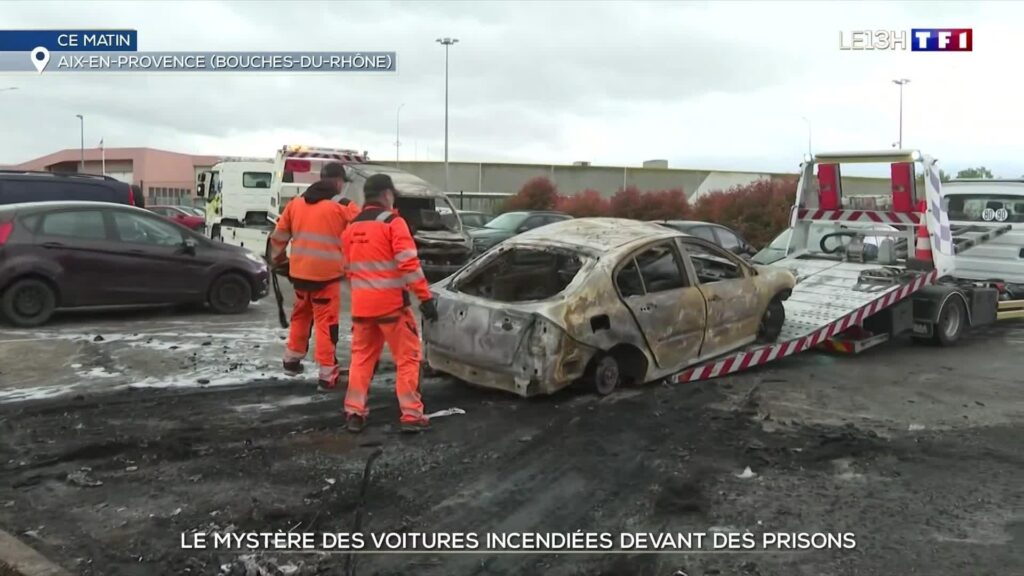
Aix-Luynes (Bouches-du-Rhône), Tuesday, April 15: two cars set on fire in the parking lot of the prison.
- Aix-Luynes (Bouches-du-Rhône). On the night of Tuesday to Wednesday, April 16, after two cars had already burnt down in the parking lot of the prison the day before, this time it was the vehicle of a representative of the SPS (Syndicat pénitentiaire des surveillants) staff of the Luynes prison that caught fire in front of his home…
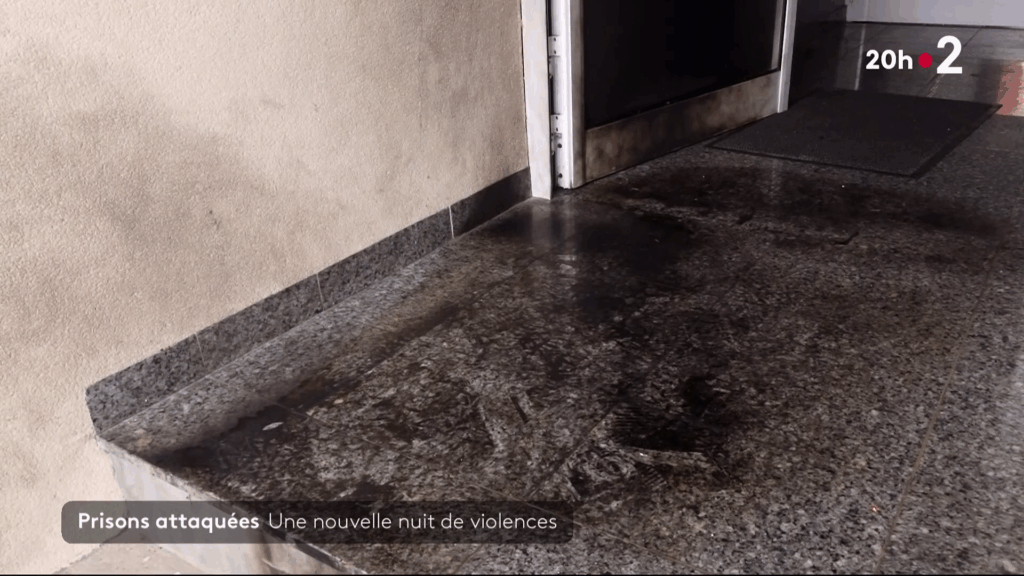 Villenoy (Seine-et-Marne), Wednesday April 16th, 2:30 a.m.: traces of the fire in the hall of the building housing a guard from the neighboring prison.
Villenoy (Seine-et-Marne). On the night of Tuesday to Wednesday, April 16, at around 2:30 a.m., a quickly extinguished fire broke out in the building hall of a guard working at the nearby Meaux-Chauconin prison, while the tag “DDPF” was written on the wall and her car was smashed in the parking lot.
Amiens (Somme). On the evening of Wednesday April 16, the letterbox at the home of a guard working at the prison in the same town was tagged with the letters “DD” [for “Défense des droits des prisonniers français”?], while her car had its tires slashed.
—————–
Questions after the prison attacks
Le Monde, April 17, 2025 (excerpt)
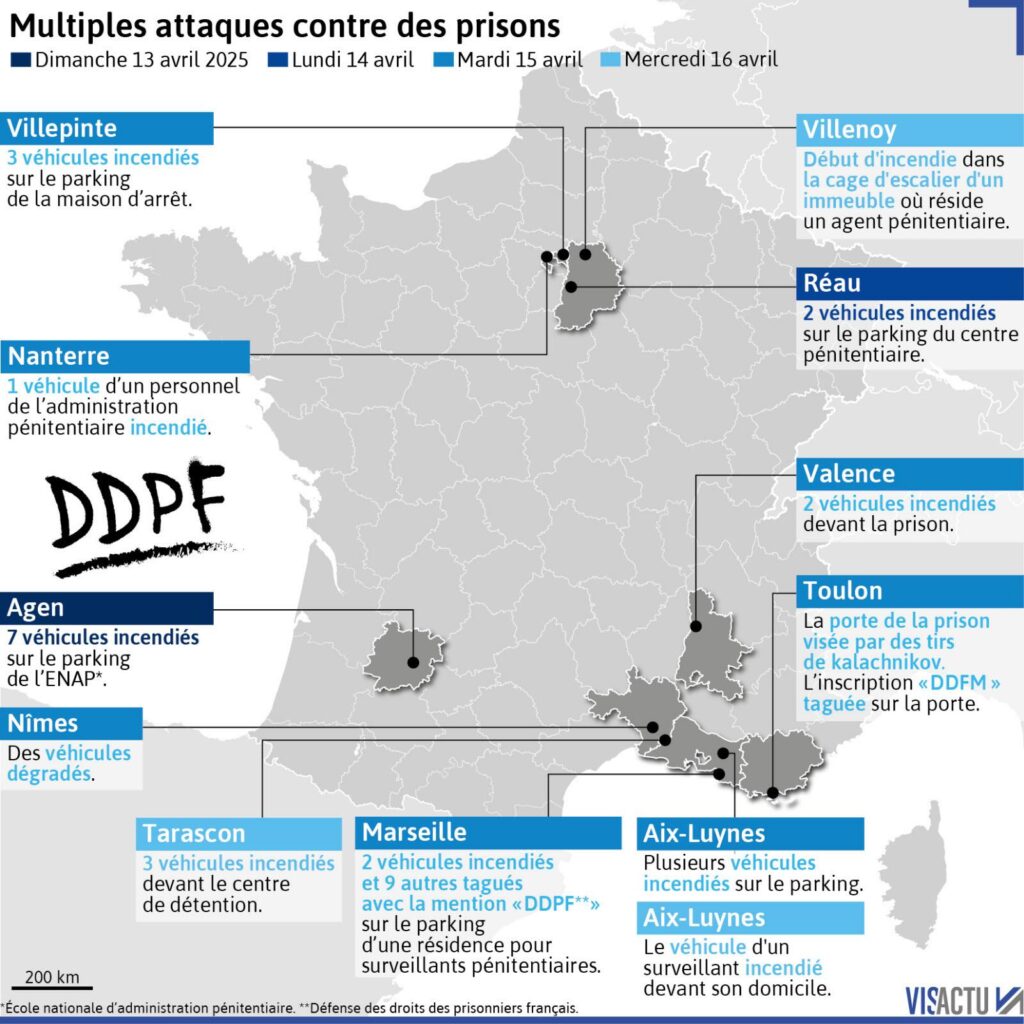
Almost everywhere, we find the same acronym “DDPF” tagged on burnt-out cars or walls. On a video posted on the encrypted messaging service Telegram, individuals, their faces still hidden by their hoods, make use of black-colored bombs, to sign their acts. Strangely, at the Toulon-La Farlède prison, a large orange-red acronym, this time with the letters “DDFM”, has been inscribed on the gray door through which the prison vans enter and leave. Was it a simple mistake or the signature of another group? A mystery. “These are groups we don’t know,” says a prison source, surprised by the claim. Among the historical connoisseurs of prison protest movements contacted by Le Monde, no one had heard of this double signature.
These attacks take place in a particularly tense context, within overcrowded establishments (with an average overcrowding rate of 130%, which can exceed 200% in several prisons), where prison guards are regularly the targets of threats or assaults. Just under a month ago, on Friday March 21, at around 9:30 p.m., three personal vehicles belonging to prison guards at the Gradignan (Gironde) prison on the outskirts of Bordeaux were set alight with Molotov cocktails. The timing of the attack was perfect: at the time, the guards were all gathered to take part in the staff association bingo. The fact that there was a fire or shots fired doesn’t surprise us that much,” says Ronan Roudaut, UFAP-UNSA union delegate at Gradignan prison. “But it’s the fact that these actions are being coordinated on a national level that’s unexpected.”
On Tuesday morning, the French Minister of Justice, Gérald Darmanin, was convinced that the actions were the work of organizations linked to organized crime. “The Republic is confronted with drug trafficking and is taking measures that will deeply disturb criminal networks,” he posted on X.
But for the time being, the intelligence services are investigating all possibilities: while the location of the incidents in part covers areas notorious for drug trafficking, the signatures and the discovery of anarchist slogans point to the possible involvement of extreme left-wing movements. “It’s far from being ruled out at this stage”, says a source within the security apparatus.
But here again, this possibility leaves several specialists sceptical. It’s possible that the extreme left might set fire to cars, but they’re not used to firing Kalashnikovs,” confided a well-informed source to Le Monde. Finally, the extreme left is by nature internationalist, and would never claim an action on behalf of ‘French prisoners’.”
In the south-east of France, which has been particularly hard hit by these concerted actions, a magistrate admits that “at the moment, we lack an interpretation grid to decipher these events”. However, an expert in libertarian circles does not rule out the idea of a convergence between an active core of activists against confinement in administrative detention centers and prisons, and young members of drug cartels who, on release from detention, become politicized. He sees this as proof of the coexistence of two modus operandi, the fire being the mark of past actions by libertarian movements, and the Kalashnikov shootings that of drug cartels.
Tougher prison conditions are leading to increasingly violent forms of action both inside and outside the prison, according to a lawyer in Marseilles, who notes “an ever-increasing use of solitary confinement, and, long before the Darmanin memo on recreational and provocative activities, a deprivation for some inmates of this time outside their cells”. For several days in August 2024, the Baumettes penitentiary in Marseilles was the scene of a mass disturbance, with simultaneous outbreaks of fire in cells in the disciplinary ward. On October 1, 2024, three prisoners were sentenced to three and four years in prison. The inmates, some of them linked to drug cartels, wanted to denounce, among other things, a refusal to transfer to another establishment and violence committed by prison officers. “Setting fire is not the best thing to do, but I don’t regret it, because their job is to be wardens, not to hit inmates”, said one of the young prisoners, who had lit a crossword magazine against his cell door.
———————-
After the attacks on prisons, the identity of the perpetrators remains unclear
Le Monde, April 17, 2025
Narcobanditism or ultra-left-wing extremism: the National Anti-Terrorism Prosecutor’s Office is not ruling out any leads at this stage. Fearing contagion, the prison administration has raised the level of precautions and controls surrounding prison security to the highest possible level.
Did anyone in French prisons know that such attacks were being organized? Were some inmates in the know, or was the operation conceived and orchestrated entirely from the outside? This is one of the many questions to which prison intelligence, the police and the justice system are seeking answers, despite the fact that the night of Wednesday April 16 to Thursday April 17 was quieter than the previous two nights. Since April 13, 30 vehicles have been destroyed or damaged in a dozen incidents. And almost everywhere the acronym “DDPF” (“Défense des droits des prisonniers français”) has been spray-painted on walls or cars. Questioned Thursday morning on Franceinfo, the anti-terrorist public prosecutor, Olivier Christen, said there was “no lead that is favored”.
After the surprise effect of the attacks, and despite the uncertainty surrounding the identity of both the instigators and the perpetrators, the prison administration has raised the level of precautions and controls surrounding the security of both the establishments and their staff to the highest possible level. A videoconference of unprecedented scope held late on Tuesday afternoon, April 15, bringing together the Minister of Justice, prison directors and prison administration managers, set out the details of the measures: reinforced rounds and identity checks around the establishments, reinforced patrols, as well as instructions for maximum discretion on the part of prison guards, both in their movements and on social networks.
Fearing that the movement could spread, including within prisons, the prison administration has contacted prefects and public prosecutors to prevent further malicious acts. “The ERIS [regional intervention and security teams] are on alert and present around the establishments, and cell searches have been stepped up”, assures the prison administration.
Political demands
According to several prison insiders, a plan for concerted action within several prisons had recently been circulating. “The aim was to prevent the ERIS from having time to react, so that they could make their demands heard,” says a well-informed source. “My clients’ first reaction was to say that these attacks didn’t surprise them at all. With the tightening of prison conditions over the last few months, they suspected that this kind of movement was going to happen”, confided a criminal lawyer, the day after a visit to the Vendin-le-Vieil prison (Pas-de-Calais), chosen by the Minister of Justice, Gérald Darmanin, to become one of the two future ‘narcoprisons’, ultra-secure establishments that will bring together the most dangerous drug traffickers from July onwards.
The investigation, led by the French National Anti-Terrorism Prosecutor’s Office, has only just begun, but it is already focusing on an account called “DDPF”, again for “Defense of French Prisoners’ Rights”, created on the Telegram platform on the night of Saturday to Sunday, i.e. even before the first cars were set alight. A text of political demands was posted there to “denounce the attacks on our fundamental rights that Minister Gérald Darmanin intends to undermine”.
This short article appealed to “all inmates, who must mobilize and wake up”: “This is a serious time, we are entering a dangerous and worrying era for the future of the prison population”. She denounced the reduction in the number of walks, the cost of telephone booths, and the elimination of activities which “disrupts the rehabilitation process”. She then launched a violent attack on the warders “who hit us, who rape certain inmates, who exert physical and psychological pressure: most suicides are due to the aggressiveness of the prison administration”…
Even if the “narcoprisons” project is not mentioned in the text, Gérald Darmanin is a bête noire: “Since the Amra affair [drug trafficker Mohamed Amra, whose escape in May 2024 caused the death of two prison officers], which the majority of inmates did not condone, the death of these guys, why use Amra to harm the 82,000 other inmates? It makes no sense. You Darmanin started the war, we just want human rights to be respected.”
Different modus operandi
Can claims of this kind be made by organizations linked to drug trafficking, such as the powerful DZ Mafia? The Marseilles-based gang has already demonstrated its ability to use codes that are not necessarily its own. In a video in the form of a “press conference”, broadcast on October 9, 2024 to deny its involvement in the murder of a cab driver, the DZ Mafia staged itself, complete with balaclavas and firearms, in a mimicry of Corsican nationalist movements.
“We can be a little puzzled about the link between these events and the very firm evolution of the policy to combat organized crime that the Minister of Justice has decided and that we are in the process of implementing”, Sébastien Cauwel, Director of the Prison Administration, cautiously declared on BFM-TV on Wednesday. “Trafficking needs calm to thrive. I don’t see the DZ Mafia’s interest at all in engaging in a power struggle with the State to defend prisoners’ conditions”, says a former inmate who now works in prisons.
The task of the investigators is complicated by the different modus operandi that seem to have coexisted. At the Toulon-La Farlède prison, the Kalashnikov bursts are clearly the signature of organized crime, linked to drug trafficking. On the other hand, in Angers in particular, spray-painted inscriptions were found on the facades of houses near the prison: “soutien aux taulard.e.s” (support for prisoners) and “la prison tue” (“prison kills”).
A flyer referring to the antifascist movement in the region was also found on site, with a call for a public meeting on April 25. References which point to the ultra-left. On Tuesday evening, a man suspected of having relayed a message on Telegram inciting people to commit damage was arrested in Essonne. At this stage, however, he is not suspected of being linked to the mysterious DDPF group, and his police custody has been lifted. “Investigations are continuing”, said the public prosecutor.
via: sansnom
Translated by Act for freedom now!