Category Archives: Sabotage, Arsons Attacks

Brissac (Hérault): a hot strike against extractivism (France)

Near Montpellier. Brissac quarry: metal conveyor belts destroyed by fire
Actu.fr, October 24, 2024 (excerpt)

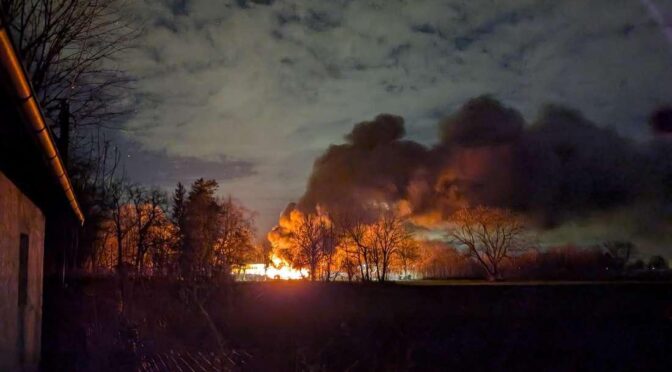
Fire alert at 6:45 a.m. on Thursday, October 24, 2024, at the Brissac quarry in the Gangeois region, north of Montpellier: metal conveyor belts used to transport ore were completely engulfed in flames at the CMSE (Carrières & Matériaux Sud-Est) extraction site operated by Colas, at Le Devois de la Vernède, on the Notre-Dame-de-Londres road.

Some fifteen conveyors were destroyed and twenty damaged, and may still be out of use. The offices, other adjoining buildings and the fleet of Colas vehicles were spared. The fifteen or so employees could find themselves out of work, while the provisional loss is estimated at 6 million euros. Fire detection experts and technicians from the criminal identification unit of the Hérault Gendarmerie are on the scene.

Continue reading Brissac (Hérault): a hot strike against extractivism (France)

Toulouse (Haute-Garonne): fire to the trucks collaborating with the A69 (France)

Charred trucks, explosions, anti-A69 tags: what we know about the violent fire in Toulouse
ActuToulouse/Ouest France/La Dépêche, October 21, 2024
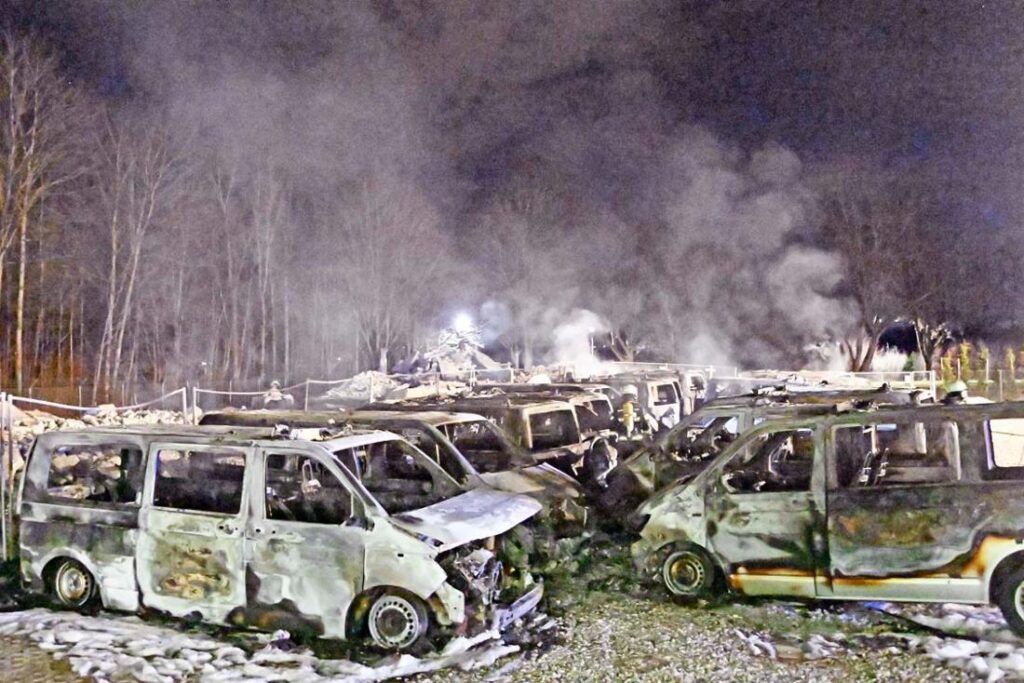
Several explosions ripped through the night, rousing many Toulousains from their beds. On Monday, October 21, 2024, at around 4 a.m., a violent fire broke out on the premises of Spie Batignolles, located in the Gramont district of Toulouse. When firefighters arrived on the scene, seven trucks were engulfed in flames. An eighth was only just saved. The explosions heard by local residents were none other than the tires of the trucks, which were subjected to temperatures too extreme for them to withstand.
Specialized in construction work, Spie Batignolles is involved in two major projects in the Toulouse region: line C of the Toulouse metro, and the A69 highway between Toulouse and Castres. This project has been the subject of fierce protests from environmental militants for many months.
The police are investigating the incident as a crime, and the Toulouse public prosecutor’s office has opened an inquiry for “deliberate damage to private property by dangerous means”. Damage is estimated at 2 million euros.

Continue reading Toulouse (Haute-Garonne): fire to the trucks collaborating with the A69 (France)

Amtrak service between NYC and New Haven suspended due to transformer fire (USA)

The fire, reported at a substation at Bronxdale and East Tremont Aves. in the Bronx, ignited around 2:30 p.m., causing a power loss for trains in the area, according to the FDNY.

The fire jumped from an overhead Amtrak transformer along the tracks to nearby brush, then to the parking lot of the adjacent substation, burning at least three cars.

Continue reading Amtrak service between NYC and New Haven suspended due to transformer fire (USA)

Berlin (Germany): Army car damaged

Kontrapolis / Wednesday, December 4, 2024

Last night, a car with a military license plate a German army logo was parked on the Maybach quay at the Hobrecht Bridge.

Something unusual to see.

In the morning, it had to be towed away, with new paint, broken windows and flat tires. Was it a private trip? Every ten years, federal officials forget: you must not park in Neukölln [ a working-class district in the south-central part of Berlin – the link refers to a similar case, a dozen years ago; Ed. ]…

via : attaque

Translated by Act for freedom now!

KPN vehicles attacked in Amsterdam (Netherlands)

In the night of Tuesday the 25th of November two KPN vehicles in Amsterdam (KPN is a leading telecommunications and IT provider in the Netherlands) got attacked.

One van was set on fire, the other got its windows smashed.This action was a retaliation for KPN’s sponsership of the NEDS armsfair, against militarism, and the technology of repression.

Against genocide and apathy.

Love and courage to those that struggle, Revolutionary hearts burn forever.

receive by email.

Flamanville (Manche): A few bolts less for an EHV pylon

A few bolts less for an EHV pylon near Flamanville
(Indymedia Nantes, September 30, 2024)

The EPR nuclear reactor in Flamanville, on which work which begun in 2006, is nearing completion and could be connected to the power grid this autumn. This step, known as “coupling”, is decisive for making what would then be France’s most powerful nuclear reactor operational. The Flamanville EPR and the announced future EPR2 reactors (Penly 3 and 4, Gravelines 7 and 8, Le Bugey 6 and 7) add to the 56 reactors currently operating in France, not counting the nuclear reactors used to propel military submarines and an aircraft carrier, and the few research reactors in service.

Continue reading Flamanville (Manche): A few bolts less for an EHV pylon

Pylon! Pylon! Fire, Fire!

Attempting to recount pylon woes from late 2022 to the present day, based on communiques and publications from recent years

Against the nuclear industry, the electrical grid and the power supply of capitalism’s most harmful… Pylons are targets. The aim here is to highlight the vulnerability of the power grid order and, in a way, to demonstrate the ability to attack capitalism using this angle.

Pylons can topple to block electricity production (as at Brennilis on January 15, 1979), but they can also target the supply of a harmful industry (as in the famous film Woman at War, which targets the aluminum industry)…

At the end of 2022, two reports from south-eastern France demonstrated the relevance, and indeed the effectiveness, of these actions

In Salindres, in the Gard region of France, the electricity supply to the chemical-industrial hub was targeted. The resistance fighters who claimed the toppling of the 225,000 volt pylon even indicated the method used, allowing anyone to cut off the electricity where it doesn’t belong!

Continue reading Pylon! Pylon! Fire, Fire!

Carrara , Italy: Incendiary  attack against three heavy vehicles at a marble quarry in the Campocecina area (Carrara, 3 November 2024)

Incendiary  attack against three heavy vehicles at a marble quarry in the Campocecina area  in Carara

Tongues of fire

In the night between Saturday 2 and Sunday 3 November a fire lit up a moonless night on the Apuan mountains, destroying three heavy vehicles in a marble quarry in the Campo di Cecina area near Carrara.

In these places where it is easy to pass unobserved machinery and structures indispensible to the industrial system are often left lying around.

May this kind of blaze spread against devastating machines and their miserable owners.

[Received by via mail and published in https://lanemesi.noblogs.org/post/2024/11/25/attacco-incendiario-contro-tre-mezzi-pesanti-presso-la-cava-di-marmo-in-localita-campo-cecina-carrara-3-novembre-2024/]

translated by Act for freedom now!

Arson attack in Terrace BC (Canada)

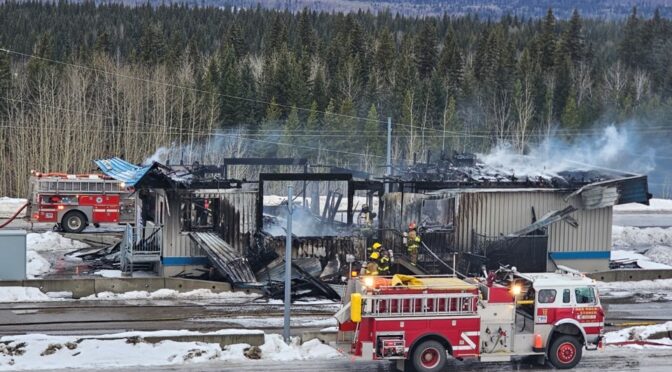
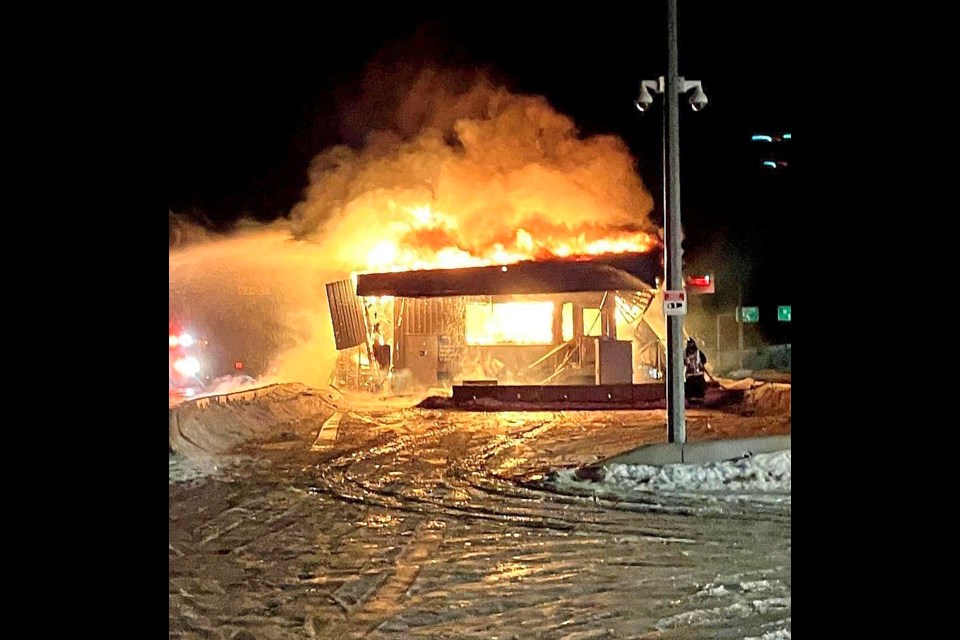
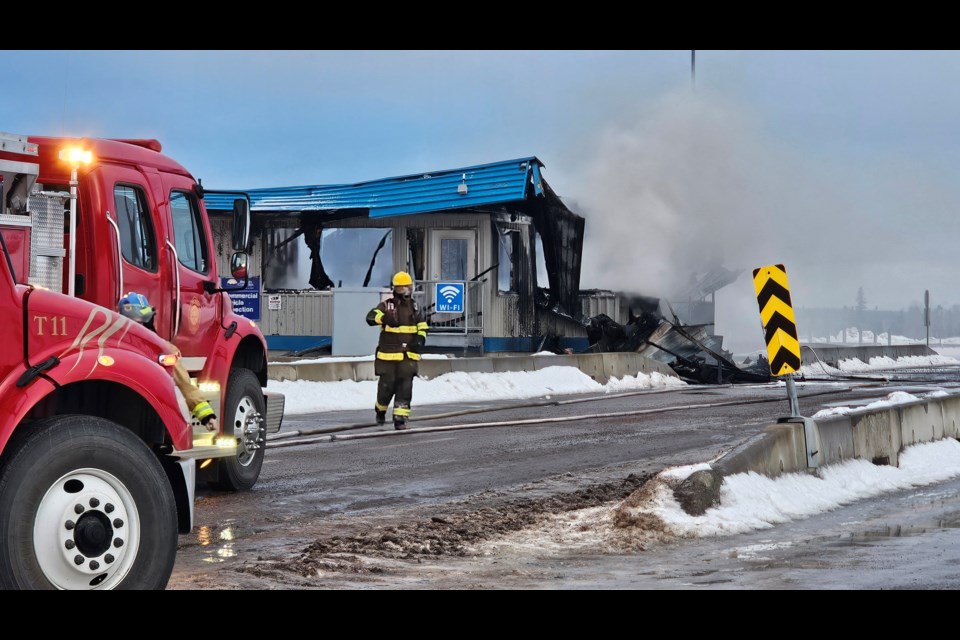
On the morning September 26th four vehicles were severely damaged as well as buildings nearby in an arson attack in Terrace BC.

With a little investigation we realized the vehicles attacked belong to McElhanney a company with a large portfolio providing surveying, engineering, GIS & remote sensing, landscape architecture, environmental services across western Canada. Near Terrace, McElhanney is working on the controversial PRGT pipeline, which has seen resistance via occupations and blockades. Further south the company has used GIS data to help plan work for the controversial TMX pipeline.
Continue reading Arson attack in Terrace BC (Canada)

Colorado Broadband Outages Being Blamed on Vandalism, Fires (USA)

On Sunday, Denver-area broadband customers from multiple companies experienced outages that the companies are blaming on fires and vandalism.

Chris Schroll lives in Parker and was impacted. His service is back but he received an email from BAM Broadband that said in part:

“We have been given more information from our upstream carrier regarding the damage and we wanted to share this with you. It has been reported that the cause of the outage was vandalism. Handholds/Manholes have been lit on fire randomly across the state for a few days and happened again last night along I-225.”

Continue reading Colorado Broadband Outages Being Blamed on Vandalism, Fires (USA)

Berg (Germany): incendiary attack on a wind turbine

On Sunday night, September 9, the waxing moon had just formed its first quarter over Lake Starnberg, some twenty kilometers southwest of Munich. Was this enough for the fish to discern the thick smoke coming from the wind farm that has been standing for ten years in the forest above the village of Berg, on the right bank of the lake? In any case, they won’t breathe a word to the investigators from the Upper Bavarian Criminal Investigation Department, tasked with solving the arson attack on one of the giants planted there at around 3am. Firstly, as a matter of dignity. Secondly, as a matter of principle, the limpid waters of the Ice Age have seen many others, such as the lifeless body of King Ludwig II, or the first summers of his cousin “Sissi”, before she was lightened of her burden on the shores of another lake by the sharpened blade of an anarchist.

What happened on that cold autumn night in the forest between a freeway and the eastern shore of Lake Starnberg? According to Bürgerwind Berg GmbH, the engineering office in charge of technical support for the Alpine wind farm operator, a first warning message was sent to them by the safety sensors on a wind turbine, followed by a second at around 3:59 a.m., which recited in code: “smoke in the nacelle”. In other words, in the machine room, some 150 meters up on the rotor side. The facts became much simpler as soon as the sleuths were able to get to the scene. According to the police report, unknown persons attacked the massive door of the wind tower with an angle grinder, cutting an opening of “40 by 60 centimetres”, before introducing “previously ignited objects” inside the structure.

Continue reading Berg (Germany): incendiary attack on a wind turbine

Munich (Germany): sabotaging the concrete industry…

Around 3 a.m. on Sunday night, September 2, employees of a small company called the fire department to report a fire at their neighbor’s premises. Their neighbor, in the Detmoldstraße industrial park to the north of Munich, is none other than a huge factory: the Max Bögl Concrete Plant, which has been covering the world in its filth since 1929 and, according to its own figures, employs 6,500 people at 40 sites worldwide.

On site, the firefighters were quickly dismayed. The flames were engulfing the production site in various places. On one side, six concrete transport trucks were ablaze, on the other an excavator, and finally, high in the sky, the company’s conveyor belt lit up the night. Despite the general alarm sounded by the first firefighters, who were joined by some fifty colleagues, the fire continued to spread, and the conveyor belt fire eventually reached the top of the mixing silo, starting to eat away at it, at the same time as several blocks of compressed cardboard from a nearby waste disposal site began to smell a bit scorched. It wasn’t until 6.30 a.m. that the sabotage against the concrete plant, which caused millions of euros worth of damage, was finally extinguished.

Continue reading Munich (Germany): sabotaging the concrete industry…

On SNCF’s post-sabotage surveillance systems (France)

Sabotage: SNCF takes action to prevent further attacks on the rail network

Le Figaro, September 9, 2024

The sabotage against the railroad tracks on the night before the Olympic Games opening ceremony on July 26 has left its mark on the SNCF. Officially, the rail company prefers to highlight its handling of this XXL attack: within three days, all train traffic had been restored. “435 agents worked 3×8 for three days. The speed with which we were able to return to normal shows the resilience of our network in the face of a very large-scale attack”, says Damien Pallant, Deputy Director General of Safety at SNCF Réseau, which is responsible for France’s railroads. The general public has discovered the fragility of the French network. And, away from the microphones, tongues are wagging within the state-owned company: “We were stunned that several axes of our network were under attack at the same time,” says one of its executives.

A fortnight earlier, the group’s CEO Jean-Pierre Farandou had seemed confident during his visit to the SNCF Réseau Île-de-France supervision center. The head of this operations center, nestled somewhere in the Gare du Nord, had presented him with a reassuring system where 25 people working in 3×8 shifts, 7 days a week, monitored the state of the network on computer screens. With 50% of equipment fitted with sensors (rails, catenaries, etc.), they were immediately informed of any faults. And that’s not even mentioning the measures intended to thwart malicious acts on these installations. For this, SNCF Réseau felt it was already doing a great deal: anti-intrusion devices on signal boxes, protected electrical transformers…
Continue reading On SNCF’s post-sabotage surveillance systems (France)

Sardinia (Italy): green capitalism under fire again

On September 9, on the occasion of attacks on industrial wind turbines in Mamoiada and Villacidro, we published a short summary of mobilizations against “energy speculation” in Sardinia, with some details about the two sabotages at the end of August.

As it happens, the series didn’t stop there, as a third occurred shortly afterwards against one of the countless “green” nuisances being installed on the island. On the night of Monday to Tuesday, September 11, at around 4 a.m., in the Garganu area near Tuili in the south of the territory, two thousand photovoltaic panels were completely destroyed after being sprayed with petrol and then set alight. The panels had been stored at the site for use by Polish energy multinational Greenvolt Power.


Continue reading Sardinia (Italy): green capitalism under fire again

Sardinia (Italy): the price of green capitalism

In Sardinia, as in many other parts of Europe, energy projects to feed green capitalism have been proliferating for several years. In these sunny and seaside regions, already infested by mass tourism, these are mainly solar and wind farms.

On this Mediterranean island off the coast of Corsica, monsters of steel and cement must be built at all costs, even if it means uprooting olive, apricot and almond trees by force, to be replaced by huge industrial wind turbines with masts up to 200 meters high. Nearly 800 new “renewable energy production” projects are officially being studied, some of which are symbolic of all the others, such as that of the Chinese multinational Chint, which in April 2024 purchased over a thousand hectares in the north of the island (at Nurra), in order to build the largest solar farm ever conceived in Europe. Faced with growing citizen protests, ranging from local committee demonstrations to picketing the port of Oristano in an attempt to block the arrival of a shipment of wind masts, and arguing in particular for the landscape and the fact that Sardinia cannot continue to be ravaged in this way just to export so-called “green” energy to the mainland, the region’s president soon found herself faced with a dilemma.
Continue reading Sardinia (Italy): the price of green capitalism