Night Owls #4: Winter’s Embers
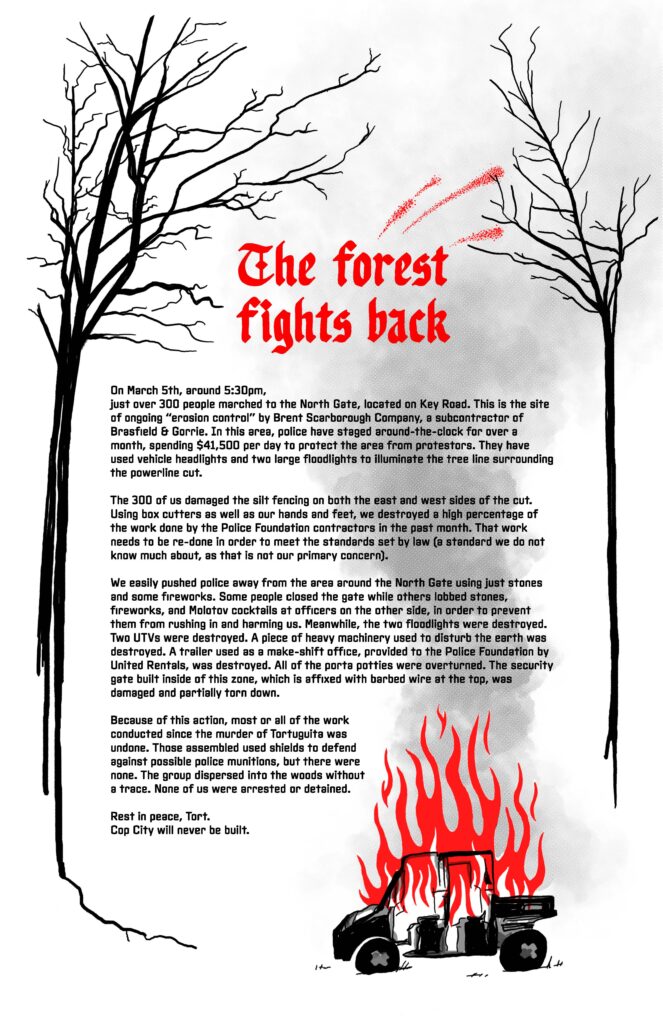 Download action poster: Print – Tabloid [For a Risograph]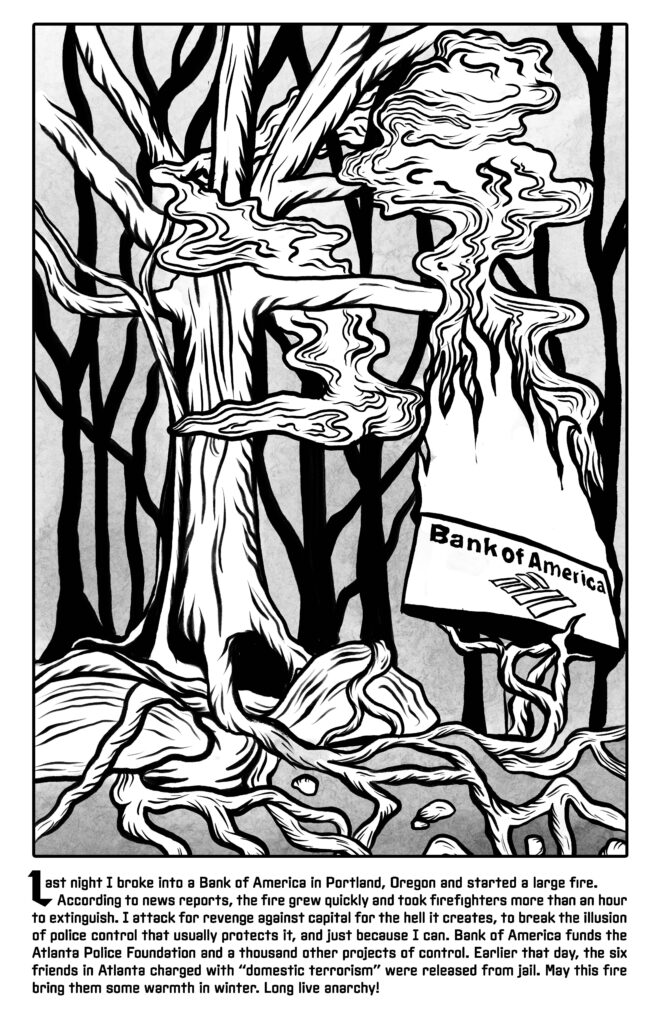

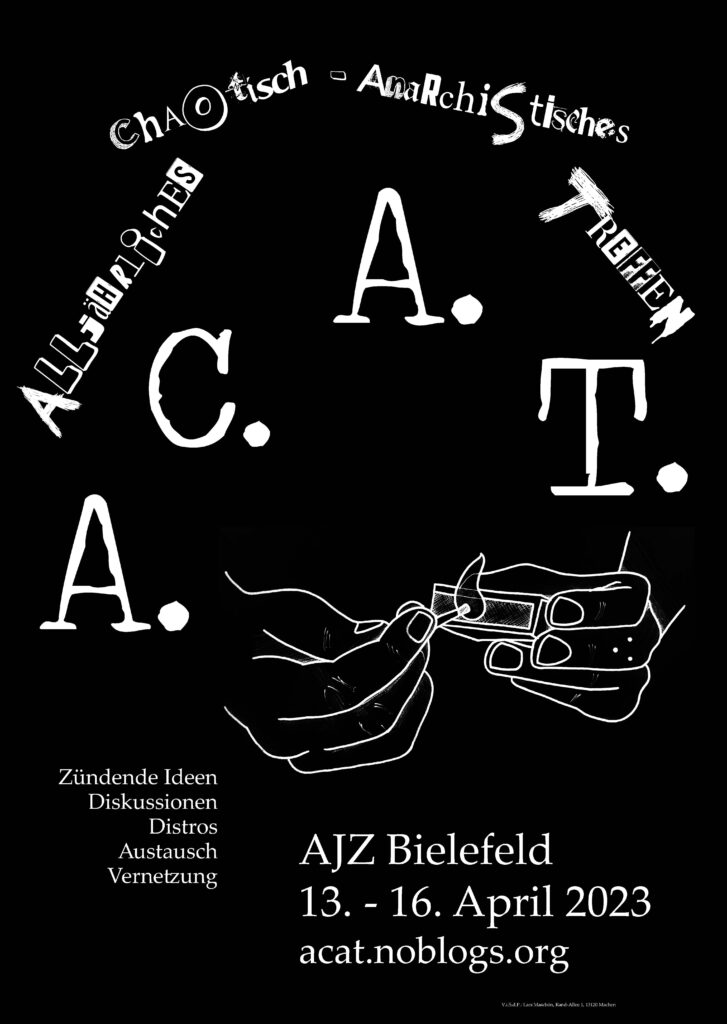
We want anarchy. We want freedom and autonomy for all without domination and borders. We want the subversion of the existing. We want social revolution.
So that our will and our ideas won‘t stay phrases without content, we have to confront ourselves with the surrounding reality—that is, with those conditions and this world in which we‘re forced to live here and now.
That‘s why we create a public space, to come together, meet each other and start to talk to one another.
We want to discuss. In bigger and smaller sessions, with new faces and known ones.
Where are we? How ought we struggle? Where to intervene, without compromise, organisations and without getting trapped in politics? And with whom? What does it mean to talk about revolt, insurrection and social revolution in a world striving for the abyss on the one hand and turning a digital prison on the other?
The meeting will take place from the 13th to the 16th of April 2023 in Bielefeld.
All anarchists, wild hearts, free spirits, subversives, and rebels recognizing themselves in this invitation are welcome.
There will be sleeping spaces and food. The number of sleeping spaces isn’t infinite. The earlier you let us know you are coming, the better. Additionally, there are parking spaces close by for those who bring their vans to sleep.
You will find a detailed program and more information in March on this blog: https://acat.noblogs.org/
Email: acat[ät]supernormal.net
So far, we have been considering the following topics:
• anarchist perspectives on war • recuperation of struggles by political parties, organisations, and other authoritarian sects • anarchist perspectives and interventions in social struggles (i.e. youth revolts) • social revolution in the face of dystopian conditions • anti-patriarchal struggles • dealing with repression, prison, and persecution • struggles against the digital enclosure of the world
In the meantime, there will be a lot of space to hang out an get to know each other. Bring your distros!
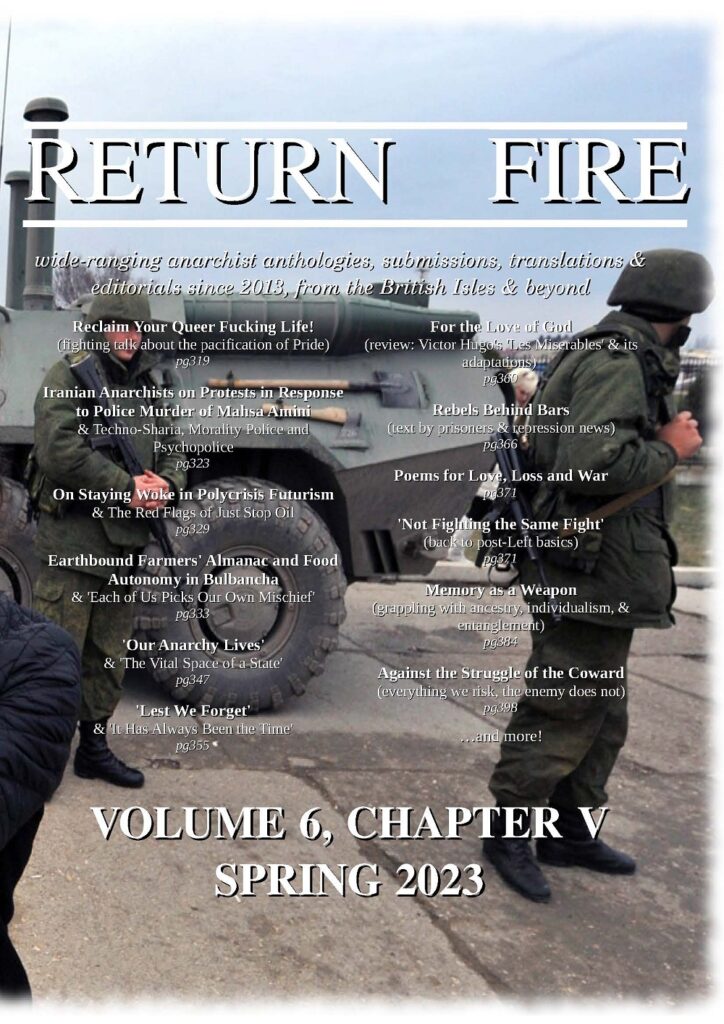
Return Fire vol.6 chap.5 out (with supplement), chap.4 graphics fixed, new texts & posters & flyers in archive
Hi comrades,
Here’s the latest chapter of Return Fire vol.6; chap.5, and here’s a separate version of the covers if printing yourself. Contents:
Reclaim Your Queer Fucking Life!
(fighting talk about the pacification of Pride)
Iranian Anarchists on Protests in Response to Police Murder of Mahsa Amini
& Techno-Sharia, Morality Police and Psychopolice
On Staying Woke in Polycrisis Futurism
& The Red Flags of Just Stop Oil
Earthbound Farmers’ Almanac and Food Autonomy in Bulbancha
& ‘Each of Us Picks Our Own Mischief’
‘Our Anarchy Lives’
& ‘The Vital Space of a State’
‘Lest We Forget’
& ‘It Has Always Been the Time’
For the Love of God
(review: Victor Hugo’s ‘Les Miserables’ & its adaptations)
Rebels Behind Bars
(text by prisoners & repression news)
Poems for Love, Loss and War
‘Not Fighting the Same Fight’
(back to post-Left basics)
Memory as a Weapon
(grappling with ancestry, individualism, & entanglement)
Against the Struggle of the Coward
(everything we risk, the enemy does not)
…and more!

INTRANSIGENCE (INTRANSIGENZA)
There is nothing more disgusting than executioners when they parade as pitiful defenders of Justice. Nothing is more hypocritical than the statements against capital punishment made by upright State representatives against dictatorial regimes that use it to suppress revolts.
In Iran at least the State has the decency to take responsibility for the deaths of its persecuted, inconceivable for a modern, democratic progressive State, which has far more subtle ways to get rid of them.
After all, why bother to kill the rebels who end up in one’s hands? Better to bury them alive in a concrete hole where time and the resulting physical and mental decomposition will take care of the rest. Provided that they do not rehabilitate, of course, which would mean them surrendering their conscience to become dissociated and collaborators. How many, in Italy alone, even if with different experiences, are in the same condition? And let it be clear, this does not detract from the brutality perpetrated against those who see their freedom and dignity taken away, for a short or long period, within the aseptic perimeter of a prison, suffering torture of all kinds by honest champions of order, family men and sons of the homeland.
Continue reading INTRANSIGENCE TAKEN FROM THE DARDI n°11 – Foglio anarchico aperiodico (Italy)
The final issue of Storm warnings, anarchist bulletin for the social war, issue 59-60(December 2022) came out. It is the full English translation of Avis de Tempêtes.
 Storm warnings, issue 59-60 (December 15, 2022) :
“To conclude, if it has always been a pleasure to write and elaborate each issue of this bulletin, we must also say that after five years, the desire to put an end to it has arrived. A certain weariness in seeking to ensure this regularity, the sometimes difficult lack of feedback or intertwined debates,
the observation of a redundancy in our ways of approaching the vast questions of action, certainly also the limits of the instrument itself, are all elements that contributed to our decision to conclude this experience of Storm Warnings. Such a decision might seem paradoxical, knowing that
the interest and need we feel for such spaces of reflection and elaboration are still alive, but the instrument we have forged over the years does not lend itself to a new start or a new format. It seemed to us more appropriate to make it disappear, so that other projects could see the light of day.”
——
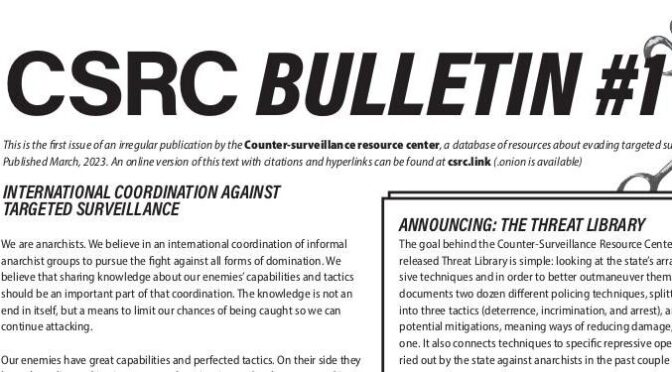
(de) CSRC Bulletin
——
(fr) CSRC Bulletin
In this issue:
What Went Down
2023, Baby!
A-Space: A Postmortem
Tag Yourself
The Fatigue of Novelty
Powering Down Domination
Here Lies a Corpse
A Response to: ‘The Forest in the City’
Letter from Alfredo Cospito
 PDF ENGLISH CLICK ON IMAGE:
A brief overview of modern forensic linguistics methods for determining authorship.
The following article tries to give an overview from a non-technical perspective and to make a corresponding evaluation. There are some academic publications on this topic that could be evaluated for a better assessment. However, my main purpose here is just to raise the issue, not to provide a sound and conclusive view so if you know anything more, publish it!
Avoiding traces that could be your undoing down the road – perhaps even after years or decades – is probably of interest to most people who occasionally commit a crime and come into conflict with the law. Avoiding fingerprints, avoiding DNA traces, avoiding shoe prints and textile fiber traces or at least disposing of clothing afterwards, avoiding surveillance cameras, avoiding tool traces, avoiding recordings of any kind, recognizing surveillance, etc. – all this should be a concern for anyone who commits crimes from time to time and wants to protect themselves from identification. But what about those traces that often arise only after a crime has been committed, out of the urge to explain one’s deed anonymously or even by using a recurring pseudonym? When writing and publishing a communiqué?
Four and one hundred and fifty
“Dear Teacher my son cannot register for the Balilla [fascist youth organisation] we are poor and we do not need hate”.
A man wrote this message to his son’s teacher in the 1930s, a message that could still be written today. We do not need hate. Not the hatred concealed in the language of the State, that which kills with the coldness of bureaucracy, which justifies even the greatest infamy. A language that we do not even pay any attention to anymore, so addicted are we to listening to it uninterruptedly without reflecting on its real meaning. The language that describes the man with a different skin colour to his own, if poor, as ‘residual load’, waste to be sent to the dump. A language that nothing will alter, not even the tiny bodies of dead children lined up side by side, because in the end even that accountancy is, for many, just a bureaucratic question. It is a question of numbers that will soon be filling up tomorrow’s statistics, not of poor unfortunates who drowned while they had hope in front of their eyes: four days at sea and the coast only 150 metres away. But the linguistic severity of bureaucracy does not give a damn about poor unfortunates. It doesn’t ask how long a night spent rigid with terror is. It doesn’t care if a journey can cost a life, because it travels by State flights.
Yet that language does not come asepticly from nowhere, it is the expression of a very specific way of thinking: that of Domination, which in turn is embodied in men and women with faces, not just in words that hurt.
Continue reading Four and one hundred and fifty – Quattro e centocinquanta
 Weelaunee – the Zone to Defend
Actforfree receive and spread:
LITTLE TURTLE CARRIES THE WORLD
01 THE OUTSIDE
None of us wanted to wake up on January 18th to the news that a forest defender in Atlanta’s Weelaunee Forest named Tortuguita, known to the Law and its death system as Manuel Teran, had been murdered by police during a morning raid. It was the last thing that we wanted to hear. Tears came to my eyes while reading the news of their killing before their name and picture had been released, and later after seeing an image of them glowing, smiling, luminously full of life I thought of how much more devastated I would feel if I had known Tortuguita, if I had heard their voice, felt the warmth of their presence, knew them as a friend, as a fellow anarchist and a comrade, how utterly broken my heart would be if they were my child, if I had raised them lovingly and spoke to them almost every day on the phone, as their mother Belkis had.
The deeply symbolic nature of Tort’s murder by some trigger-happy cops also immediately struck me, containing a cosmological metaphor illustrating the meaning of our times – a young forest defender named Little Turtle, by all accounts a gentle and dignified soul who took their name to honor the celebrated indigenous Miami warrior who lead a confederacy of Native fighters to victory against the US Army in 1791, born while the Sun passed through the astrological sign Taurus, which is believed by some to be the sign most deeply associated with our home planet, Earth, is shot down in cold blood for blocking the construction of a hated police training facility and defending the land of this continent which is said by many Native peoples to be carried on the back of a turtle through the universe. Turtle Island. Time and the meaning it contains sometimes flows like a river, sometimes encircles us like the tides of an infinite sea, and sometimes it connects us like the web of an invisible spider, the strands of which, when plucked like the strings of a harp, create transcendent and unforeseen resonances. There are no coincidences.
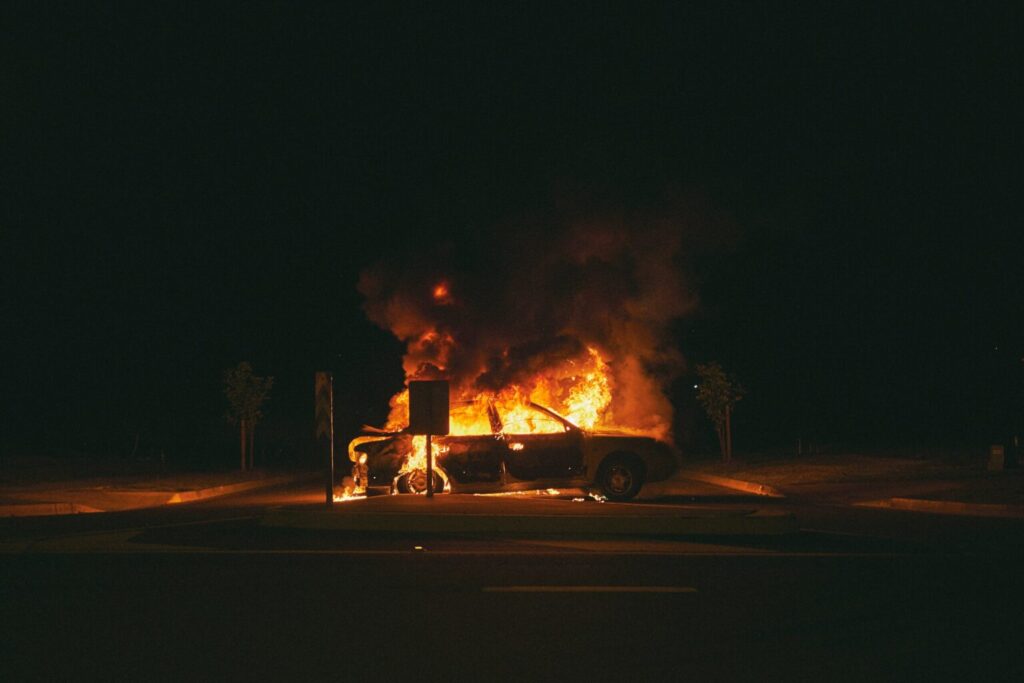
For those of us aligned with the defense of the Weelaunee Forest the grief quickly turned to anger, burning rage, vast and terrible like the black hole said to be at the center of our spinning galaxy. The call went out – they would have wanted fierce and direct action against those responsible. In addition to an unknown number of beautiful public and private memorial rituals in the weeks since then, there has also been a massive wave of rituals of another kind: attacks and acts of sabotage against police infrastructure as well as contractors working with and financial institutions funding Cop City – the forces working to bring their hellish and widely hated training facility into our world. Images and stories of the riot which followed Tort’s murder in Atlanta and the damaged facade of the Atlanta Police Foundation girded our spirits, the widely broadcast picture of a burning police SUV serving as a fitting memorial to the fallen comrade.
Continue reading LITTLE TURTLE CARRIES THE WORLD FEBRUARY 2023
 (Social peace)
The State is weak
The decision of the supervisory court in Rome’s made public on 19 December confirming the detention of the anarchist Alfredo Cospito under 41 bis is in fact a death sentence in view of the comrade’s decision not to break the hunger strike to the bitter end that he began on 20 October. The State is flexing its muscles and preparing for the showdown. Its motto could be summed up as kill one to arrest one hundred, aiming at the liquidation of the anarchist movement, at least that of our generation. What it is actually giving is proof of is its weakness. We have been telling ourselves for two months that this is not the time for analysis and reflection, that the situation is urgent, that action must be taken. Yet, if it is true that for anarchism theory is never separate from practice as they are inextricably intertwined, then perhaps this is precisely the time not to stop and reflect, but to reason while continuing to act.
In a nutshell. We believe that the Italian State has made a big mistake by deciding to apply 41 bis to an imprisoned anarchist for the first time. This mistake has led to the occurrence of the largest mobilisation of denunciation and struggle, concrete and international, against the 41 bis since this infamous regime of annihilation and torture was inaugurated in 1992. This movement is not led by sincere democrats, but is driven in its propulsive essence by the individual action of an indomitable comrade, who is risking his own life in this struggle, and by the many actions and initiatives, individual and collective, of an anarchist movement that has been able to regain its anger and vitality.
In the face of all this, paradoxically, today the State might consider that – since the mistake has now been made and it will have to be paid for – killing Alfredo Cospito could be the least painful option.
The alternative would be defeat and having to take a major step backwards, not least because the international anarchist movement does not, for its part, promise to take steps backwards in exchange for the life of a comrade. Anarchism is not bartering (nor could it ever), a kind of disarmament in exchange for Alfredo’s declassification. Thus the State has no guarantee that the anarchists will stop. On the contrary, it fears they will be invigorated by a victory against 41 bis.
It is a risky bet. And Alfredo’s life today rolls on the dice of these vile gamblers.
Anarchists in 41 bis: genesis of a political-military
Breakthrough attempt It is spring 2022. The country is supported by the government of Unità Nazionale [National Unity] led by what many believe is the most influential man of the European political and economic elites: Mario Draghi. Social peace is suffocating. On the other hand, there is war, real war, on Europe’s doorstep. The Draghi government, particularly its centre-left component, is a fervent supporter of NATO policy. By far one of the most warmongering governments in the alliance. This causes enormous sacrifices for the population. Draghi knows this well and he knows equally well that social peace is a fragile marriage that can collapse at any moment. Draghi knows this well precisely because, as head of the European Central Bank, he is one of those responsible for the social butchery in Greece.
The homeland of Beccaria? A homeland of gravediggers
So many people are digging for a corpse, but no one takes the responsibility of being the executioner. At the same time, it’s full of gravediggers ready to throw shovels of mud preparing the grave for the anarchist. A confused and dishevelled ballet around the gallows with many bit players: ‘zero tolerance’, institutional blame-game, audience depending changes of course, the spectre of anarchy that keeps the government, or rather the state, ‘under checkmate’, and then the ‘mass-murdering’ anarchists colluding with the mass-murdering mafiosi, with the appearance on stage of the PD [Partito Democratico, “Democratic Party”].
A poorly written and poorly acted theater, a scramble of ignorant ‘experts’, of professional and compulsive liars, of low journalism, sloth and cowardice that does nothing but reveal what is the potential of an individual waging a struggle alone against the state moloch. A moloch, by the way, that by its own makers claim must be very fragile if a few writings on the walls, broken shop windows and a few burnt cars are enough to put it in ‘danger’.
Whichever way you look at it, the struggle of an anarchist thrown into a torture regime has broken the prevailing narrative. Despite the ridiculous attempt to credit him as colluding with (or, even worse, directed by…) the Mafia, despite the ridiculous attempt to misrepresent his acts and words, it would seem that a little critical sense prevails, and that the attempt to undermine his credibility and integrity achieves the opposite effect of bringing out the linear coherence of anti-authoritarians and revolutionaries who continue to defend their ideas and practices without being distracted by the fireworks of post-modern media politics. And that unite, whereas repression would divide.
Continue reading The homeland of Beccaria? A homeland of gravediggers by Anarchist Anna Beniamino (Italy)
via: athens.indymedia.Translated by Act for freedom now!
—————————————————————————
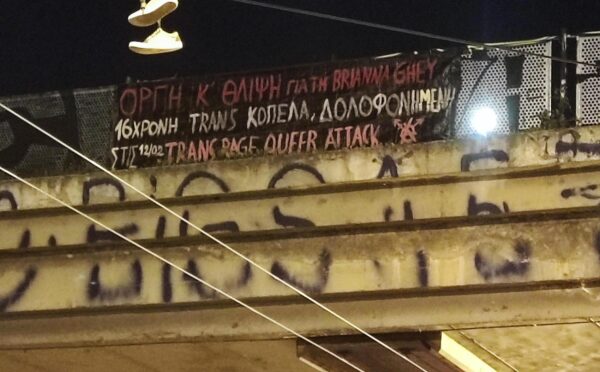
On the murder of 16-year-old transgender Brianna Ghey on 12/02 in Britain
TW: Transphobic violence, murder
On Sunday 12/2, 16-year-old trans girl Brianna Ghey was murdered after a targeted stabbing attack in a public park in England. Cops and mainstream media claim that the evidence is still not enough to call it a transphobic attack. Of course, how can a targeted murderous attack on a trans person not be transphobically motivated?
In the face of the killer we see the two 15-year-olds who have so far been accused of carrying out the vile act of hate, but we also see the mainstream media – true to their role – murdering Brianna again by erasing and concealing her trans identity from the public and using her deadname.
We see the State with its policies trying to pass-and passing-laws that exclude trans people. We see the ever increasing wave of fascism in England, we see the rise of the terfs population making the ground barren for an inclusive feminist solidarity. We see the chronic demonisation of the trans community, exclusion, marginalisation, loneliness, abandonment and disregard, hatred.
Testimonies from friends confirm her traumatic past experience as a transgender individual, as she had been subjected to years of verbal bullying (online and offline), up to physical bullying after being beaten up by a group of her classmates.
We’re here again after this hot winter! Still a time of war, climate-struggle/destructivity/pessimism/idealism, repression, technology and an online mirror-world, farmers, arsonists and uprisings trough out the world.
Not all of this could be captured in this little big pocket-sized RUMOER, but some found its way in.
We do like to spread this zine for free, not just by mail or in social spaces, but also on the streets and
events. This does cost money…If you can, donate lots:
BIC: INGBNL2A NL75 INGB 0004253090 in the name of ITHAKA in Utrecht, in the description RUMOER.
You can order paper versions by sending an email to rumoer at riseup dot net.
Enjoy the reading and see you soon! XXX RUMOER
via: ilrovescio.info
Clandestine humanitarian
Chatting in pleasant company during a dedicated theme evening, it had been assumed that the institutional solution to get out of the cul de sac into which the established order has stubbornly slipped while awaiting entry into play of Cartabia [ex-minister of justice] (another wild card that could possibly be used) with dignity (in their opinion), could only lean towards a humanitarian one. To save ass and face without putting the failure of the hard line and the power of the State in question, in the hope that it will work, downplaying responsibility and guilt and illustrating pietas to gain points now in free fall, at least in the eyes of outsiders.
The entry of the fire brigade was quite obvious given the incorruptibility of Alfredo; the issue was the timing, a petty battle that will presumably be taken to the extreme in order to build the possible above-mentioned construction by not asking the right questions and allowing the facial plasticity of all the institutions involved, who are now struggling to stay afloat in that sea they had deluded themselves into thinking they were damming up and which is becoming more and more impetuous.
Today newspapers inform us that another collection of signatures bearing 38 names of distinguished firefighters of the last hour has been forwarded to Carlo Nordi and to the government to ask for a “gesture of humanity and courage” for Alfredo.