È disponibile, da oggi, il numero 0 di “Su Nudha” – Foglio Anarchico Sardo. (A-periodico)
Category Archives: General
EN/ES/FR/ GR / POSTER SABOTAGE: We can fight the war. Not by being soldiers, but by being saboteurs. Directly, by attacking the war industry that makes war possible.
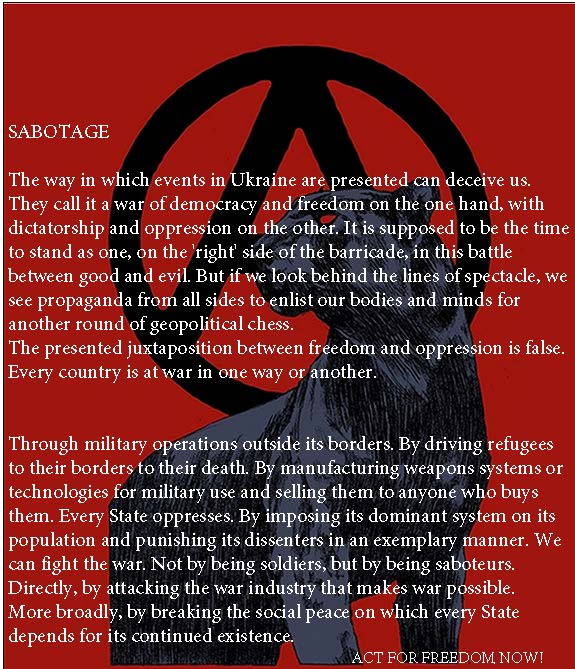
SABOTAGE
The way in which events in Ukraine are presented can deceive us. They call it a war of democracy and freedom on the one hand, with dictatorship and oppression on the other. It is supposed to be the time to stand as one, on the ‘right’ side of the barricade, in this battle between good and evil. But if we look behind the lines of spectacle, we see propaganda from all sides to enlist our bodies and minds for another round of geopolitical chess. The presented juxtaposition between freedom and oppression is false. Every country is at war in one way or another.
Through military operations outside its borders. By driving refugees to their borders to their death. By manufacturing weapons systems or technologies for military use and selling them to anyone who buys them. Every State oppresses. By imposing its dominant system on its population and punishing its dissenters in an exemplary manner. We can fight the war. Not by being soldiers, but by being saboteurs. Directly, by attacking the war industry that makes war possible.
More broadly, by breaking the social peace on which every State depends for its continued existence.
SABOTAJE
La forma en que se presentan los acontecimientos en Ucrania puede engañarnos. Lo llaman una guerra de democracia y libertad por un lado, con la dictadura y la opresión por el otro. Se supone que es el momento de mantenerse unidos, en el lado «correcto» de la barricada, en esta batalla entre el bien y el mal. Pero si miramos detrás de las líneas del espectáculo, vemos propaganda de todos los lados para alistar nuestros cuerpos y mentes para otra ronda de ajedrez geopolítico. La yuxtaposición presentada entre libertad y opresión es falsa. Todos los países están en guerra de un modo u otro.
Mediante operaciones militares fuera de sus fronteras. Conduciendo a los refugiados a sus fronteras hasta la muerte. Fabricando sistemas de armas o tecnologías de uso militar y vendiéndolos a quien los compre. Todo Estado oprime. Imponiendo su sistema dominante a su población y castigando ejemplarmente a sus disidentes. Podemos luchar contra la guerra. No siendo soldados, sino siendo saboteadores. Directamente, atacando la industria bélica que hace posible la guerra.
Más ampliamente, rompiendo la paz social de la que todo Estado depende para seguir existiendo.
anarquia.info
Royaume-Uni : Sabotage
La manière dont sont présentés les événements en Ukraine peut nous induire en erreur. Ils la décrivent comme une guerre avec d’un côté la démocratie et la liberté et de l’autre côté la dictature et l’oppression. Apparemment, le moment serait venu de rester uni.e.s, du « bon » côté de la barricade, dans cette bataille entre le bien et le mal. Mais si on regarde derrière les lignes du spectacle, on voit de la propagande venir de tous les côtés, afin d’enrôler nos corps et nos esprits dans une nouvelle partie d’échecs géopolitique. La juxtaposition qui est présentée, entre liberté et oppression, est fausse. Chaque pays est en guerre, d’une manière ou d’une autre.
Par des opérations militaires à l’extérieur de ses frontières. En repoussant les réfugiés aux frontières, vers la mort. En fabriquant des systèmes d’armement ou des technologies à usage militaire et en les vendant à quiconque veuille les acheter. Chaque État opprime. En imposant son système dominant à sa population et en punissant de manière exemplaire les dissident.e.s. Nous pouvons combattre la guerre. Non pas en étant des soldats, mais en étant des saboteur.euse.s. Directement, en attaquant l’industrie de l’armement, qui rend la guerre possible.
Plus largement, en brisant la paix sociale dont dépend l’existence perpétuelle de tout État.
Act for freedom now!
attaque
ΣΑΜΠΟΤΑΖ
Ο τρόπος με τον οποίο παρουσιάζονται τα γεγονότα στην Ουκρανία μπορεί να μας εξαπατήσει. Το ονομάζουν πόλεμο της δημοκρατίας και της ελευθερίας από τη μία μεριά, με τη δικτατορία και την καταπίεση από την άλλη.
Υποτίθεται πως είναι η στιγμή να σταθούμε σαν ένα, από τη ¨σωστή¨ πλευρά του οδοφράγματος, σε αυτή τη μάχη μεταξύ καλού και κακού. Αλλά εάν κοιτάξουμε πίσω από τις γραμμές του θεάματος, βλέπουμε προπαγάνδα απ΄όλες τις πλευρές να επιστρατεύσουμε τα σώματα και τα μυαλά μας για έναν ακόμη γύρο στο γεωπολιτικό σκάκι. Η παρουσιαζόμενη αντιπαράθεση μεταξύ ελευθερίας και καταπίεσης είναι ψευδής. Κάθε χώρα είναι με τον έναν ή τον άλλο τρόπο σε πόλεμο.
Μέσω στρατιωτικών επιχειρήσεων εκτός των συνόρων της. Οδηγώντας τους πρόσφυγες στα σύνορά της ως το θάνατο. Κατασκευάζοντας οπλικά συστήματα ή τεχνολογίες στρατιωτικής χρήσης και πουλώντας τα σε οποιονδήποτε αγοράζει. Κάθε κράτος καταπιέζει. Επιβάλλοντας στον πληθυσμό του το κυρίαρχο σύστημα και τιμωρώντας παραδειγματικά τους αντιφρονούντες του.
Μπορούμε να πολεμήσουμε τον πόλεμο. Όχι όντας στρατιώτες, αλλά όντας σαμποτέρ. Άμεσα, επιτιθέμενοι στην πολεμική βιομηχανία που κάνει τον πόλεμο εφικτό. Ευρύτερα, σπάζοντας την κοινωνική ειρήνη, στην οποία βασίζεται κάθε κράτος για τη συνέχιση των κινήσεων του.
https://athens.indymedia.org/post/1617530/
Police raided the Bublina squat in Prague (Czech Republic)
On Wednesday, 9 of March 2022, police raided the Bublina squat in Prague and conducted a search. Four people, one dog and one cat were in the building and surrounding area at the time. The armed police unit broke down several doors but caused no injuries and no one was charged. The court-approved search warrant was built on the suspicion that one person present had committed violence against a public authority and also damage to property. The raid was said to be intended to help secure evidence of these offences. During the search, which lasted several hours, computers, mobile phones, documents, a gas pistol and spray paint were seized. Then the police left and left the squat unsecured. It was later reoccupied.
The suspicions stated in the protocol relate to several protests that happend last year. These protests were against the brutal police crackdown in which Roma man Stanislav Tomáš died after police officers pinned him to the ground and knelt on his neck for several minutes.
Continue reading Police raided the Bublina squat in Prague (Czech Republic)
Hunger strike of Dimitris Chatzivasileiadis 11-18/3,in solidarity with political prisoners in Greece and Turkey
Actforfree receved by email:
We wish to inform you about the hunger strike the imprisoned anarchist Dimitris Chatzivasileiadis is doing from 11/3 to 18/3, in solidaritywith political prisoners in Greece and Turkey, on the occasion of the visit of Greece’s prime minister to Istanbul on 13/3. Please spread this news through your networks.
Here follows the announcement in Greek, English and Turkish:
[GR]
Απεργία πείνας του Δημήτρη Χατζηβασιλειάδη 11-18/3 : Αλληλεγγύη με τους πολιτικούς κρατούμενους σε Ελλάδα και Τουρκία Στις 13 Μάρτη θα συναντηθεί ο Μητσοτάκης με τον Ερντογάν. Η κυβέρνηση Μητσοτάκη πριν 2 χρόνια ακριβώς, στις 19 Μάρτη 2020, φυλάκισε 11 επαναστάτες από την Τουρκία, ως αντάλλαγμα για το κλείσιμο των τούρκικων
συνόρων στους μετανάστες. Οι 11 συναγωνιστές καταδικάστηκαν από ελληνικό δικαστήριο αποκλειστικά με βάση την ευρωπαική λίστα «τρομοκρατίας», συνολικά σε 333 χρόνια φυλάκισης. Στην προηγηθείσα συνάντηση του Τσίπρα με τον Ερντογάν, στις 4 Δεκέμβρη 2017, η ελληνική κυβέρνηση δώρισε στο τούρκικο φασιστικό καθεστώς, τη φυλάκιση 9 αγωνιστών που βασανίστηκαν κατά τη σύλληψή τους και απελευθερώθηκαν μετά από 18 μήνες. Το ελληνικό και το τούρκικο κράτος είναι καλοί συνεργάτες ενάντια στην επαναστατική πάλη των λαών. Το ελληνικό και το τούρκικο κράτος είναι συνέταιροι στην πρώτη γραμμή του ΝΑΤΟϊκού ιμπεριαλισμού. Η τούρκικη στρατοκρατία αποτελεί την αιχμή της ΝΑΤΟϊκής τρομοκρατίας στη Μέση Ανατολή, τη Μεσόγειο και τη Μαύρη Θάλασσα. Continue reading Hunger strike of Dimitris Chatzivasileiadis 11-18/3,in solidarity with political prisoners in Greece and Turkey
Welcome to the 53rd edition of B(A)D News: Angry Voices From Around The World, for February 2022
Episode 53 (02/2022)
Welcome to the 53rd edition of B(A)D News: Angry Voices From Around The World, for February 2022. A commonly produced monthly show of the anarchist and anti-authoritarian radio network, this time edited by Anarchist Radio Berlin.
Check out all the shows. Look for the a-radio-network collection on archive.org or at our website, a-radio-network.org.
In this Episode we will hear contributions from:
1) Črna Luknja radio show collective on Radio Študent in Ljubljana, Slovenija prepared a piece out of a full interview they did with an anti-racist activist in Brazil.
2) Frequenz A from Leipzig on the repression against a group of 14 year old anarchists in Sibiria who threatened to blow up a virtual FSB Building in a virtual game.
3) Free Social Radio 1431AM, Thessaloniki gives us an update about the recent threats from the anti-terror police against an anarchist action group in Thessaloniki.
4) Anarchist Radio Berlin translated an interview with a person involved in the struggle for legal abortion in Poland after the death of a pregnant person whose acces to abortion was denied.
You can directly download it from archive.org here
Italy – The book I Giustizieri – Propaganda del fatto e attentati anarchici di fine Ottocento [The Avengers – Propaganda by the deed and anarchist attacks at the end of the nineteenth century] has been reprinted
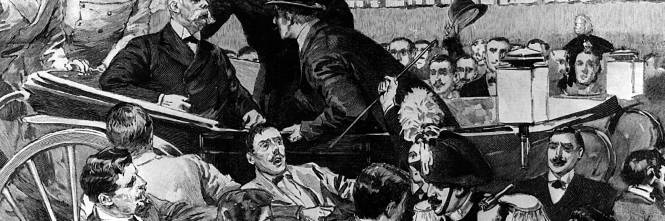
The reconstruction of the archive of Edizioni Monte Bove continues. We are glad to communicate the reprint of the book I Giustizieri – Propaganda del fatto e attentati anarchici di fine Ottocento by Gino Vatteroni.
Following raids on 11th November, computers were seized and layout programs and original files were lost, so what we are presenting here is not a second edition, but the exact reprint of the book of 2018. 10 euros per copy, 6 euros for distributors.
Here is a short presentation:
From Giovanni Passannante to Gaetano Bresci, twenty years of vengeance, individual and class vengeance. Not just a chronological and encyclopaedical collection of anarchist attacks on the lives of the tyrants, which terrorized governments at the end of the nineteenth century, but also a necessary analysis of the economic, social and political context in Italy after the unification, also looking at what happened in France in 1894. A war arms in hand declared by a minority of the exploited on the liberal State. Continue reading Italy – The book I Giustizieri – Propaganda del fatto e attentati anarchici di fine Ottocento [The Avengers – Propaganda by the deed and anarchist attacks at the end of the nineteenth century] has been reprinted
February 12, 2022, 300 people demonstrated against the Polish internment camps.(Poland)
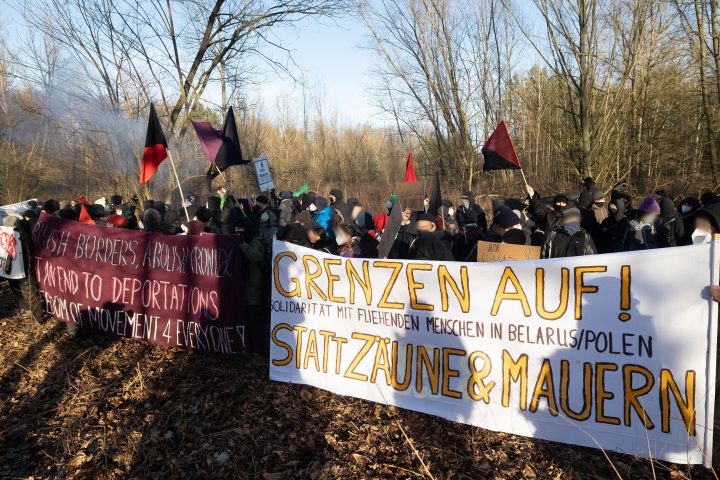
Yesterday, Saturday, February 12, 2022, 300 people demonstrated against the Polish internment camps. Also the coach of Solibus e.v. from Berlin came with about 50 activists* to Krosno Ordzańskie, 150km away. Together with German and Polish groups and many individuals, they protested for the freedom of movement of refugees and against the conditions in all arrival centers in the country. There were speeches by various groups and letters from those affected were also read out in several languages.
With drums, banners and chants, the demonstrators gathered in front of the camp in Krosno Ordzańskie, where currently about 100 people are detained in a former barracks. These are people who made headlines at the turn of the year on the Polish-Belarusian border because they became pawns of Lukashenko’s, Poland’s and the EU’s policies. In the meantime, we know that at least 21 people died at this border, some of them froze to death. Continue reading February 12, 2022, 300 people demonstrated against the Polish internment camps.(Poland)
To block Greece’s participation in the imperialist wars
 English translation of our collective’s text regarding the situation in Ukraine and Greece’s involvement. It is our duty to work against Greece’s participation, and to build international struggles against the war, against all capitalist wars. (You can find the text in pdf form as well, in the end of the page).
“Those at the top say:
Peace and war are of different substance.
But their peace and their war
are like the wind and storm.
War grows from their peace, like son from his mother.
He bears her frightful features
Their war kills whatever their peace has left over.”
In the early hours of February 24th Russia decides to invade Ukraine, with coordinated missile attacks and simultaneous raid of the army.
This move marks an escalation of tensions and rivalries in the region, with probably most notable events being the rejection of Ukraine’s 2013 EU accession agreement by then-President Yanukovych -who was pushing for an agenda of closer relations with Russia- and the uprising that followed (also known as the “Euromaidan”), with the active participation of the far right and the support of the Euro-Atlantic bloc, which led to the ouster of the president. The general unrest that prevailed at the time, gave Russia the “opportunity” to invade Crimea and annex it to its territory. It also sparked protests (with the support of Russia) against Euromaidan and the new regime, and riots, culminating in the arson of the Trade Union House in Odessa, in May 2014, by Ukrainian hooligans and neo-Nazis, which led to the horrific death of 42 of people who were burned alive. At the same time, and as separatists declared the Donetsk and Luhansk People’s Republics in eastern Ukraine, the unrest escalated into a war, with more than 15,000 killed, and intensified attacks by Ukraine during the past months.
Continue reading To block Greece’s participation in the imperialist wars
Against War and Military Mobilization – Preliminary Notes on the Invasion of Ukraine
The Russian state is trying to conquer Ukraine. The same Russian state that supported the suppression of the Belarusian freedom movement and only a few weeks ago used tanks to put down the revolt in Kazakhstan. Putin is trying to extend his autocratic rule, crushing any rebellious or resistance movement inside and out. But when now all Western democrats sing the defense of freedom and peace in one chorus, this is an orchestrated hypocrisy: the same democrats now invoke peace whose “peace operations” aka. wars of aggression, drones, bombs and occupations enforce colonial relations of power and exploitation, supply dictators and torturers with weapons and are directly or indirectly responsible for massacres of refugees and insurgents.
The holy peace in Europe, which in any case has not existed as advertised for 70 years and which has always meant war in the global South – through proxy wars, through arms supplies, through borders and colonialism. If the West is fully behind Ukraine, it is because it is an ally. Both sides of this war disgust us: instead of positioning ourselves on one side of this war, we oppose all state armies and their wars – we abhor not only their massacres, but also their blind obedience, nationalism, stench of barracks, discipline and hierarchies. So, if we oppose any form of militarism and state, it does not mean that we think it is wrong to take up arms. If Ukrainian anarchists now choose to defend themselves at gunpoint – themselves and their neighbors, not the Ukrainian state – then we stand in solidarity with them. But an anarchist position against war – even against an imperialist war of aggression – must not degenerate into defending a state and its democracy – or becoming a pawn of it. We do not choose the side of the lesser evil or that of the more democratic rulers – because these same democracies are also only interested in their own expansion of power and are also built on repression and imperialism.
Continue reading Against War and Military Mobilization – Preliminary Notes on the Invasion of Ukraine
Against their war,against their peace for insurrection , freedom and anarchy (UK)
A3 pdf
A4 pdf
AGAINST THEIR WAR- AGAINST THEIR PEACE!
Under our noses the imperialist armies are massing in Ukraine, make no mistake, they are preparing, yet again, for a generalised slaughter. The British Army are already deploying troops and ‘high tech’ weapons, including missile systems to be installed along the Ukrainian coast. The Russian Army are similarly massing thousands of troops along the border, preparing for all out war.
Ukraine is of ‘strategic’ interest in the ongoing energy crisis
engulfing Europe. One set of oligarchs want to place a new pipeline
carrying world-poisoning fuel from Russia to the west. Another set want to frustrate these attempts to profit their own national bourgeousie. In addition to this, the U.S. and the U.K. want to bring Ukraine into ‘Nato’, their gangster-imperialist international formation which dreams only of endless war and plunder, especially now Afghanistan has been looted for all its worth, of fossil fuels as well as its opium (which continues to flood the western cities, the spoils of war!). Russia also has brutal imperialist ambitions, the only way their disgusting government of tin-pot autocrats, thieves and murderers can perpetuate
itself is to redraw the class tension in Russian society into a
nationalistic clash between Russia and ‘the west’.
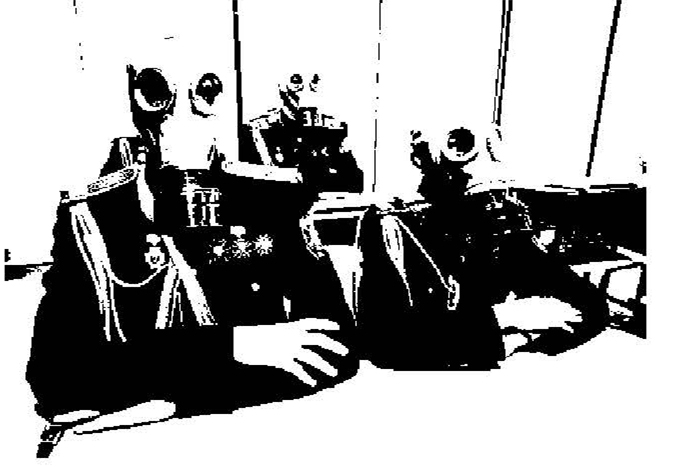
Accordingly, this provides excellent cover for their sponsorship of real state terror, rather than the laughable antics which the british media focusses on, of providing assistance at every level to the grey beuraucrat manikins, all basically interchangable, who run Belarus and Kazakhstan, enriching themselves and those who can bribe them, while using their police to stamp on any sign of courageous upheaval.
Continue reading Against their war,against their peace for insurrection , freedom and anarchy (UK)
Hamburg: anarchist interventions against all wars, borders and states
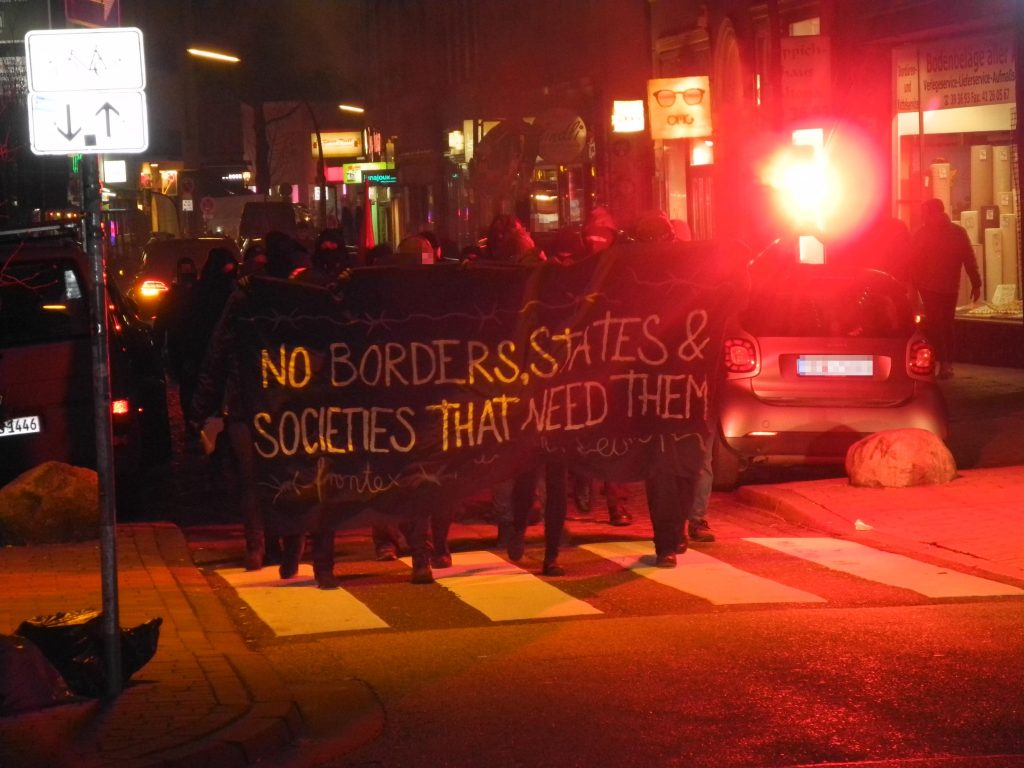
On Sunday 27.02.2022 about 60 people met for an anarchist rally in Arivati Park/Neuer Pferdemarkt Hamburg to take to the streets againstthe war in Ukraine and all militarism.
Banners (“Stop war!( in Russian) -Against the war in Ukraine! Against any war! Against any militarization!) were hung up and a speech was given. An anarchist anti-militarist poster was distributed and a solidarity photo was taken for the anarchist comrades in Ukraine.
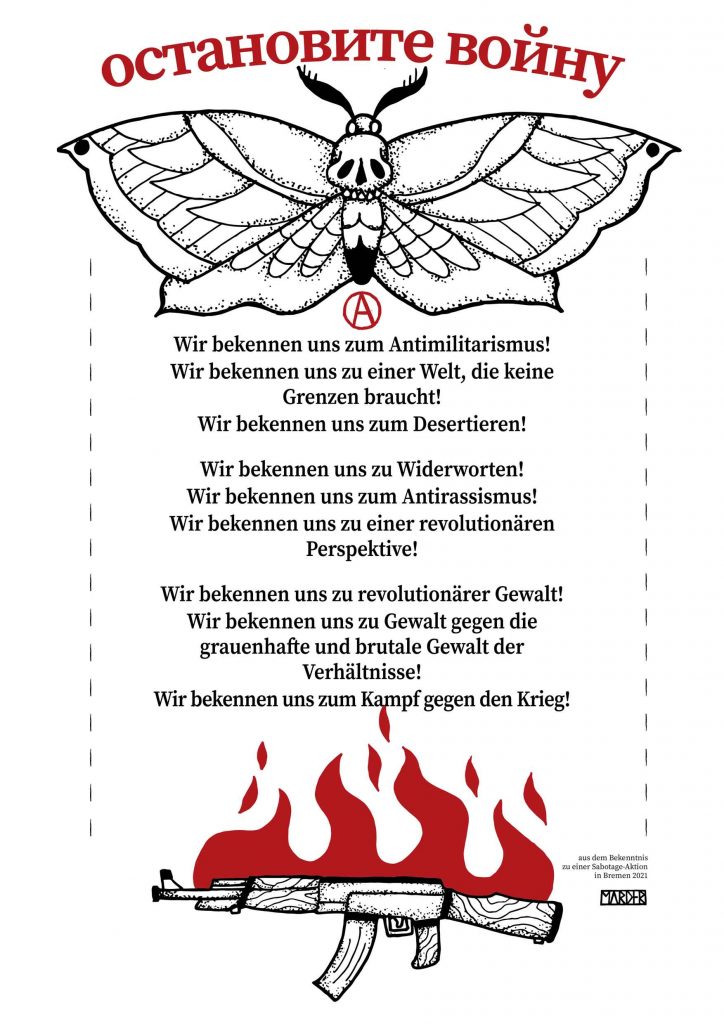
Continue reading Hamburg: anarchist interventions against all wars, borders and states
Italy : Don’t join, sabotage
Italy – Don’t join, sabotage
“It is easy to hit uniformly flying birds.”
Baltasar Gracián, The Art of Worldly Wisdom
One thing is sure. Social peace is increasingly becoming a minefield of disasters. Two years of “war on the virus” did not pass unscathed. War metaphors are never neutral or by chance. In the face of the Enemy, it is necessary to close ranks, speak with one voice and isolate the deserters – as they cannot be shot. Confinements, drones over cities, forests and beaches, a NATO general as extraordinary Commissioner for the Emergency, curfews, green passes, bans on demonstrations in city centres, truncheon blows democratically distributed among logistics porters and any group of dissidents who try to approach an institutional building or a TAV tunnel: the sequence is neither accidental nor improvised. As the streets fill up with uniforms and cameras, bodies must be captured with no exception by the techno-industry and its miraculous products.
The language of power and its TV acrobats is becoming increasingly brutal – we need a Bava Beccaris, you’ll turn into green sludge, let’s organize separate carriages, only those who deserve it will get free treatment…- while the “antagonistic” language finds itself disarmed, forced to defensive premises (if anyone claims that Draghi expresses the interests of international financial capital, they will immediately add that this is not a conspiracy theory view…). Such a condition of submission – and of communication of war, as a technocrat in the mood for clarity put it – seems the ideal context for the international use of the military to bring a piece of Afghanistan inside Europe. Russian army exercises on the border with Ukraine, images of anti-atomic bunkers and voluntary enlistments in Kiev, NATO troops in Romania, Latvia, and the Black Sea. Who can rule out that from diplomatic manoeuvres and threats they will not move on to weapons? The boundary of the interests at stake is jagged. The very expression “Atlanticist and Europeanist camp” in no way defines a homogenous camp because NATO goals break up more or less explicit or unsayable political and economic balances in Europe (regarding the German and French States and not only). The Italian government itself servilely collaborates with NATO manoeuvres, by deploying fighter-bombers in Romania, tanks in Lithuania and aircraft carriers on the Black Sea, but the capitalists of ENEL, ENI, Banca Intesa and Unicredit continue to do business with their counterparts in Moscow. Nobody wants a USA-Russian clash, but States do not go where they want to go but where their power and the structural dynamics of domination and profit on which they are based take them. In the infinite variables, however, there is one constant factor. War – as a set of means that devour their alleged ends – always needs social peace. Therefore it won’t be with refined geopolitical analyses that we will stop the winds of war but by breaking up the home front, sabotaging national unity, making the danger of defeatism be felt. Continue reading Italy : Don’t join, sabotage
Chile: the Mapuche struggle continues under a state of emergency
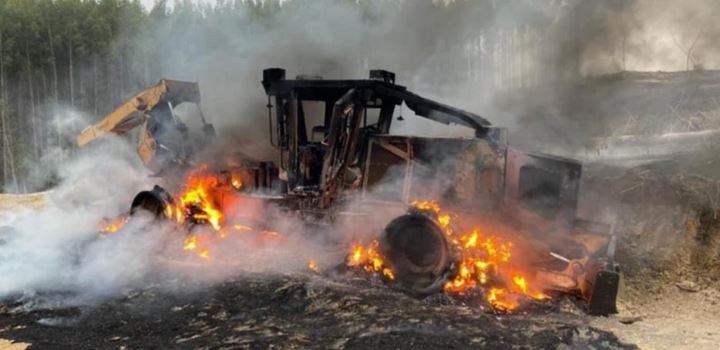 In part of the Mapuche areas, namely the four provinces of Bío Bío, Arauco, Malleco and Cautín, the Chilean state declared a state of emergency on 12 October following the offensive of the struggle groups, which are multiplying land occupations and attacks on forestry interests. This has meant an increase in police roadblocks to prevent people from moving around and, above all, the occupation of the territory by armed forces who have come to reinforce the cops and carabinieri on the ground to protect the resource exploiters. Today, January 27, this state of emergency (called Estado de Excepción Constitucional) has just been renewed for the eighth consecutive time since October by the Parliament, setting its new expiry at February 24.
In an assessment of the first 100 days of this state of emergency at the beginning of January, President Piñera’s government boasted that nearly 56,700 checks on people and vehicles had been carried out in these two regions and 140 people had been imprisoned, resulting in a 44% drop in the number of “incidents of rural violence“. However, one cannot but notice that despite the heavy military occupation, the incendiary attacks, shootings and barricades against the cops have not at all stopped, officially going from 108 in the previous hundred days (July-September) to 89 since October. And even the arrival of the new left-wing leader, Gabriel Boric, who won the Chilean presidential election in December (he will take office on 11 March), has not changed the situation.
Continue reading Chile: the Mapuche struggle continues under a state of emergency
War starts here: Let’s cripple its infrastructure where we can
via Zündlappen
February 6, 2022
It is difficult to judge the current situation in Ukraine from a political point of view. Is the whole thing just the well-known dick comparison, some megalomaniac and war-mongering armies and politicians or will it really come to war? This text leaves such questions aside and devotes itself instead to those questions that make much more sense from our point of view: how can a military conflict, a war, a potential NATO war be sabotaged? It is in the nature of things that this text can at most give a few suggestions and we do not want to present ready-made solutions, but simply put a few ideas into the room.
We publish this text on the Internet because we want to share these thoughts with as many like-minded people as possible, with whom it would be impossible for us to discuss these issues face to face. However, we think that any (strategic) exploration of this debate should not take place on the Internet above all because this merely serves repression but is unlikely to have any added value for those who are also determined to use their creative energy to pursue some of the thoughts raised here.
Continue reading War starts here: Let’s cripple its infrastructure where we can
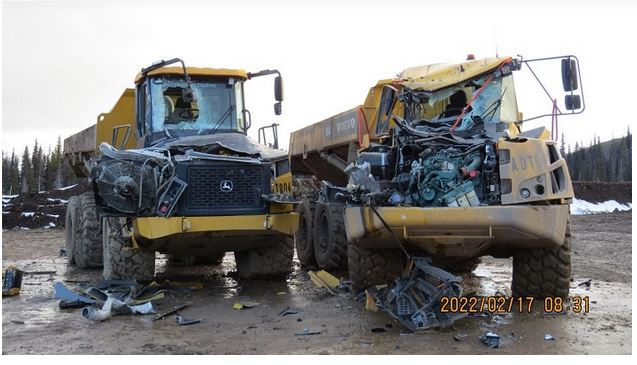
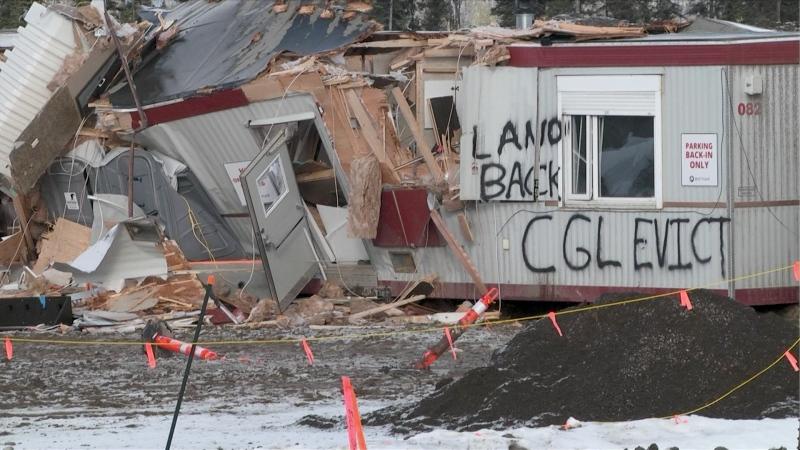
CGL Pipeline work site attacked
Masked mob swarms Northern, B.C. pipeline work site, causes millions in damage