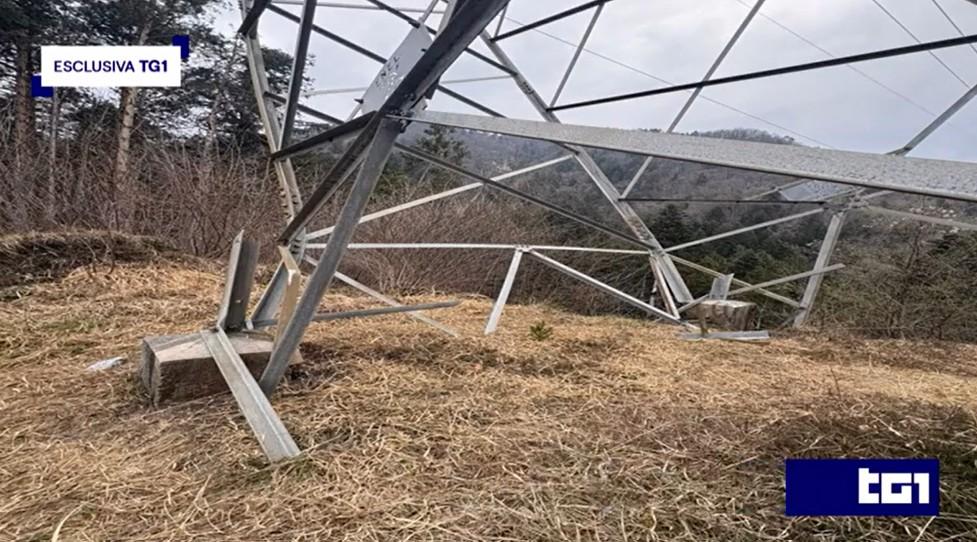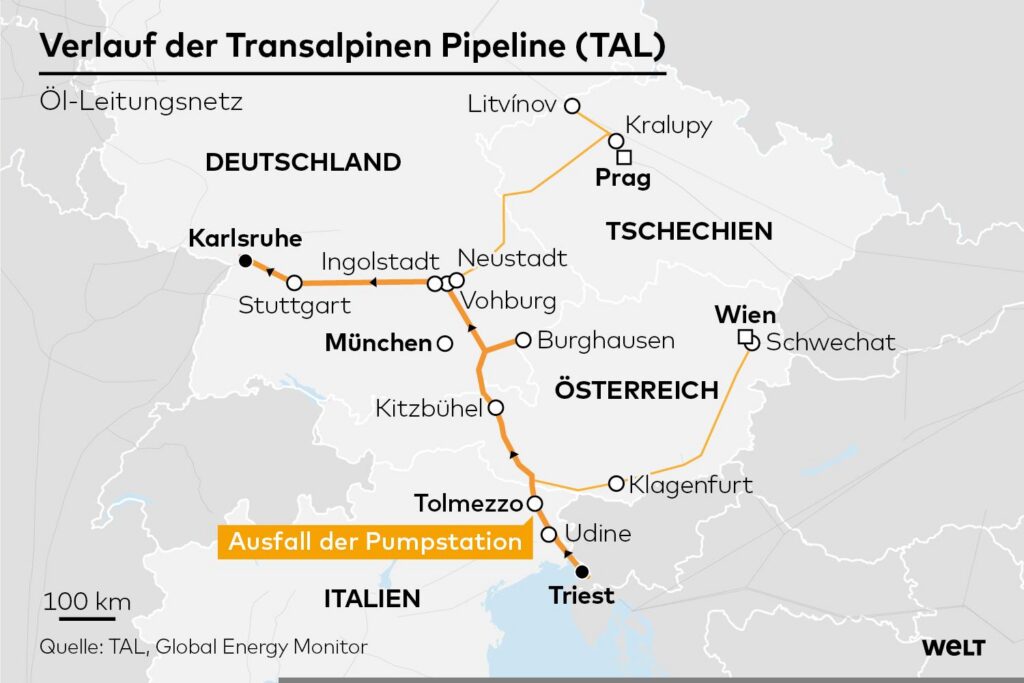
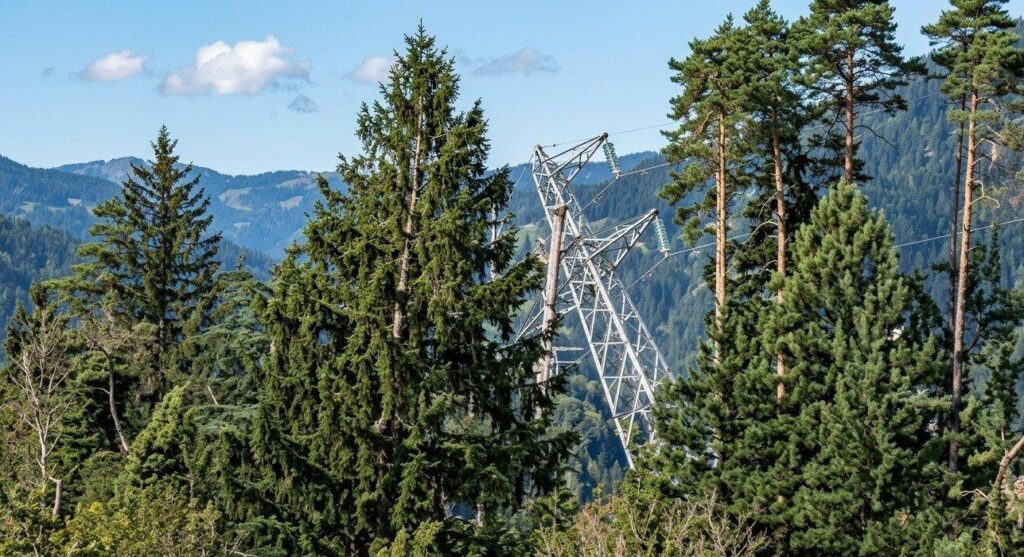
Terzo (Italy), March 25, 2026. Sabotage of the pylon supplying electricity to the pumps of the TAL oil pipeline.
(https://infranero.xyz/delicatessen/May 14, 2026)
“The principle behind the new deployment of units is clear: seek out the enemy to strike at its most vulnerable points”
(Logbook of the Garibaldi Carnia batallion, 1945)
It’s only now that we’ve learned that, in late March, the destruction of a single electricity pylon in Italy would have cut off oil supplies to Central Europe for several days [March 25–30, Translator’s Note]. Once it arrives at the port of Trieste, the black gold is indeed fed into the Transalpine Pipeline (TAL), which apparently covers no less than 40% of Germany’s oil needs, 90% of Austria’s, and more than 50% of the Czech Republic’s.
But all this crude oil doesn’t flow underground for thousands of kilometers by the will of the Holy Spirit alone, or by the mere force of inertia. It needs to be pumped, which means that transporting it requires energy—a great deal of energy—that comes from facilities scattered all over the surface. The toppled pylon, for example—number 416, installed by the company Terna—is located in Terzo, a small village of three hundred residents on the road between Tolmezzo and Paluzza (in the Friuli region).
Surprisingly, the news of the sabotage was reported only by the German press, while here in Italy it was denied by the TAL Group (which operates the pipeline), which called it “information completely without foundation,” preferring to describe the incident as a “technical slowdown in operations”: a version that was, however, in turn denied by Terna itself, which instead attributes the damage to its power line to “unknown individuals.” And indeed, the images released are unambiguous, showing some of the pylon’s support columns cut clean through.
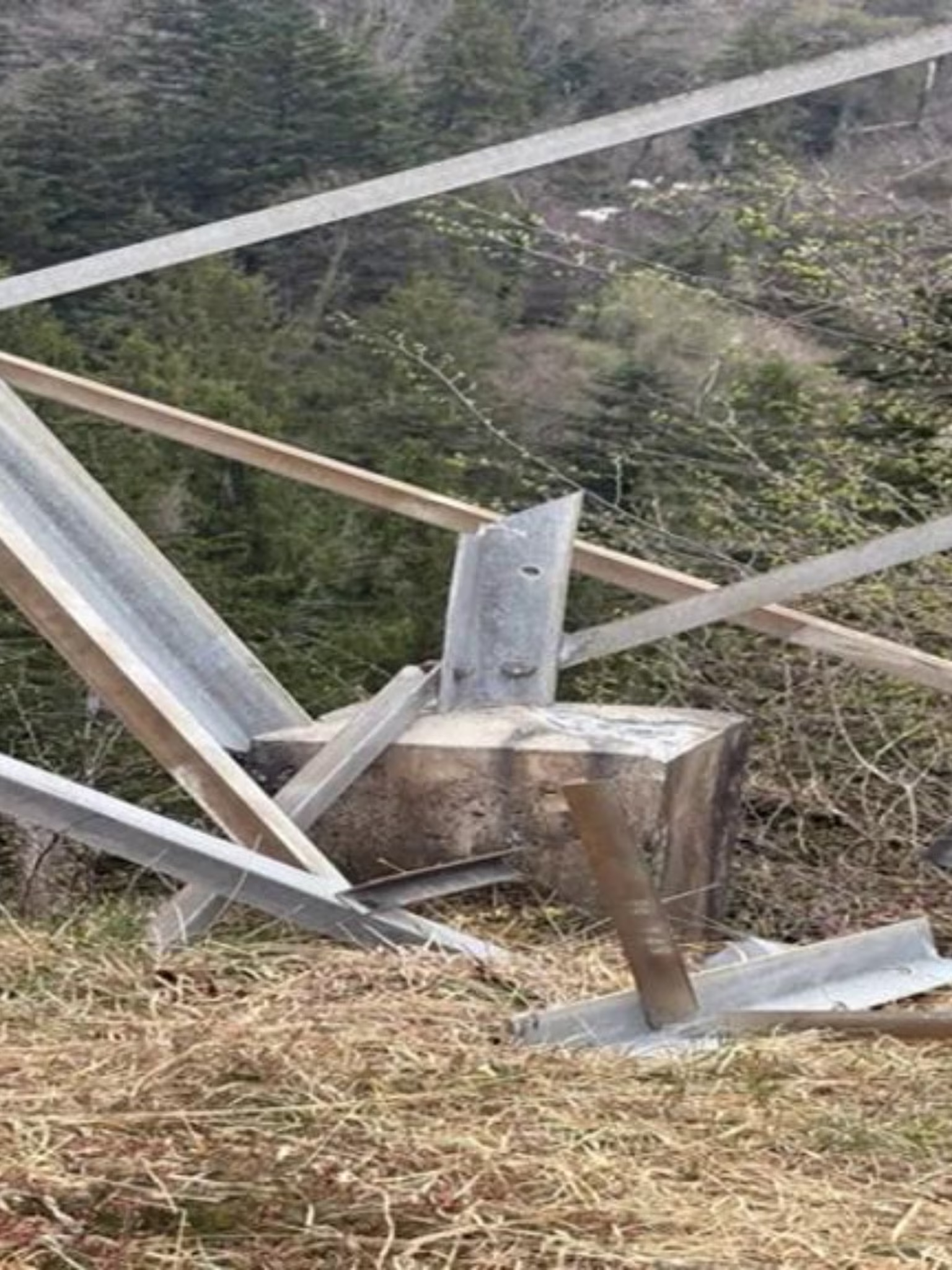
As for those responsible for this act—which occurred precisely at a time when oil is in short supply worldwide as a result of the war launched by the United States and Israel against Iran—the investigation is still ongoing. Some see the hand of some more or less sinister foreign intelligence service behind it, while others attribute it to a few more or less anarchist local rebels. Both hypotheses are understandable. The first, because the best way to deter the spread of bad examples is to attribute them to state conspiracies and the games of power. The second, because what suggests this is the very location where the sabotage took place.
Because Carnia is a land of resistance and anarchy. It was here, in the midst of these mountains, that the first partisan brigade in Italy was formed; it was here that the first zone liberated from Nazism and Fascism was established (an experience that lasted two months during the summer of 1944 before being brutally suppressed), it was here that the anarchists were so firmly established that they gave rise to entire villages. Where the occupying forces controlled the roads and villages, the partisans moved through the woods, relying on mountain huts and barns for shelter.
After all, it would not be so strange if today the heirs of Aso were to take those same mountain trails, setting out to seek out the enemy and strike at its most vulnerable points.