You will always be alive with us through our action and our lives. “ACTION REPLACES TEARS”
Alfredo Maria Bonanno, born in 1937 in Catania, Sicily, is one of the most prolific contemporary anarchists, responsible for Anarchismo editions and other publishing ventures. In 1977 he was sentenced to 18 months in prison for his book La Gioia Armata (Armed Joy). This book had been published at a historical moment when the Italian revolutionary movement was openly going on the offensive, while similar conditions existed in other European countries (Germany, Spain, England, Greece, Chile and more) and the question of violence was on the daily agenda. His contribution lies in a celebration of the pervasive class violence that liberates and satisfies the individual, but at the same time he sounds the alarm about the emergence of the armed party, which reduces the class conflict to a militaristic dimension, imposing the mediation of a small minority of armed men on the complexity of tens of thousands of people struggling by all means against the current reorganization of Capital, which at that moment seemed weak.
In the spirit of the book, all authentic liberating and destructive action comes from a logic of satisfaction in the struggle, not a self-sacrificing duty in accordance with the dictates of a micro-bureaucracy. The Italian Supreme Court ordered the destruction of the copies of the book that were in circulation, and sent a circular to public libraries to dispose of any copies they might have had.
Several librarians objected to this Nazi-inspired tactic. Its circulation was generally banned, and copies were confiscated from the homes of anarchist militants in the context of police raids on houses.
Shortly afterwards, the author was accused of being an “instigator” of the Azione Rivoluzionaria, an armed organisation of 1976-79, which operated on the basis of “affinity groups” throughout central Italy, mainly against newspapers and party offices, and similar “manipulative mechanisms of consensus-building”. In 1979 the organisation was practically dismantled with the arrest of 86 people and the arrest of Salvatore Cinieri and Gianfranco Faina. The first went on to die in prison in a scuffle with criminal inmates when he defended a prisoner suspected of submitting an escape plan, while the second was released to die of lung cancer after being diagnosed with a tumour while in custody.
Continue reading Anarchist comrade Alfredo M. Bonanno has died on 6th December at the age of 86 →


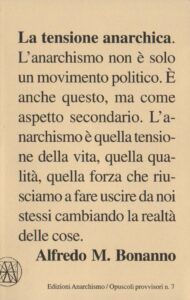 organizzativi basati sull’affinità e sull’informalità. Quello che lo differenziava radicalmente da qualsiasi intellettuale non era solo il suo rifiuto di ogni carriera accademica e di ogni rappresentazione mediatica, ma il fatto che analizzare lo Stato e il capitalismo non serviva per lui ad andare a dormire con le idee più chiare, bensì a trarne delle precise conseguenze – etiche, pratiche, organizzative – nella vita quotidiana.
 electronic ankle bracelet fitted. That’s 1,400 more than at the same time last year. Among them, 228 convicts (3.5%) have already sabotaged the home detention device, mostly by cutting it off, writes Het Laatste Nieuws on Tuesday.