Switch off! – the system of destruction
About 20 people storm a construction site of the Coastal Gas Link pipeline in western Canada. They are armed with axes and flares, threaten employees, hijack heavy construction vehicles, destroy the site’s building and ultimately the vehicles themselves. The damage amounted to millions. That was almost a year ago. It is still unclear who sabotaged the construction of the pipeline in the province of British Columbia. Fracked gas was soon to flow through the pipeline, which runs right through indigenous land, to the West Coast, from where it would be shipped on to Asia.
A call…
Whether you occupy universities, schools, trees or streets. Whether you spend your nights worrying or sabotaging. Whether you strike or write about it.
The certainty that the current system will result in the collapse of the massively damaged ecosystem has already inspired countless people to resist. Tens of thousands are taking to the streets against the “business as usual” of the capitalist machinery, people are resisting the destructive large-scale projects en masse, the infrastructure of the system is being blocked and courageous fighters are setting fire to the machines that are being used to rob them of the very basis of life. What we need in the struggle against the destruction of nature and the resulting social misery is the shared pursuit of real revolutionary rupture and freedom of all. Pursuing an initiative that rejects all compromises and cosmetic corrections of the state and brings about a transformation of our social relations. Because the destruction of the planet by the neoliberal economic system is inextricably linked to patriarchal patterns of thought, racism and colonialism. The initiative for this must necessarily come from below. From the struggles of the excluded. From the struggles of those who enact a self-organized solidarity against the state’s promises of salvation. From the struggles of those who see that there can be no compromises in the fight against the systemic destruction of the biosphere.
Continue reading Switch off! – the system of destruction


Among the tedious publications that the French state releases every year to offer a semblance of democratic veneer is the annual report of the Commission Nationale de Contrôle des Techniques de Renseignement (CNCTR), the body created in 2015 to monitor the proper use of spying measures deployed by these agencies. The release of its 2022 Annual Report on June 15 may have passed somewhat unnoticed, but it’s still worth extracting a few bits of information. All the more so since the report details the official array of surveillance measures carried out on their own initiative, upstream and as a preventive measure, by all the intelligence agencies, leaving us to imagine how this expansion can then be translated into additional prolonged surveillance in a judicial rather than administrative framework (in the form of opening a preliminary investigation or inquiry, which the person who is targeted will not immediately be aware of).
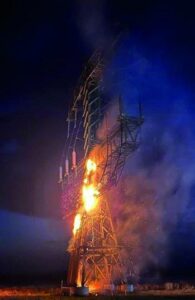
electricity pylon in the vicinity of La Motte-Servolex, on the outskirts of Chambery.


buildings set aflame. A total of 26 police stations (ten police stations, ten gendarmerie barracks and six municipal police stations) were attacked. The Ministry of the Interior reports that 45 members of the security forces were wounded and some 773 people arrested on the fifth night of the revolt.
Lognes (Seine-et-Marne), night of July 1 to 2: the community centre with the incendiary car which was used to ram it.
Nanterre (Hauts-de-Seine), night of 1 to 2 July: the Red Cross van did not escape the rioters
July, 2,560 fires on the public highway (against 3,880 in the night From Thursday to Friday), 1,350 vehicles torched (against 1,919 at night previous) and 266 burnt or damaged buildings, including 26 town halls, 24 schools and 5 justice establishments (against 492 the previous night). In addition, 58 cop dens were attacked (31 commissariat-type stations, 16 municipal police stations. and 11 gendarmerie barracks). 1,311 people were arrested that night across France. A total of 79 police officers and gendarmes were injured.
In Mont-Saint-Martin (Meurthe-et-Moselle), after several attempts, thirty people burst into the town hall where they found two private security guards.


premises were also reported (damong which 7 by fire), 4 gendarmerie barracks, 14 municipal police stations (including 10 burnt). At least eight town halls burned or damaged, 6 schools and six public buildings. 133 members of the police forces were injured, including 123 policemen and 10 gendarmes.